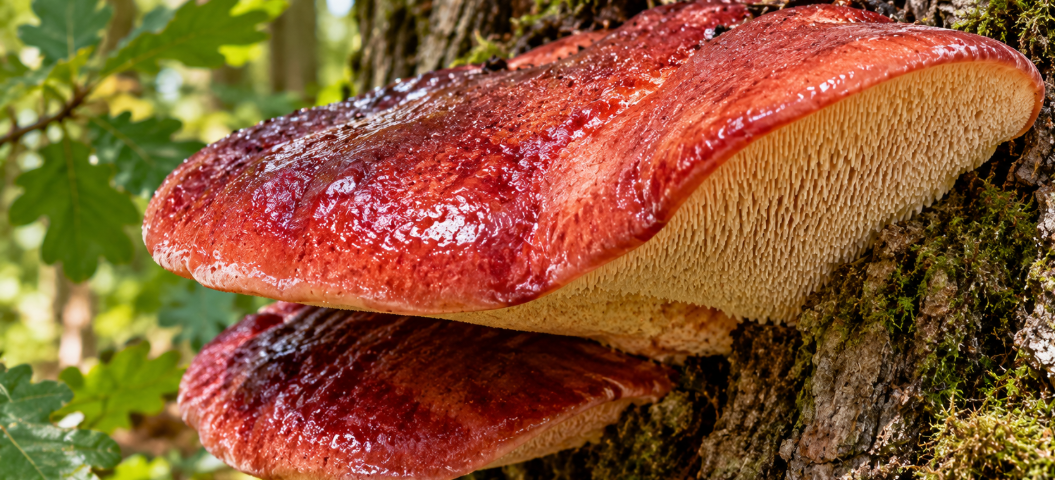
Imagine walking through an old oak forest and spotting what looks like a thick slab of raw beef growing straight out of a tree.
It’s deep red, slightly glossy, and surprisingly fleshy. Cut into it, and you may discover pale streaks running through the interior, along with a reddish liquid that looks remarkably like blood.
It sounds unusual, but that’s exactly what makes beefsteak fungus one of the most fascinating wild mushrooms to discover.
Also known as ox tongue fungus, this distinctive mushroom has a long history as a wild edible. Its unusual appearance, juicy texture, and tart flavor set it apart from almost everything else you’ll find in the woods.
Despite its name, however, beefsteak fungus doesn’t taste like an ordinary beefsteak. Its flavor is distinctly acidic, sometimes with a fruity or lemon-like sharpness.
That’s part of what makes cooking with it so interesting.
For anyone learning to forage, beefsteak fungus also offers an opportunity to study an entirely different kind of mushroom. Instead of growing on a traditional stem with gills, it forms a thick, tongue-shaped bracket attached to wood.
In this guide, we’ll explore beefsteak fungus identification, where to find it, how to recognize lookalikes, its nutritional benefits, responsible harvesting, and how to prepare it for the table.
Quick Field Identification & Foraging Tips
Found a possible beefsteak fungus? Use this quick reference while you’re in the field.
- Look at the shape: Thick, fleshy, tongue-shaped or semicircular bracket growing from wood.
- Check the color: Pinkish red, reddish orange, deep red, or brownish red, depending on age.
- Examine the surface: Often moist, slightly sticky, and finely bumpy when fresh.
- Look underneath: Tiny, closely packed pores rather than gills.
- Check the tubes: Unlike most polypores, the individual tubes can be separated from one another.
- Examine the flesh: Pale to reddish, with streaks resembling marbled meat.
- Look for red moisture: Fresh specimens often release reddish liquid when cut or squeezed.
- Check the tree: Most often associated with oak, and also found on sweet chestnut in Europe.
- Best season: Summer through fall, particularly after suitable rainfall.
- Best specimens: Young, firm, juicy mushrooms that haven’t become tough or decayed.
- Flavor: Tart, acidic, sometimes fruity, and occasionally slightly bitter.
- Edibility: Considered edible when correctly identified, fresh, and thoroughly cooked.
- Regional note: More frequently documented in eastern North America than in the Pacific Northwest.
Important: The red color and meat-like appearance are useful clues, but neither establishes edibility. Confirm the pores, separately formed tubes, internal flesh, and attachment to hardwood before considering a harvest.
Beefsteak Fungus at a Glance
| Feature | Description |
|---|---|
| Common names | Beefsteak fungus, ox tongue fungus, beefsteak polypore |
| Scientific name | Fistulina hepatica species complex |
| North American species | Includes Fistulina americana |
| Family | Fistulinaceae |
| Mushroom type | Fleshy, bracket-forming fungus |
| Cap color | Pinkish red to reddish brown |
| Typical width | Approximately 3–10 inches |
| Shape | Tongue-shaped, fan-shaped, or irregularly rounded |
| Underside | Cream to pale yellowish pores that darken with age |
| Flesh | Soft, juicy, pale to reddish with marbled streaks |
| Stem | Usually absent or very short and attached to the side |
| Spore print | Pale pinkish, yellowish, or ochre-toned |
| Habitat | Living or dead hardwood, especially oak |
| Season | Summer through fall |
| Growth pattern | Usually alone or in small groups |
| Flavor | Sour, acidic, sometimes slightly fruity |
| Edibility | Edible when correctly identified and thoroughly cooked |
| Main concern | Confusion with other reddish bracket fungi |
A Quick Note About Its Scientific Name
Most traditional field guides identify beefsteak fungus as Fistulina hepatica.
That name remains widely used, particularly for the European species.
However, modern DNA research has shown that mushrooms once grouped under this name include several distinct species.
In 2022, researchers formally described Fistulina americana from northeastern United States collections previously identified as Fistulina hepatica.
The two species look very similar, and separating them reliably may require microscopic examination or DNA analysis.
For that reason, this guide uses the familiar common name beefsteak fungus while discussing the broader Fistulina hepatica group.
This keeps the identification practical without overlooking recent research.
How to Identify Beefsteak Fungus
Beefsteak fungus has one of the most unusual appearances of any edible woodland mushroom.
A fresh specimen may look so much like raw meat that you might wonder whether someone left something against the tree.
However, appearance alone isn’t enough.
The most reliable identification comes from examining the shape, pores, flesh, moisture, and growing location together.
1. The Shape: A Thick Tongue Growing from Wood
Young beefsteak fungi often resemble rounded, fleshy tongues emerging from the side of a tree.
As they grow, they expand into broad brackets.
Mature specimens may become fan-shaped, semicircular, or irregularly lobed.
Some have rounded edges, while others become flattened and slightly wavy.
Unlike a typical cap-and-stem mushroom, beefsteak fungus usually attaches directly to the wood.
Occasionally, a short, thick, sideways stem is visible.
Most mature specimens measure several inches across, although exceptionally large ones can grow wider.
2. The Upper Surface: Red, Moist, and Slightly Rough
Fresh beefsteak fungus is usually pinkish red, salmon red, or deep reddish orange.
As it ages, the color often darkens toward brownish red or liver brown.
The surface may look slightly glossy, particularly after rain.
When fresh, it can feel moist or sticky.
Look closely, and you’ll often notice a finely bumpy or roughened texture rather than a perfectly smooth surface.
This combination of fleshy shape, rich red coloring, and moist texture is one of the mushroom’s most recognizable features.
However, older specimens can lose some of their characteristic appearance.
3. The Underside: Tiny Pores, Not Gills
Turn the mushroom over and examine its underside.
You won’t find the blade-like gills associated with mushrooms such as meadow mushrooms.
Instead, beefsteak fungus has a surface covered in tiny pores.
When young, this surface is usually cream, whitish, or pale yellowish.
As the mushroom ages, it may become darker or develop reddish-brown discoloration.
Bruising can also cause the pore surface to darken.
One particularly useful detail is that the tubes forming those pores are separate from one another.
With a hand lens or careful examination of a cut specimen, you may be able to see the individual tubes.
Most familiar bracket fungi have tubes that share walls and form a more tightly connected structure.
This unusual arrangement is one of the strongest identification features of Fistulina.
4. The Flesh: Marbled Like Raw Meat
Cutting a fresh beefsteak fungus can be a memorable experience.
The interior often looks remarkably similar to raw beef.
You may see pale, pink, reddish, or cream-colored flesh marked by darker red streaks.
Some specimens show a distinctly marbled appearance.
The flesh is usually soft, thick, and juicy when young.
As the mushroom matures, it can become firmer, more fibrous, and less pleasant to cook.
For identification, examine a clean cross-section through the thickest part.
The combination of marbled flesh and separate tubes beneath the cap is particularly useful.
5. The Red Liquid: A Memorable Clue
One of the most famous characteristics of beefsteak fungus is its reddish moisture.
Fresh specimens may release red droplets when cut, bruised, or gently squeezed.
This liquid often looks surprisingly similar to diluted blood.
Of course, it isn’t blood. It’s moisture containing naturally occurring fungal pigments and other dissolved substances.
The effect can be especially noticeable in young, well-hydrated mushrooms.
However, older or dried-out specimens may release little or no liquid.
Don’t use the absence or presence of red droplets as your only identification test.
6. The Smell and Texture
Beefsteak fungus usually has a mild odor.
It may smell somewhat mushroom-like or slightly fruity, but it doesn’t have a consistently strong fragrance.
Its texture is more distinctive.
Young specimens feel fleshy and unusually moist compared with many other bracket fungi.
Older specimens become firmer and may develop a rubbery quality.
A strong rotten smell, visible mold, or slimy decay is a reason to leave the specimen behind.
7. The Spore Print
Beefsteak fungus produces a pale spore deposit, often described as pinkish, yellowish, or ochre.
However, obtaining a clear spore print from a bracket fungus can be less straightforward than from a typical gilled mushroom.
If you attempt one, place a mature fresh specimen with the pore surface facing downward over suitable dark and light backgrounds.
Cover it loosely to protect against drafts and leave it undisturbed.
A visible deposit may appear if the specimen is actively releasing spores.
For practical field identification, the separately formed tubes and marbled flesh usually provide more useful clues than the spore print alone.
Where Does Beefsteak Fungus Grow?
Beefsteak fungus is closely associated with hardwood trees, especially oak.
It’s often found growing low on the trunk, near the base, or directly from old stumps.
Sometimes it appears to be growing from the ground.
However, in these cases, it may actually be attached to buried roots or concealed wood.
Common places to search include:
- Mature oak woodlands
- Old hardwood forests
- Oak stumps and fallen trunks
- Tree bases with wounds or decaying wood
- Woodland edges containing established oaks
- Areas with buried hardwood roots
In Europe, sweet chestnut is another well-known host.
The fungus grows on both living and dead wood.
It can act as a decomposer and may also contribute to decay within living trees.
Does Beefsteak Fungus Grow on Conifers?
Typical beefsteak fungi are associated with hardwoods rather than conifers.
If you find a bright red bracket growing from a pine, spruce, or Douglas-fir, don’t automatically identify it as beefsteak fungus.
Several unrelated polypores grow on conifer wood.
Some may have reddish surfaces that look similar from a distance.
The host tree is an important part of identification.
Does Beefsteak Fungus Grow in the Pacific Northwest?
Beefsteak fungus is much more frequently documented in eastern North America, where oak forests provide suitable habitat.
It is not a typical mushroom of western Washington’s Douglas-fir and western hemlock forests.
That doesn’t mean every unusual red bracket found in the Pacific Northwest can be dismissed. It means identification requires extra care, particularly when the habitat doesn’t match the usual pattern.
For Pacific Northwest foragers, established hardwood stands are more relevant places to investigate than conifer-dominated forests.
Unusual western collections should be documented carefully and, when possible, reviewed by a regional mycologist.
When Is Beefsteak Fungus Season?
Beefsteak fungus generally fruits from summer through fall.
In much of Europe, it is commonly observed from July through October or November.
In eastern North America, late summer and autumn are also productive periods.
Actual timing varies with rainfall, temperatures, and local habitat.
Warm weather followed by sufficient moisture can encourage new fruiting bodies.
However, this fungus doesn’t necessarily appear in the same quantities every year.
When Is the Best Time to Harvest?
Young, freshly developed mushrooms offer the best texture.
Look for specimens with moist, healthy surfaces and flesh that is still fairly tender.
As beefsteak fungus ages, it becomes tougher and often develops a stronger sour flavor.
If a specimen is dry, heavily insect-damaged, or beginning to decay, it’s better to leave it behind.
Does Beefsteak Fungus Return to the Same Tree?
It can.
The visible mushroom is only the fruiting body of a fungus living within the wood.
That fungal network may persist for years, producing new brackets when conditions are favorable.
However, fruiting isn’t guaranteed every season.
If you discover a healthy specimen, record the tree species, location, date, and weather.
You may have found a location worth checking again.
Beefsteak Fungus Lookalikes
Beefsteak fungus is fairly distinctive when young and fresh.
Its combination of red coloring, soft marbled flesh, separate tubes, and reddish liquid helps distinguish it from many other bracket fungi.
However, several reddish wood-growing mushrooms can cause confusion, especially when specimens are older or viewed only from above.
Resinous Polypore (Ischnoderma resinosum)
Resinous polypore can develop a dark reddish-brown cap and grows as a bracket on hardwood.
Its younger growth may look soft compared with many other polypores.
However, it generally develops a darker, often velvety or zoned upper surface.
Its internal flesh is not characteristically marbled like raw meat.
The pore layer also lacks the individually separated tubes of beefsteak fungus.
This species becomes tougher as it ages and should not be substituted for beefsteak fungus in a recipe.
Shaggy Bracket (Inonotus hispidus)
Shaggy bracket is another large fungus associated with hardwood trees.
Its color often ranges from orange-brown to rusty brown.
Young specimens may have a relatively soft texture, but the cap develops a distinctly hairy or shaggy surface.
This contrasts with the finer, bumpy texture of typical beefsteak fungus.
Its internal structure and pores are also different.
Shaggy bracket isn’t a culinary substitute for beefsteak fungus.
Red-Belted Polypore (Fomitopsis mounceae and Related Species)
Red-belted polypores can have reddish or reddish-brown zones across their caps.
They’re particularly familiar in conifer forests.
However, they form tough, woody brackets rather than soft, juicy, meat-like fruiting bodies.
Their flesh doesn’t resemble marbled beef and doesn’t release the same characteristic reddish liquid.
They also lack the separate tubes associated with Fistulina.
Other Reddish Bracket Fungi
Several additional wood-decaying fungi develop red, orange, or brown fruiting bodies.
Some grow directly on logs, while others emerge from living trunks.
Rather than relying on color, examine the mushroom’s texture, interior, underside, and host wood.
A red bracket isn’t necessarily beefsteak fungus.
Beefsteak Fungus Lookalike Comparison
| Mushroom | Key distinguishing features | Edibility |
|---|---|---|
| Beefsteak fungus (Fistulina spp.) | Fleshy red bracket, separate tubes, marbled interior, reddish moisture | Edible when confirmed and cooked |
| Resinous polypore | Dark, often zoned cap, different internal flesh | Not recommended as a substitute |
| Shaggy bracket | Orange-brown cap with shaggy or hairy surface | Not recommended |
| Red-belted polypore | Hard, woody bracket, often on conifers | Inedible |
| Other reddish brackets | Variable shapes, pores, and flesh | Depends on species |
Identification reminder: Even though beefsteak fungus has relatively distinctive features, no mushroom should be eaten based only on its color or resemblance to a photograph.
Is Beefsteak Fungus Edible?
Yes. Beefsteak fungus has a long history of culinary use and is generally considered edible when correctly identified and properly prepared.
However, its eating quality is a little different from what the name might suggest.
Although it resembles raw meat, it doesn’t have the rich, savory flavor of beef.
Instead, it has a tart, sour character that can be quite noticeable.
Some people enjoy that acidity, while others find it overpowering.
Young specimens usually have the most appealing texture.
Older mushrooms may become rubbery, fibrous, or unpleasantly sour.
For beginners, I recommend cooking fresh, correctly identified specimens thoroughly rather than eating them raw.
Start with a small serving, especially if you’ve never eaten this mushroom before.
Individual digestive sensitivities are possible with any wild edible mushroom.
What Does Beefsteak Fungus Taste Like?
The flavor is probably the biggest surprise.
Despite looking like a thick piece of red meat, beefsteak fungus often tastes acidic, with a fruity or lemon-like sharpness.
Some specimens have a mild mushroom flavor underneath that tartness.
Others are noticeably sour.
The intensity can vary with age and growing conditions.
This makes beefsteak fungus especially interesting in recipes that benefit from a little acidity.
Garlic, butter, onions, herbs, and creamy sauces can help balance its flavor.
However, don’t expect it to taste like grilled steak.
Its appearance is much closer to beef than its flavor.
Nutritional Benefits of Beefsteak Fungus
Beefsteak fungus is more than an unusual woodland curiosity.
It also contains nutrients and naturally occurring compounds that researchers have begun studying in greater detail.
Like many edible mushrooms, it’s mostly water and relatively low in fat.
However, its nutritional profile differs from familiar cultivated mushrooms.
What Does the Research Show?
A 2025 study measured the nutritional composition of beefsteak fungus and compared it with another edible mushroom.
The researchers reported the following approximate values for 100 grams of fresh Fistulina hepatica:
| Nutrient | Amount per 100 g |
|---|---|
| Calories | 43 kcal |
| Water | 88 g |
| Protein | 1.22 g |
| Fat | 0.14 g |
| Available carbohydrates | 9.3 g |
These figures provide a useful reference, but they’re not guaranteed values for every wild specimen.
Species differences, habitat, age, and growing conditions can affect nutrient levels.
Protein and Carbohydrates
Beefsteak fungus contains a modest amount of protein.
However, despite its meat-like appearance, it isn’t nutritionally comparable to beef.
Fresh beefsteak fungus contains far less protein than a similar serving of meat.
It also contains carbohydrates, including naturally occurring compounds found in mushroom tissues.
Its main culinary value lies in its unusual flavor and texture rather than high protein content.
Natural Organic Acids
One of the most interesting nutritional characteristics of beefsteak fungus is its organic acid profile.
Researchers have identified several organic acids, including malic, citric, oxalic, and fumaric acids.
Malic acid is also found naturally in fruits such as apples.
These compounds help explain the mushroom’s distinctly tart flavor.
A 2025 analysis found that malic acid was especially prominent in the samples studied.
However, organic acids shouldn’t automatically be described as providing special medical benefits.
They are simply part of the mushroom’s natural chemical makeup.
Antioxidant Compounds
Researchers have also identified phenolic compounds in beefsteak fungus.
These include substances such as caffeic acid, ellagic acid, and other plant- and fungus-associated compounds.
Laboratory studies have explored their antioxidant activity.
Although these findings are interesting, they don’t establish that eating beefsteak fungus prevents disease or provides a medical treatment.
For everyday foraging, it’s better to appreciate the mushroom as an unusual edible food rather than a medicinal supplement.
Vitamins and Minerals
Like other fungi, beefsteak fungus obtains mineral nutrients from its growing environment.
However, comprehensive, standardized vitamin and mineral data remain limited.
Rather than assuming it has the same nutritional composition as common button mushrooms, it’s more accurate to acknowledge that detailed information is still developing.
The takeaway is that beefsteak fungus can contribute variety to your meals, but it isn’t a substitute for a balanced diet.
How to Harvest Beefsteak Fungus Responsibly
Before harvesting, confirm that you’ve found an edible beefsteak fungus and that collection is permitted.
Because this mushroom grows directly from wood, it’s important to avoid unnecessary damage to the host tree.
Choose Fresh Specimens
Look for mushrooms that are:
- Firm but still fleshy
- Moist without being slimy or decayed
- Richly colored
- Free from extensive insect damage
- Attached to suitable hardwood
- Structurally consistent with beefsteak fungus
Avoid collecting old, dark, leathery brackets.
These are generally less enjoyable to cook.
How to Remove the Mushroom
Use a clean, sharp knife to cut the fruiting body close to its attachment point.
Avoid cutting into healthy bark or digging into the tree.
If the mushroom is growing from a living oak, remember that the fungus may be contributing to internal wood decay.
Harvesting the visible bracket doesn’t remove the fungus living inside the tree.
Harvest Only What You Need
Large beefsteak specimens can provide a substantial amount of food.
There’s rarely a reason to harvest every fruiting body from a location.
Leave some behind for spore production and the insects and other organisms that use them.
As with any wild mushroom, avoid collecting from contaminated sites.
How to Clean Beefsteak Fungus
Fresh beefsteak fungus can be quite juicy, so handle it gently.
Begin by removing loose bark, dirt, and insects.
Use a clean knife to trim away tough portions near the attachment point.
A soft brush or damp cloth usually removes most remaining debris.
If necessary, rinse briefly under cool running water.
Then pat the mushroom dry.
Should You Remove the Pore Layer?
For young, fresh specimens, the pore layer may be tender enough to leave attached.
However, older mushrooms can have tougher tubes or less appealing textures.
Some cooks trim away the pore surface before slicing.
You can decide based on the condition of your specimen.
The main goal is to keep the tender, healthy flesh and remove anything tough or deteriorating.
How to Store and Preserve Beefsteak Fungus
Fresh beefsteak fungus is best enjoyed soon after harvesting.
Its high moisture content makes careful storage especially important.
Refrigerating Fresh Beefsteak Fungus
Place cleaned mushrooms in a breathable container or paper bag.
Keep them refrigerated and cook them promptly.
Avoid storing wet mushrooms in tightly sealed plastic bags.
If the flesh becomes slimy, develops an unpleasant odor, or shows signs of decay, discard it.
Can You Freeze Beefsteak Fungus?
Yes, although cooking it first is generally preferable.
Slice the mushroom into manageable pieces.
Cook it thoroughly, allow it to cool, then package it in freezer-safe containers.
The frozen portions can later be added to soups, sauces, or cooked dishes.
Texture may change after freezing, so smaller pieces often work better than large slabs.
Can You Dry Beefsteak Fungus?
Drying is possible, but this isn’t always the best preservation method.
The mushroom’s naturally juicy flesh and acidic flavor can make dried specimens less appealing than fresh ones.
If you decide to dehydrate it, slice it thinly and follow reliable mushroom-drying procedures.
Dry thoroughly before storage and discard any preserved mushrooms that develop mold or moisture.
For most home cooks, preparing beefsteak fungus fresh or freezing cooked portions is the more practical option.
How to Cook Beefsteak Fungus
Beefsteak fungus is one of those wild mushrooms that rewards a little experimentation.
Its acidic flavor makes it different from ordinary sautéed mushrooms.
If you simply cook a thick slab in butter and expect it to taste like steak, you may be disappointed.
Instead, think of it as a tart, meaty-textured ingredient that works best when paired with complementary flavors.
Thin slicing can improve the texture, while thorough cooking helps soften the flesh.
Garlic, onions, butter, cream, and herbs work particularly well.
Garlic Butter Beefsteak Fungus with Shallots
This simple recipe is a good starting point for anyone cooking beefsteak fungus for the first time.
The shallots add sweetness, while the butter helps balance the mushroom’s natural acidity.
Servings: 2–3
Preparation time: 15 minutes
Cooking time: Approximately 20–30 minutes, depending on thickness
Ingredients
- 2 cups of cleaned, positively identified young beefsteak fungus
- 2 tablespoons butter
- 1 tablespoon olive oil
- 1 small shallot, finely chopped
- 2 cloves garlic, minced
- ¼ cup vegetable or chicken broth
- 1 tablespoon chopped parsley
- Salt and black pepper to taste
- Optional splash of cream
Instructions
- Clean the mushroom and remove any tough or damaged portions.
- Slice the flesh into thin, evenly sized strips.
- Heat the olive oil in a skillet over medium heat.
- Add the shallot and cook until softened.
- Add the mushroom strips and cook for several minutes, stirring occasionally.
- Pour in the broth and simmer gently until the mushroom becomes tender and is thoroughly cooked, adding a little more liquid if necessary.
- Allow excess liquid to evaporate.
- Add the butter and garlic, then cook for another minute or two.
- Season with salt and pepper.
- Finish with parsley and a little cream if desired.
Serve over rice, mashed potatoes, or toasted bread.
The finished dish should have a pleasant balance of savory richness and the mushroom’s natural tang.
Other Ways to Use Beefsteak Fungus
Once you’ve tried it, consider experimenting with:
- Creamy mushroom sauces
- Savory pasta dishes
- Mushroom and onion fillings
- Slow-cooked vegetable stews
- Thinly sliced mushroom preparations
- Rice dishes with fresh herbs
The key is working with its acidity rather than trying to hide it completely.
Important: Thorough cooking improves food safety and texture, but it cannot make a poisonous or incorrectly identified mushroom safe.
The Ecological Role of Beefsteak Fungus
Beefsteak fungus plays an important role in hardwood forests.
It grows in association with living or dead wood, helping break down woody material over time.
Unlike many familiar mushrooms that decompose forest litter, beefsteak fungus specializes in wood.
It is associated with a process called brown rot.
What Is Brown Rot?
Wood contains several important structural materials, including cellulose and lignin.
Brown-rot fungi break down much of the cellulose and related carbohydrates, leaving behind a higher proportion of the darker lignin-rich material.
As a result, affected wood may become brown and eventually brittle.
In oak trees, beefsteak fungus can also produce distinctive reddish-brown staining.
Historically, some of this stained wood has been valued by woodworkers and furniture makers.
In Britain, it’s sometimes called brown oak.
Is Beefsteak Fungus Harmful to Trees?
It can contribute to wood decay in living hardwoods, particularly older trees.
However, decay fungi are also part of natural forest processes.
They help recycle nutrients and create habitats within aging trees and fallen wood.
Cavities and decaying sections may eventually provide shelter for insects, birds, and other wildlife.
Finding beefsteak fungus on a living tree doesn’t necessarily mean that tree is about to fall.
However, it can indicate internal decay.
If the tree is near a house, road, trail, or frequently used area, a qualified arborist should assess any structural concerns.
Beefsteak Fungus Safety Tips
Although beefsteak fungus is generally recognized as edible, responsible foraging still requires care.
Confirm the identification. Examine the shape, pores, separately formed tubes, marbled flesh, and host tree.
Be aware of regional differences. North American beefsteak fungi may belong to species not recognized in older field guides.
Avoid old or spoiled specimens. Fresh, tender mushrooms are more suitable for food.
Cook thoroughly. Raw preparations appear in some traditional recipes, but cooking is the more conservative choice.
Try a small serving first. Individual digestive sensitivities are possible.
Avoid contaminated growing areas. Don’t harvest from sites with known pollution or chemical contamination.
Don’t confuse appearance with flavor. Beefsteak fungus resembles meat but has an acidic taste and very different nutritional properties.
Get expert confirmation when uncertain. An experienced local mycologist can help assess unusual finds.
If someone becomes ill after eating a wild mushroom, seek medical advice promptly. In the United States, Poison Control is available at 1-800-222-1222.
Frequently Asked Questions About Beefsteak Fungus
How Do You Identify Beefsteak Fungus?
Look for a fleshy, reddish, tongue-shaped bracket growing from hardwood, particularly oak.
Fresh specimens often have marbled flesh and release reddish liquid when cut.
The underside contains tiny pores made from individually separate tubes.
Always check all identifying features together.
Is Beefsteak Fungus Edible?
Yes. Properly identified beefsteak fungus is traditionally considered edible.
However, fresh young specimens are generally preferred, and thorough cooking is recommended.
Does Beefsteak Fungus Taste Like Beef?
No.
Although it resembles raw meat, its flavor is distinctly sour or acidic.
Some people describe it as slightly fruity.
It works best in recipes that complement that acidity.
Why Does Beefsteak Fungus Bleed?
Fresh specimens may release reddish liquid when cut or squeezed.
The liquid contains moisture and natural fungal pigments.
It isn’t actual blood.
Does Beefsteak Fungus Grow on Oak Trees?
Yes. Oak is one of its best-known hosts.
In Europe, it also grows on sweet chestnut.
North American collections are especially associated with hardwood habitats.
Can Beefsteak Fungus Grow on the Ground?
It may appear to.
However, specimens near the ground are often attached to buried roots or concealed wood.
Does Beefsteak Fungus Grow in Washington State?
Beefsteak fungi are more frequently documented in eastern North America than in the Pacific Northwest.
Any suspected Washington collection deserves careful examination, especially if it occurs outside typical oak habitat.
What Time of Year Does Beefsteak Fungus Appear?
Summer through fall is the usual fruiting period.
Late summer and early autumn are particularly productive in many regions.
Can You Eat Beefsteak Fungus Raw?
Some traditional recipes use very thin slices of raw beefsteak fungus.
However, raw wild mushrooms may cause digestive problems, and incorrect identification carries additional risks.
Thorough cooking is the recommended approach for beginners.
Is Beefsteak Fungus Medicinal?
Researchers have studied its organic acids and antioxidant compounds.
However, there isn’t sufficient clinical evidence to recommend it as a treatment for specific diseases.
It’s better appreciated as an unusual wild edible mushroom.
Can Beefsteak Fungus Return Every Year?
Yes, the underground or wood-inhabiting fungus may persist and produce new fruiting bodies when conditions are favorable.
However, it won’t necessarily fruit every year.
Is Beefsteak Fungus Good for Beginner Foragers?
It’s an excellent mushroom to study because of its distinctive shape, texture, and internal structure.
However, beginners should still confirm all identification features and seek expert assistance before eating unfamiliar specimens.
Final Thoughts: One of the Forest’s Most Unusual Mushrooms
Beefsteak fungus is a perfect reminder that nature doesn’t always follow our expectations.
Most of us picture mushrooms as small caps rising from the forest floor.
Then we find something that looks like a thick slab of raw meat growing from the side of an oak tree.
It’s an unforgettable sight.
But beyond its unusual appearance, beefsteak fungus has a fascinating story.
It’s an edible mushroom with a distinctive tart flavor. It plays an important role in hardwood decay, and modern research continues to reveal new details about the different species within the group.
For anyone learning to forage, it offers another opportunity to practice careful observation.
Look at the cap. Examine the pores. Study the flesh. Notice the tree it’s growing on.
And remember, a mushroom doesn’t have to end up in your cooking pot to be worth discovering.
Sometimes the best part of foraging is simply learning what the forest has been hiding in plain sight.
The next time you’re walking through an oak woodland, take a closer look at the base of the trees.
You never know when something extraordinary might be waiting there.
Get outside and do something wild.
Continue Your Mushroom Foraging Journey
Interested in discovering more unusual wild mushrooms?
Explore our Hen of the Woods Identification Guide to learn about another popular edible associated with oak trees.
You can also read our Meadow Mushroom Identification Guide for a closer look at a familiar edible mushroom with important poisonous lookalikes.
For more species, habitats, harvesting advice, and field identification resources, visit The Hunter Gatherer Society.
Research and Additional Resources
These references provide further information about beefsteak fungus identification, recent taxonomy, edible uses, and nutrition.
- MushroomExpert: Fistulina hepatica — Detailed morphological description, habitat, pores, and identification characteristics.
- Frontiers in Microbiology: Two New Species of Fistulina — Peer-reviewed research describing Fistulina americana and related species.
- First Nature: Beefsteak Fungus — Field identification, habitat, appearance, season, and culinary notes.
- Wild Food UK: Beefsteak Fungus — Practical identification and traditional culinary information.
- Separations: Nutritional and Antioxidant Profiles of Fistulina hepatica — Published research examining nutritional composition and naturally occurring compounds.
- PubMed: Phenolic Compounds and Organic Acids of Beefsteak Fungus — Research on organic acids, phenolic compounds, and laboratory antioxidant activity.


