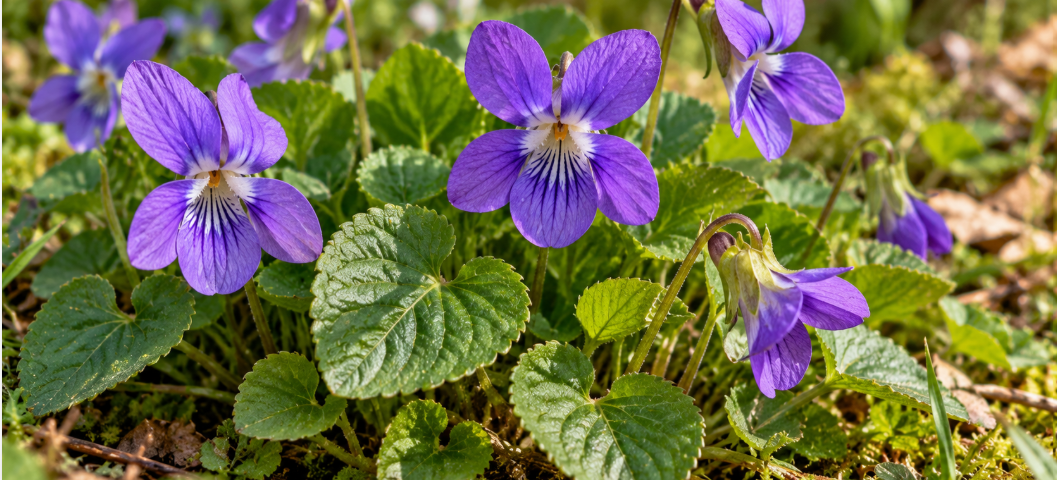
Every spring, one of the prettiest wild edibles begins appearing in lawns, meadows, and woodland edges. Small purple flowers rise above fresh green leaves, sometimes covering the ground in beautiful little patches.
Most people admire them for a moment and keep walking.
But those familiar little flowers are violets, and they’re much more than a welcome sign of spring.
Wild violets have been enjoyed for generations as edible flowers, tender greens, and ingredients in traditional recipes. Their blossoms add a beautiful splash of color to salads, while their mild leaves can be used in soups and other dishes.
Better yet, many violets grow close to home. You don’t necessarily have to hike deep into the forest to discover them.
However, there’s more to wild violet identification than finding a purple flower with heart-shaped leaves.
Several species belong to the genus Viola. Their flowers may be purple, blue, white, yellow, or a combination of colors. Some have heart-shaped leaves, while others look quite different.
In this guide, we’ll explore how to identify wild violets, recognize important lookalikes, harvest them responsibly, and enjoy their edible flowers and leaves.
Quick Field Identification & Foraging Tips
Found a possible wild violet? Here’s what to check while you’re in the field.
- Look at the flowers: Five petals, usually arranged with two upper petals, two side petals, and one lower petal.
- Check the lower petal: Often has darker lines leading toward the center of the flower.
- Look behind the flower: A small backward-pointing spur is a useful violet characteristic.
- Examine the leaves: Many common species have heart-shaped or rounded leaves, often with gently toothed edges.
- Check the growth habit: Often low-growing, in small clumps or spreading patches.
- Flower colors: Purple, blue, white, yellow, or combinations, depending on species.
- Where to look: Lawns, meadows, woodland edges, moist forests, and streambanks.
- Best season: Primarily spring, although flowering times vary by species and region.
- Edible parts: Flowers and tender leaves of positively identified edible species.
- Harvesting tip: Pick healthy flowers and young leaves from clean, unsprayed locations.
- Important lookalike: Lesser celandine, which has similar heart-shaped leaves but is toxic.
- Safety reminder: Avoid harvesting roots, rhizomes, and unidentified violet species for food.
Field identification tip: The flower is usually your best starting point. Heart-shaped leaves alone aren’t enough to identify a violet safely.
Wild Violets at a Glance
| Feature | Description |
|---|---|
| Common names | Wild violet, common blue violet, woodland violet |
| Scientific name | Viola spp. |
| Plant family | Violaceae |
| Plant type | Mostly herbaceous perennials; some annuals |
| Typical height | Approximately 2–10 inches for many common species |
| Flowers | Five petals, usually with a short spur |
| Flower colors | Purple, blue, white, yellow, or multicolored |
| Leaves | Often heart-shaped, rounded, or oval; variable by species |
| Leaf edges | Usually smooth to finely toothed or scalloped |
| Habitat | Lawns, meadows, woodlands, and moist ground |
| Blooming season | Primarily spring through early summer |
| Edible parts | Flowers and tender leaves of known edible species |
| Flavor | Mild, fresh, sometimes slightly sweet |
| Main lookalikes | Lesser celandine, ground ivy, and other low-growing plants |
| Main safety concern | Misidentification and contaminated harvesting areas |
What Are Wild Violets?
Wild violets belong to the genus Viola, a diverse group of flowering plants found throughout much of the world.
You might recognize them as small purple flowers growing in your lawn. However, violets include far more than the familiar blue-purple species.
Some prefer damp woodland soil. Others thrive in sunny meadows, rocky slopes, or cool mountain habitats.
Many are native North American wildflowers, while others were introduced from Europe and eventually established themselves outside gardens.
The familiar common blue violet, Viola sororia, is widespread in eastern North America and is one of the most commonly gathered edible violets.
Other species, including Viola adunca, Viola glabella, and Viola odorata, have their own appearances, habitats, and traditional uses.
This diversity is why I prefer using Viola spp. when discussing wild violets as a group.
It acknowledges that several species share recognizable characteristics without pretending they’re all identical.
How to Identify Wild Violets
Wild violets are usually easiest to recognize when they’re flowering.
Their blossoms have a distinctive shape that helps separate them from many other small spring plants.
Once you’ve learned that pattern, their leaves and growing habits become much easier to recognize.
1. The Flowers: Five Petals with a Distinctive Shape
Start with the flowers.
Most violets have five petals arranged in a slightly uneven pattern.
Typically, you’ll see two petals toward the top, one on each side, and one larger petal pointing downward.
The lower petal often has darker lines running toward the center.
These markings are sometimes called nectar guides because they can help direct pollinating insects toward the flower.
Unlike a daisy, violet flowers aren’t arranged in a perfectly even circle.
Their slightly irregular shape is one of the most useful identification clues.
2. The Spur: A Small Detail Worth Checking
Turn a violet flower gently to the side.
Near the back, you may notice a small projection extending behind the petals.
This is called a spur.
It contains nectar in many violet species and plays a role in pollination.
The spur may be short and rounded or longer and more noticeable, depending on the species.
It’s a helpful feature when separating true violets from other flowers with a similar color.
3. The Leaves: Often Heart-Shaped
Many familiar wild violets have beautiful, heart-shaped leaves.
The base of each leaf curves inward where it connects to the stalk, creating the familiar heart shape.
The edges may be gently scalloped or finely toothed.
You may also notice prominent veins spreading outward through the leaf.
However, not every violet has heart-shaped foliage.
Some species have narrow, lance-shaped, rounded, or deeply divided leaves.
That’s why leaves alone aren’t enough to identify every member of the genus.
When you’re first learning violets, flowering plants provide the clearest identification clues.
4. The Stems and Growth Habit
Many common lawn violets grow as low clumps.
Their flowers and leaves rise on separate stalks from a central crown near the ground.
Other species have leafy stems that extend upward or spread through surrounding vegetation.
Depending on the species, a violet patch may stay compact or gradually spread through underground rhizomes and seeds.
The plants are generally small and delicate, although some woodland species grow noticeably taller.
5. The Roots and Rhizomes
Many perennial violets grow from underground structures called rhizomes.
These help the plants survive from year to year and sometimes allow them to spread into new areas.
However, there’s usually no reason to dig up violet roots when gathering food.
The tender leaves and flowers are the useful culinary parts.
Leaving the underground structures intact also helps preserve future growth.
6. Seed Capsules and Hidden Flowers
One of the more surprising things about violets is that some can produce seeds without displaying another showy flower.
Many species develop small, closed flowers that fertilize themselves.
These are called cleistogamous flowers.
They often appear later in the growing season and may be hidden among the leaves.
Eventually, small seed capsules develop.
Some violets scatter their seeds when the capsules split open, while ants may also help move seeds to new locations.
It’s a fascinating reproductive strategy that helps explain why violets can establish persistent patches.
Common Wild Violet Species in North America
Several species are worth becoming familiar with, especially if you enjoy spring foraging.
Common Blue Violet (Viola sororia)
This is one of the best-known North American violets.
Its flowers are usually blue-purple, although white and other color forms occur.
The leaves are generally heart-shaped, with gently toothed edges.
Common blue violet frequently grows in lawns, woodland openings, and moist grassy areas.
Its flowers and tender leaves are recognized as edible, making it a popular starting point for learning wild violets.
Early Blue Violet (Viola adunca)
Early blue violet is widespread across North America, including the Pacific Northwest.
It often grows in meadows, open forests, and grassy habitats.
Its flowers are usually bluish purple, with a relatively noticeable spur.
The leaves can be more oval or rounded than those of some familiar lawn violets.
Because its appearance varies, examine the flower and the rest of the plant carefully.
Pioneer Violet (Viola glabella)
Pioneer violet is particularly familiar in moist Pacific Northwest forests.
Unlike the common purple lawn violet, this species produces yellow flowers.
It often grows in damp woodland habitats and along streambanks.
The plant generally has leafy stems, and its heart-shaped leaves may be larger than those of smaller violets.
Its cheerful yellow flowers can brighten an otherwise shady forest floor.
Yellow-flowered violets deserve extra identification care because some unrelated spring plants also produce yellow blossoms.
Sweet Violet (Viola odorata)
Sweet violet is originally from Europe but has become established in parts of North America.
It’s especially well known for its fragrant flowers.
The blossoms are often deep purple, although other colors occur.
Sweet violet has a long culinary history, particularly in flavored syrups, candies, and floral preparations.
Unlike many wild violets, its scent can be quite noticeable.
Evergreen Violet (Viola sempervirens)
This is another interesting species for Pacific Northwest foragers.
Evergreen violet often grows in moist coastal and low-elevation forests.
Its leaves may remain green throughout much of the year in suitable conditions.
The flowers are yellow rather than purple.
In western Washington, it can be found in mossy woodland habitats where moisture remains fairly consistent.
A note about edible species: The flowers and leaves of several well-known violets have established culinary uses. However, that doesn’t mean every Viola species has the same food history or has been studied equally. Identify your local species and confirm its edible use before harvesting.
For additional regional information, the University of Washington’s Burke Herbarium provides an excellent reference for violet species found in Washington.
Where Do Wild Violets Grow?
One of the things I enjoy about violets is how adaptable they can be.
Depending on the species, you might find them in a backyard lawn, along a woodland trail, or tucked beneath moss and fallen leaves.
Common habitats include:
- Moist lawns and grassy yards
- Woodland edges
- Shaded forest openings
- Streambanks and creek corridors
- Meadows and open fields
- Mossy forest floors
- Garden borders and hedgerows
- Cool, moist mountain habitats
Many species prefer moist, well-drained soil and some protection from intense afternoon sun.
However, others are adapted to relatively dry meadows and open slopes.
Understanding the species you’re looking for will help you find the right habitat.
Finding Wild Violets in the Pacific Northwest
Western Washington and Oregon support a particularly interesting variety of violets.
In coastal forests, you may encounter yellow-flowered species growing among moss, ferns, and fallen branches.
In open areas, blue-purple violets may appear in grassy patches and woodland clearings.
Some species flower quite early during mild springs, while others bloom later at higher elevations.
If you enjoy spring foraging, violets are worth watching for as the days begin growing longer.
When Is Wild Violet Season?
Spring is the main season for many wild violets.
In mild climates, some begin flowering as early as late winter.
Others bloom from April into June, depending on elevation and local weather.
In mountain environments, flowering may continue well into summer.
Best Time to Harvest Flowers
For edible flowers, choose fully opened blossoms that look fresh and healthy.
Late morning can be a good time to gather them, after dew has dried.
Avoid flowers that are wilted, damaged, or beginning to deteriorate.
Fresh flowers provide the best appearance for salads, decorations, and syrups.
Best Time to Harvest Leaves
Young, tender leaves are generally most appealing.
They can be gathered during active growth, especially in spring.
As the season advances, some leaves become larger and tougher.
If you’re collecting leaves for the first time, harvest only from plants you’ve already identified while flowering.
This avoids relying on foliage alone.
Wild Violet Lookalikes
Wild violets have some useful identification characteristics, but several low-growing plants can resemble their leaves.
The greatest confusion often happens before the flowers appear.
That’s when a patch of heart-shaped leaves may look familiar without providing enough information for a confident identification.
Lesser Celandine (Ficaria verna)
Safety concern: Toxic plant
Lesser celandine is one of the most important violet lookalikes to recognize.
It appears early in spring and often grows in dense patches in damp lawns, woodland edges, and streamside habitats.
Its glossy, rounded or heart-shaped leaves can resemble violet leaves before flowering.
However, the flowers are very different.
Lesser celandine produces shiny yellow flowers with numerous narrow petals, usually more than the five found on violets.
It also develops small underground tubers.
The plant contains irritating substances and should not be collected as a violet substitute.
The University of Maryland Extension’s lesser celandine guide provides useful identification information.
Ground Ivy (Glechoma hederacea)
Lookalike concern: Similar foliage and flower color
Ground ivy, sometimes called creeping Charlie, is a low-growing member of the mint family.
Its rounded, scalloped leaves can resemble those of some violets.
It also produces small purple-blue flowers in spring.
However, the flowers have a distinctly different shape.
Ground ivy flowers are two-lipped rather than having the five-petaled violet arrangement.
The plant also has square stems and opposite leaves, typical features of many mint-family plants.
When crushed, the foliage often releases a strong, mint-like aroma.
Ground ivy has its own traditional uses, but it should never be treated as a violet simply because its leaves and flowers look similar.
Wild Ginger (Asarum Species)
Safety concern: Do not use as an edible violet substitute
Some wild ginger species have heart-shaped leaves that may remind beginners of violets.
However, the plants are generally larger, and their unusual flowers grow close to the ground.
They don’t produce the familiar five-petaled violet blossoms.
Wild ginger species also contain compounds that raise serious safety concerns, including aristolochic-acid-related toxicity in some species.
They should not be gathered as edible violets.
Young Mallow (Malva Species)
Mallow leaves can sometimes resemble violet leaves, especially when the plants are young.
However, mallow flowers have a more regular five-petaled shape.
Their stems and overall growth habit also differ.
Many mallows have their own edible uses, but accurate identification remains important.
Violet Lookalike Comparison
| Plant | Key features | Safety |
|---|---|---|
| Wild violet (Viola spp.) | Five unevenly arranged petals, often a spur, variable leaves | Some species have edible flowers and leaves |
| Lesser celandine | Glossy heart-shaped leaves, shiny yellow flowers with many petals | Toxic; avoid |
| Ground ivy | Creeping square stems, opposite leaves, two-lipped purple flowers | Different plant; don’t confuse |
| Wild ginger | Large heart-shaped leaves, unusual flowers near ground level | Avoid as a food substitute |
| Mallow | Rounded leaves and more evenly arranged five-petaled flowers | Separate identification required |
Remember: When violets aren’t flowering, their identification becomes more challenging. Beginners should wait for flowers rather than gathering uncertain leaves.
Are Wild Violets Edible?
Yes. Several familiar wild violet species have edible flowers and leaves.
Common blue violet and sweet violet are especially well known for culinary use.
The flowers are often enjoyed fresh, while the tender leaves can be eaten raw in modest quantities or cooked.
However, edibility varies in how well it has been documented among species.
For that reason, it’s best to identify the exact violet you’re gathering rather than assuming every plant in the genus has been equally studied.
What Do Wild Violet Flowers Taste Like?
Violet flowers generally have a mild flavor.
Some are slightly sweet, while others have a delicate green or floral taste.
Sweet violet can have a more noticeable fragrance than many North American species.
The flowers are particularly appealing because of their color.
A small handful can make an ordinary salad look like something from a spring garden party.
What Do Wild Violet Leaves Taste Like?
Tender violet leaves usually taste mild, fresh, and green.
They may remind you of young spinach or other delicate salad greens.
When cooked, the leaves can become quite soft.
Some also release a slightly slippery texture, particularly in soups.
That quality comes from naturally occurring plant substances called mucilage.
It’s similar to the texture you may notice when cooking certain other leafy vegetables.
Nutritional Benefits of Wild Violets
Wild violets are a pleasant way to add variety to your spring meals.
Their leaves contain several naturally occurring nutrients and plant compounds.
However, nutritional values differ among species, growing conditions, and preparation methods.
Detailed, standardized nutrition information is limited for many wild North American violets.
That makes it important to avoid exaggerated claims about their nutritional benefits.
Vitamin C
Violet leaves have a traditional reputation as a source of vitamin C.
Some analyses of violet species have found measurable amounts of this vitamin.
Vitamin C supports normal immune function, helps the body produce collagen, and contributes to iron absorption.
However, the amount in your own harvest will depend on the species and growing conditions.
Cooking and storage can also reduce vitamin C levels.
Vitamin A Precursors
Green leaves contain pigments involved in photosynthesis.
These may include carotenoids, some of which the body can convert into vitamin A.
Vitamin A supports normal vision, immune function, and healthy tissues.
As with other wild greens, the exact amounts vary.
Minerals
Violet leaves contain mineral nutrients taken up from the soil.
Depending on species and conditions, these may include calcium, potassium, and magnesium.
These minerals support normal muscle, nerve, and bone function.
However, violet leaves shouldn’t be treated as a replacement for a balanced diet or as a guaranteed concentrated source of any particular mineral.
Anthocyanins and Natural Plant Pigments
The beautiful purple and blue colors found in many violet flowers come partly from plant pigments known as anthocyanins.
These compounds are also found in foods such as blueberries, blackberries, and purple cabbage.
Researchers study anthocyanins because of their antioxidant properties.
However, the presence of these compounds doesn’t mean violet flowers can prevent or treat disease.
For everyday foraging, the greatest benefit of violets is their ability to add freshness, color, and variety to seasonal meals.
Traditional Uses of Wild Violets
Violets have a long history in both European and North American plant traditions.
Different species have been used as foods, decorative flowers, fragrant ingredients, and herbal preparations.
Sweet violet, for example, has been used in traditional European sweets, syrups, and perfumes.
Other violet species appear in regional food and herbal traditions.
Historically, violet preparations have been associated with coughs, skin care, and other wellness uses.
However, traditional use doesn’t automatically establish medical effectiveness.
Modern research into violet extracts and plant compounds is ongoing, and findings from laboratory studies shouldn’t be confused with proven benefits from eating wild violet flowers or leaves.
For everyday foraging, I recommend enjoying violets primarily as a seasonal food rather than treating them as medicine.
How to Harvest Wild Violets Responsibly
Gathering violets is simple, but choosing the right location matters.
Because these plants often grow in lawns and landscaped areas, contamination is an important concern.
Avoid gathering from:
- Lawns treated with herbicides or pesticides
- Busy roadsides
- Industrial properties
- Areas exposed to contaminated runoff
- Places regularly used by pets
- Public landscapes where chemical treatments are unknown
Even a beautiful patch of flowers may not be suitable for food.
Harvest Flowers Gently
Use clean fingers or small scissors to gather fully opened flowers.
Avoid pulling up entire plants.
Flowers are delicate, so place them loosely in a shallow container rather than packing them tightly into a bag.
Take only what you need and leave plenty for pollinators and future seed production.
Harvest Young Leaves Selectively
When gathering leaves, select healthy, tender growth from a known edible species.
Clip individual leaves rather than uprooting the plant.
If you’re unsure about the identification, wait until flowers are present.
For beginners, flowers from a confidently identified common edible violet are generally the easiest place to start.
Avoid Rare or Sensitive Species
Not every violet grows abundantly.
Some species occupy specialized habitats such as wetlands, rocky alpine slopes, or fragile woodland communities.
For example, the Olympic violet (Viola flettii) is restricted to the Olympic Mountains.
Finding an uncommon violet can be exciting, but it isn’t a reason to harvest it.
In sensitive habitats, photographs and field notes are often the best souvenirs.
How to Clean and Store Wild Violets
Fresh violet flowers are delicate and don’t keep as long as many other wild foods.
For the best quality, use them soon after harvesting.
Cleaning the Flowers
Inspect each flower for insects, debris, or damage.
If needed, rinse gently in cool water and allow the flowers to dry on a clean towel.
Avoid vigorous washing, which can bruise the petals.
Storing Fresh Violets
Place the cleaned flowers in a shallow container lined with a slightly damp paper towel.
Refrigerate and use them promptly, preferably within a day or two.
The leaves can be stored like other tender greens.
Keep them clean, lightly wrapped, and refrigerated until you’re ready to prepare them.
Freezing Violet Flowers
Freezing works well when you’re planning to use the flowers in decorative ice cubes or cooked preparations.
Place individual blossoms in an ice cube tray, add water, and freeze.
The result is a beautiful addition to spring and summer drinks.
Drying Violets
Violet flowers and leaves can also be dried for later culinary use.
Dry them carefully using appropriate food preservation methods, then store in airtight containers away from moisture and sunlight.
The flowers may lose some color and fragrance during drying.
How to Use Wild Violets in the Kitchen
One of my favorite things about violets is how easily they can brighten a simple meal.
You don’t need a complicated recipe to enjoy them.
A few fresh blossoms scattered over a salad can completely change its appearance.
The tender leaves also provide an interesting alternative to ordinary salad greens.
Easy Ways to Enjoy Violet Flowers
Try adding the flowers to:
- Fresh spring salads
- Fruit bowls
- Cakes and cupcakes
- Homemade syrups
- Floral vinegars
- Decorative ice cubes
- Butter or soft cheese spreads
Because their flavor is delicate, violets work especially well in dishes where they won’t be overwhelmed by stronger ingredients.
Cooking with Violet Leaves
Young leaves can be added to salads or lightly cooked.
They work well in soups, vegetable dishes, and other recipes that call for mild leafy greens.
However, large amounts of raw leaves may be harder for some people to digest.
If you’re trying violet greens for the first time, a small portion of cooked leaves is a sensible approach.
Recipe: Homemade Wild Violet Syrup
Wild violet syrup is one of the prettiest ways to preserve a spring harvest.
Depending on the species and flower color, the finished syrup may range from lavender to deep purple.
The result is wonderful for lemonade, sparkling water, and desserts.
Makes: Approximately 1½–2 cups
Preparation time: 15 minutes, plus steeping
Ingredients
- 1 loosely packed cup of fresh, positively identified edible violet flowers
- 1 cup hot water
- 1 cup granulated sugar
- Optional small amount of lemon juice
Instructions
- Gently inspect and rinse the violet flowers.
- Remove excessive green stems and place the blossoms in a heat-safe container.
- Pour 1 cup of hot water over the flowers.
- Cover and allow the mixture to steep until cooled, then refrigerate for several hours or overnight.
- Strain out the flowers, reserving the colored liquid.
- Combine the infused liquid and sugar in a saucepan.
- Warm gently, stirring until the sugar dissolves.
- Remove from the heat and allow the syrup to cool.
- Add a few drops of lemon juice if desired to observe how the color changes.
- Refrigerate the finished syrup in a clean, covered container.
Use the syrup within several days, or freeze portions for longer storage. This is a refrigerator recipe, not a shelf-stable canning method.
Why Does Violet Syrup Change Color?
Here’s a fun little bit of kitchen chemistry.
Many purple violets contain pigments that react to changes in acidity.
When you add lemon juice, the color may shift toward pink or reddish purple.
The exact reaction depends on the type of violet and the composition of the infusion.
It’s a beautiful reminder that wild foods can be interesting in more ways than one.
The Ecological Importance of Wild Violets
Wild violets aren’t just attractive spring flowers.
They also provide important resources for wildlife.
Several butterfly species use violets as host plants.
That means their caterpillars depend on violet leaves for food.
Among the best-known examples are fritillary butterflies, whose caterpillars feed on various Viola species.
Violet flowers can also provide nectar for visiting insects.
In addition, ants help disperse the seeds of some violets.
Certain violet seeds have small food-rich structures attached to them. Ants carry these seeds away, consume the attached material, and leave the seeds in new locations.
It’s a fascinating relationship between a tiny woodland flower and the creatures living around it.
Why Leaving Some Violets Matters
When you find a large patch of edible violets, it’s tempting to gather plenty.
However, those plants are doing more than providing food for us.
Their leaves support insects, their flowers contribute to spring biodiversity, and their seeds help establish future plants.
Harvest lightly and leave the majority of each patch undisturbed.
A few flowers for the kitchen can be plenty.
Important Wild Violet Safety Tips
Wild violets can be enjoyable edible plants, but a few precautions are essential.
Identify the species. Not every Viola species has equally well-documented edible uses.
Start with flowering plants. Violet leaves can resemble those of unrelated species, including toxic lesser celandine.
Avoid roots and rhizomes. The established culinary uses discussed here concern flowers and tender leaves, not underground parts.
Choose clean harvesting areas. Avoid pesticides, herbicides, polluted soil, and contaminated runoff.
Be careful with ornamental plants. Garden violets and pansies may have been treated with chemicals unsuitable for edible flowers.
Introduce new foods gradually. Even properly identified edible plants may cause individual sensitivities.
Avoid medicinal claims. Concentrated violet preparations may have different properties from small amounts used as food.
If you’re pregnant, breastfeeding, managing a medical condition, or taking medication, seek appropriate professional guidance before using violet preparations medicinally.
Frequently Asked Questions About Wild Violets
Are Wild Violets Edible?
Many familiar wild violet species have edible flowers and tender leaves.
However, edibility should be confirmed for the particular species you’re collecting.
Common blue violet and sweet violet are among the better-known culinary species.
Can You Eat Violet Flowers Raw?
Yes. Flowers from positively identified edible violet species can be enjoyed raw.
They’re popular in salads, desserts, and decorative garnishes.
Always gather them from clean, unsprayed locations.
Can You Eat Violet Leaves Raw?
Tender leaves of known edible species can be eaten raw in modest amounts.
However, beginners may prefer lightly cooked leaves, particularly when trying them for the first time.
Are Yellow Violets Edible?
Some yellow-flowered violet species have traditional edible uses.
However, don’t assume that every yellow-flowered plant resembling a violet is safe.
Toxic lesser celandine also produces yellow flowers and can have similar leaves.
Confirm the exact species before harvesting.
What Is the Difference Between Wild Violets and Pansies?
Both belong to the genus Viola.
Pansies are often cultivated for their larger, more colorful flowers, while wild violets are generally smaller.
However, flower size and color vary considerably among species.
Do Wild Violets Come Back Every Year?
Many wild violets are perennials that return from established underground structures.
They may also spread by seed.
Some species can gradually form extensive patches in favorable conditions.
Do Violets Grow in Shade?
Yes. Many species thrive in partial shade or woodland habitats.
Others prefer open meadows and sunnier environments.
Habitat preferences depend on the species.
Are Wild Violets Good for Pollinators?
Yes. Violet flowers can provide resources for pollinating insects, and various violet species support the caterpillars of fritillary butterflies.
Can You Harvest Wild Violets from Your Lawn?
Only if you can positively identify the plants and know the lawn hasn’t been treated with harmful chemicals.
Avoid collecting from areas exposed to pesticides, herbicides, heavy traffic, or animal waste.
Do All Wild Violets Have Heart-Shaped Leaves?
No.
Many familiar species do, but the genus includes plants with narrow, oval, rounded, and divided leaves.
The flower structure is often a more dependable starting point for identification.
Final Thoughts: Small Flowers Worth a Closer Look
Wild violets are a wonderful example of how much there is to discover when we slow down and pay attention to the plants growing around us.
They’re easy to overlook.
A few purple flowers in the lawn or a little patch of yellow blossoms along a woodland trail might not seem especially remarkable at first.
But once you learn to recognize them, those familiar flowers reveal a much more interesting story.
Some provide edible blossoms and tender spring greens. Others support butterflies and pollinators or help bring color to shady forest floors.
And because violets come in so many shapes and colors, they offer a great opportunity to practice careful plant identification.
The next time you notice a patch of wild violets, take a closer look.
Examine the flowers. Check the leaves. Notice where they’re growing.
You might discover that one of spring’s prettiest little flowers has been waiting right at your feet all along.
Get outside and do something wild.
Continue Your Foraging Journey
Enjoyed learning about wild violets? There are plenty of other edible plants hiding in plain sight.
Our Chickweed Identification Guide is a great place to continue exploring tender spring greens.
You can also discover another familiar wild plant in our Stinging Nettle Identification Guide.
For more edible plants, harvesting tips, recipes, and field identification advice, visit our Wild Edible Plant Identification Guides.
And if you’re building your foraging skills from the beginning, explore the complete HGS Foraging Identification Guides library.
Research and Additional Resources
The following botanical and university extension resources provide additional information about wild violets, their habitats, edible uses, and important lookalikes.
- University of Minnesota Extension: Wild Violet — Identification, edible leaves and flowers, growth habits, and harvesting safety.
- University of Washington Burke Herbarium: Viola — Regional violet species, distribution, flowering seasons, and botanical identification.
- Penn State Extension: Lesser Celandine — Identifying toxic lesser celandine and distinguishing its leaves from wild violets.
- Washington State Noxious Weed Control Board: Lesser Celandine — Toxicity, habitat, and identification information relevant to Pacific Northwest foragers.


