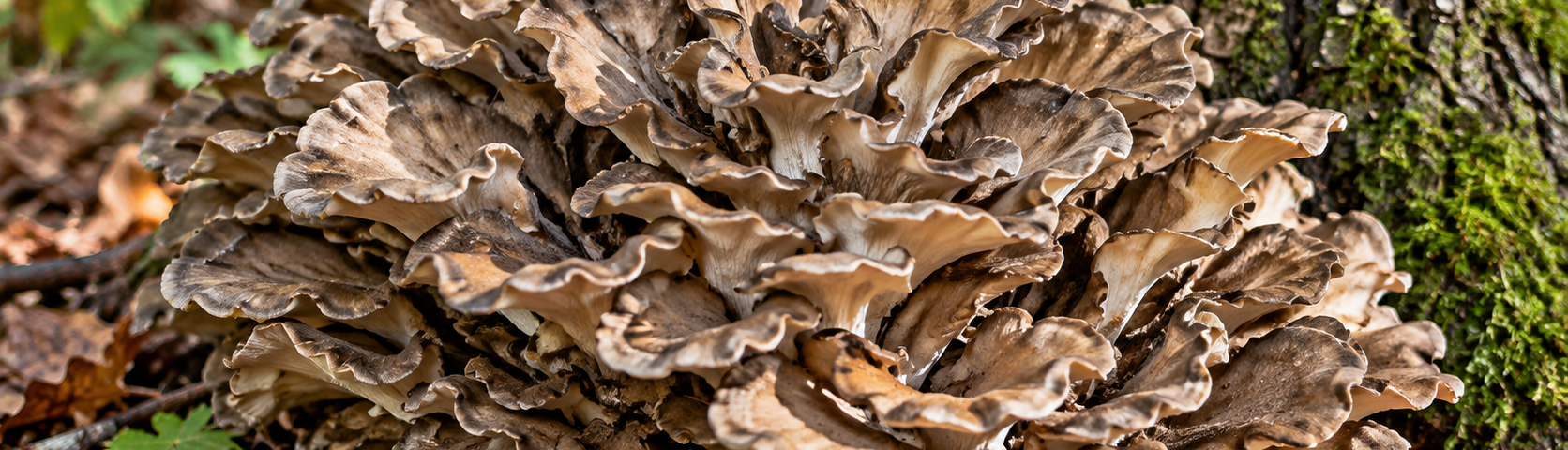
Hen of the woods is one of those mushrooms that can make you stop in the middle of a fall walk and stare.
At first glance, a large cluster looks almost like a pile of gray and brown leaves gathered around the base of a tree. Get closer, though, and the structure becomes much more interesting.
Dozens of small, overlapping caps rise from one thick, branching base. Each cap looks like a little fan, spoon, or feather. Together, they form the ruffled shape that gives hen of the woods its name.
The scientific name is Grifola frondosa. You may also know it as maitake, especially when you see cultivated versions in grocery stores or restaurants.
For foragers, hen of the woods has another advantage. It has several strong identification characteristics that work well together.
Hen of the woods grow in a large rosette.
They have pores instead of gills.
Its caps are usually gray to gray-brown.
The underside is white to cream.
And most importantly, the entire cluster branches from a shared pale base, usually at the base of an oak or from roots beneath the ground.
That does not mean we identify it from one photograph.
Several other large polypores can grow in similar places. Black staining polypore and Berkeley’s polypore are especially worth learning before you harvest.
If you are still building your mushroom identification skills, start with the Hunter Gatherer Society’s Wild Mushroom Identification Guides and our guide to identifying wild mushrooms safely.
Quick Answers
Is hen of the woods edible?
Yes. Hen of the woods, Grifola frondosa, is a well known edible mushroom and is also cultivated commercially as maitake. Young, tender specimens are considered the best for eating. The USDA Forest Service lists it as a choice edible.
Does hen of the woods have gills?
No. It is a polypore. The underside of each cap contains tiny pores rather than gills.
Where does hen of the woods grow?
Look near the base of mature hardwood trees, especially oaks. The mushroom often appears to grow from the ground because it can fruit from buried roots.
What color is hen of the woods?
The upper caps usually range from gray and smoky brown to darker gray-brown. The undersides are white, cream, or pale yellowish.
When is hen of the woods in season?
In North America, fruiting usually occurs from late summer through fall. In many eastern regions, September through November is prime season.
Does hen of the woods stain black?
Normally, no. A polypore that quickly darkens or blackens when bruised should make you consider black staining polypore, Meripilus sumstinei.
Does hen of the woods come back to the same tree?
It often can. The fungus lives in the tree or root system, while the mushroom you see is only the fruiting body. Established sites may produce again in later seasons.
Hen of the Woods at a Glance
| Feature | Hen of the Woods |
|---|---|
| Scientific name | Grifola frondosa |
| Common names | Hen of the woods, maitake, ram’s head, sheep’s head |
| Mushroom type | Polypore |
| Growth habit | Large rosette of overlapping fan or spoon shaped caps |
| Cap color | Gray, smoky gray, gray-brown to brown |
| Underside | White to cream pore surface |
| Gills | None |
| Base | Thick, pale and repeatedly branching |
| Flesh | White, firm and fibrous |
| Staining | Normally does not rapidly blacken |
| Spore print | White |
| Primary host | Oak |
| Fruiting position | Ground level at tree bases, roots or stumps |
| Best season | Late summer through fall |
| Edibility | Choice edible when correctly identified and cooked |
| Major lookalikes | Black staining polypore, Berkeley’s polypore, cauliflower mushroom |
| Best stage to harvest | Young, tender and fresh |
The important part is the combination.
A gray mushroom is not enough.
A rosette is not enough.
A mushroom growing beside an oak is not enough.
The complete pattern should fit.
What Is Hen of the Woods?
Hen of the woods is the common name for Grifola frondosa, a large polypore fungus in the order Polyporales.
The accepted name Grifola frondosa is recognized by major fungal biodiversity databases.
Unlike a classic mushroom with one cap and one stem, hen of the woods produces a compound fruiting body.
One pale central structure branches again and again. At the end of those branches are dozens, and sometimes hundreds, of small caps.
That branching pattern creates the familiar ruffled rosette.
The Japanese name maitake is also widely used for the species, especially in cultivated food markets.
Hen of the woods is both parasitic and decomposing in its relationship with trees. It can infect living hardwood roots and lower trunks and continue breaking down wood after the tree declines. UMass describes it as a cause of white pocket rot, with oaks as its primary host.
For a forager, the important part is simpler:
Think mature hardwoods, especially oak, and look around the base.
How to Identify Hen of the Woods
Hen of the woods gives us several identification points.
Use all of them.
Look for a Large Ruffled Rosette
Start with the overall shape.
A mature hen can look like a large mound of feathers.
Instead of one large cap, the fruiting body contains many smaller caps packed tightly together.
These overlap like shingles.
The entire cluster may be roughly circular or irregular, depending on the tree roots and surrounding ground.
The USDA Forest Service describes hen of the woods as a large fruiting body with overlapping shelves near hardwood trees and stumps.
Large specimens can become impressive.
Missouri’s Department of Conservation reports clusters reaching several feet across in exceptional cases.
You do not need to find a giant for the identification to work.
Young hens can be much smaller.
Examine the Individual Caps
Now look at the individual fronds.
Each cap is usually:
- Fan shaped
- Spoon shaped
- Tongue shaped
- Flattened
- Thin toward the edge
- Wavy along the margin
The caps tend to overlap heavily.
Colors range from smoky gray and gray-brown to darker brown.
Some specimens have subtle bands or zones of lighter and darker color.
Young cap edges may be paler than the center.
As the mushroom ages, colors often fade and the margins become thinner, drier, and less appealing.
A typical fruiting body is composed of numerous small caps rather than a handful of giant thick shelves.
That becomes particularly helpful when comparing hen of the woods with Berkeley’s polypore.
Check Underneath for Pores
Turn one of the fronds over.
You should not see gills.
Hen of the woods has a white to cream pore surface.
The pores are tiny and can be difficult to see without looking closely.
This is one of the first major checkpoints.
If your mushroom has true gills, it is not hen of the woods.
The pore surface continues down portions of the branching structure rather than stopping sharply beneath each cap.
Missouri’s field guide describes the pores as angular and white to yellowish.
Find the Branching Base
This is one of my favorite identification features.
Follow several caps inward.
Instead of each cap having a separate stem entering the ground, the stems merge into a thick, pale branching structure.
Think of a small tree turned upside down.
One sturdy base divides into branches.
Those branches divide again.
The small caps sit at the ends.
That architecture is an important part of the hen of the woods identification pattern.
The center and lower base can become quite tough even when the outer fronds are still tender.
Cut the Flesh
The interior flesh should be white.
Young outer fronds are firm but tender enough to cook.
Closer to the central base, the mushroom becomes denser and more fibrous.
One thing you should not expect is rapid black staining.
Cutting or pressing hen of the woods should not cause the dramatic dark bruising associated with black staining polypore.
That simple test can be extremely useful when the overall shapes look similar.
Take a Spore Print if Needed
Hen of the woods produces a white spore print.
A spore print usually is not necessary when every other characteristic is clear.
It can still add another point of confirmation when you are studying a specimen.
Keep in mind that a white spore print does not identify hen of the woods by itself. Several other polypores also produce pale spores.
Where Does Hen of the Woods Grow?
Tree association is extremely important with this mushroom.
Hen of the woods is most strongly associated with oak.
UMass lists oaks as the primary hosts, although other deciduous hardwoods may occasionally support the fungus.
Look around:
- Mature oaks
- Old oak stumps
- Large hardwood root systems
- Older hardwood forests
- Woodland edges with mature trees
- Parks containing old oaks
The mushroom may look like it is growing directly from soil.
Do not let that fool you.
The fungus can fruit from underground roots, so the visible mushroom may sit several inches or even farther from the trunk.
That is why looking at the surrounding trees matters.
Remember the Tree
If you find a confirmed hen of the woods, remember the location.
Take a photograph.
Save a GPS pin if appropriate.
Write the tree into your foraging journal.
Hen of the woods can return near the same infected tree in later seasons because the underground fungal organism remains present after the fruiting body disappears.
A good hen tree can become a place worth checking every fall.
When Is Hen of the Woods in Season?
Hen of the woods is primarily a late summer and fall mushroom.
The USDA Forest Service gives its fruiting season as late summer through fall. Missouri reports September through November for its region.
Exact timing depends on:
- Region
- Rainfall
- Temperature
- Elevation
- Tree health
- Local weather patterns
Autumn rain followed by moderate temperatures can bring hens out quickly.
Once a fruiting body begins developing, check it regularly if you can.
A mushroom that is perfect today may become tough, buggy, or waterlogged surprisingly soon.
A Pacific Northwest Note
Hen of the woods is particularly associated with eastern North American hardwood forests.
MushroomExpert describes Grifola frondosa as widely distributed east of the Rocky Mountains but rare in western North America.
That matters for Pacific Northwest foragers.
Finding a large rosette polypore at the base of a western tree does not automatically mean you have hen of the woods.
Western forests contain other large polypores, including Bondarzewia species and other fungi that can create broadly similar shapes.
If you are west of the Rockies, put extra weight on:
- Host tree
- Pore structure
- Individual cap size
- Branching pattern
- Bruising reaction
- Regional field guides
Regional ecology should always be part of mushroom identification.
Is Hen of the Woods Edible?
Yes.
Properly identified hen of the woods is widely regarded as an excellent edible mushroom. The USDA Forest Service lists it as a choice edible, and cultivated maitake is sold commercially.
The best part is usually the younger outer fronds.
These are thinner, more tender, and easier to cook.
The thick central base can become fibrous.
With a mature specimen, you may find yourself trimming away quite a bit of tough material while keeping the soft outer caps.
What Does Hen of the Woods Taste Like?
Hen of the woods has a rich savory flavor.
Expect something:
- Earthy
- Woodsy
- Deeply savory
- Slightly nutty
- Umami rich
Research on maitake flavor chemistry has found substantial amounts of compounds associated with umami taste, including amino acids and 5′ nucleotides.
Good preparation brings out that flavor even more.
The thin cap edges can become wonderfully crisp while the thicker parts stay tender.
When Should You Harvest Hen of the Woods?
The best hen is not necessarily the biggest hen.
I would rather find a medium sized young mushroom than a massive old one.
Look for:
- Firm fronds
- Clean white pore surfaces
- Flexible cap edges
- Good gray or brown color
- Fresh mushroom smell
- Minimal insect damage
- No sliminess
- No extensive drying
Leave mushrooms that are:
- Mushy
- Sour smelling
- Heavily insect damaged
- Waterlogged
- Moldy
- Very dry
- Brittle
- Extremely tough
Old hens can look impressive in photographs but disappointing in the kitchen.
How to Harvest Hen of the Woods
A large hen can contain a surprising amount of food.
There is rarely a need to tear the entire cluster apart.
Use a clean knife and cut the fruiting body near its base.
Try to avoid digging deeply into the soil or damaging surrounding roots.
Once you have the mushroom, turn it over before putting it in your basket.
The underside can hold:
- Soil
- Leaves
- Beetles
- Slugs
- Small sticks
- Other forest debris
A quick field cleaning saves a lot of work later.
For more on responsible identification and harvesting, see the Hunter Gatherer Society’s Wild Mushroom Foraging Safety guide.
How to Clean Hen of the Woods
Hen of the woods looks beautiful from the outside.
Inside can be another story.
Its branching structure gives insects and forest debris plenty of hiding places.
Start by breaking or cutting the cluster into large sections.
Then separate the individual fronds.
Trim away the tough central core.
Inspect every section closely.
A soft brush or damp towel works well for light dirt.
If the mushroom is genuinely dirty, a quick rinse is fine. Just dry the pieces well afterward.
I would avoid leaving it submerged in water.
The many folds can trap moisture, which makes browning harder when you cook it.
How to Cook Hen of the Woods
Hen of the woods is one of those mushrooms that does not need an elaborate recipe.
A hot pan and a little patience can do most of the work.
Pan Sautéed Hen of the Woods
Tear the cleaned mushroom into manageable pieces.
Heat a skillet.
Add a little butter or oil.
Spread the mushroom pieces into the pan without crowding them.
Let the edges brown before moving everything around.
Season with salt near the end.
Garlic, thyme, black pepper, or a squeeze of lemon all work well, but try the mushroom simply prepared at least once.
The crisp edges are often the best part.
Roast It
Toss clean fronds lightly with oil and seasoning.
Spread them in a single layer on a baking sheet.
Roast until the edges brown and become crisp.
This is a great method when you have a large harvest.
Add It to Eggs
Cook the mushroom first.
Once it has browned and softened, add it to scrambled eggs, omelets, or a breakfast skillet.
Use It in Soup
Hen of the woods has enough flavor to stand up to broth.
It works especially well in:
- Mushroom soup
- Wild rice soup
- Chicken soup
- Vegetable soup
- Ramen
- Stews
Add It to Pasta or Risotto
Brown the mushroom separately first.
Then fold it into pasta, risotto, or cooked grains.
That preserves the texture instead of boiling the mushroom into softness.
Cook Wild Hen of the Woods Before Eating
I recommend cooking wild hen of the woods rather than eating it raw.
Cooking improves the texture and flavor, and it is a sensible general practice with wild mushrooms.
If you have never eaten hen of the woods before, start with a small portion.
Even correctly identified edible mushrooms can affect individuals differently.
And remember the Hunter Gatherer Society rule:
If you cannot confidently name it, do not eat it.
Hen of the Woods Nutrition
Hen of the woods is not only valued for flavor.
Cultivated maitake also has an interesting nutritional profile.
USDA nutrient data for raw maitake list about the following amounts per 100 grams:
| Nutrient | Approximate amount |
|---|---|
| Calories | 31 kcal |
| Protein | 1.9 g |
| Carbohydrate | 7.0 g |
| Dietary fiber | 2.7 g |
| Fat | 0.2 g |
| Water | About 90 g |
| Potassium | 204 mg |
| Phosphorus | 74 mg |
| Zinc | 0.75 mg |
| Copper | 0.25 mg |
| Niacin | About 6.6 mg |
USDA data also report vitamin D in raw maitake, although vitamin D content in mushrooms can vary considerably with light exposure and growing conditions.
Those numbers are useful for understanding maitake as food, but they are not a guaranteed nutrition label for a wild mushroom.
Wild specimens can vary with:
- Substrate
- Growing conditions
- Maturity
- Moisture
- Sunlight exposure
- Geography
The broader research literature describes Grifola frondosa as high in water, low in fat, and a source of carbohydrates, fiber, protein, B vitamins, minerals, and polysaccharides.
What About Beta Glucans?
Maitake has received considerable research attention because it contains fungal polysaccharides, including beta glucans.
That is scientifically interesting.
It has also generated an enormous supplement market.
Those are not the same thing.
Laboratory studies and early research into isolated maitake compounds should not be translated into claims that eating wild hen of the woods prevents, cures, or treats cancer, diabetes, immune disorders, or other diseases.
The evidence is much more complicated.
For our purposes, hen of the woods does not need a medical claim attached to it.
It is already a flavorful, low calorie mushroom that provides fiber, micronutrients, and a range of naturally occurring fungal compounds.
That is enough reason to appreciate it as food.
Hen of the Woods Lookalikes
Hen of the woods is distinctive once you learn its complete structure.
Still, several large rosette fungi deserve comparison.
Black Staining Polypore
Black staining polypore, Meripilus sumstinei, is probably the comparison I would learn first.
It can also produce a huge mass of overlapping caps near the base of hardwood trees.
That is where the confusion starts.
The easiest clue is in the name.
Black staining polypore darkens when bruised, cut, or handled.
North Carolina State’s mycological herbarium describes the fresh pore surface as darkening when touched.
Its individual caps are generally larger and broader than the numerous smaller fronds of hen of the woods.
Hen of the woods
Small gray-brown fronds.
Dense branching rosette.
No dramatic black bruising.
Black staining polypore
Larger fan shaped caps.
Broad sprawling rosette.
White pore surface that darkens after handling.
If you are unsure, bruise a fresh section and give it time.
That staining reaction is extremely useful.
Berkeley’s Polypore
Berkeley’s polypore, Bondarzewia berkeleyi, is another massive fungus associated with hardwoods, especially oaks.
It can form large rosettes near tree bases and stumps.
However, the individual caps are usually much larger, thicker, and paler than those of hen of the woods.
North Carolina State describes Berkeley’s polypore as tan to yellowish with large caps and a tough to corky texture.
UMass also notes its strong association with oak and other eastern hardwoods.
Think:
Hen of the woods = many smaller gray feathers.
Berkeley’s polypore = fewer, thicker, pale shelves.
That is simplified, but it is a useful starting point.
Cauliflower Mushroom
Cauliflower mushrooms can form large pale clusters around trees and stumps.
However, the structure is completely different.
Instead of distinct fan shaped caps with a pore surface, cauliflower mushrooms form curled, ribbonlike folds.
Missouri’s Department of Conservation includes eastern cauliflower mushroom among the species that may be confused with hen of the woods at first glance.
Once you examine the structure closely, the difference is usually obvious.
A cauliflower mushroom looks more like a pile of curled noodles or ribbons.
A hen looks like overlapping feathers.
Umbrella Polypore
Umbrella polypore is another branching polypore that can resemble hen of the woods.
However, its caps are more clearly defined and often more rounded.
Each small cap tends to sit on a more obvious centrally attached stalk rather than forming the densely feathered, lateral caps typical of hen of the woods.
It is considerably less common, which makes careful documentation especially useful if you think you have found one.
Hen of the Woods Lookalike Comparison
| Feature | Hen of the Woods | Black Staining Polypore | Berkeley’s Polypore | Cauliflower Mushroom |
|---|---|---|---|---|
| Overall shape | Dense feathered rosette | Large spreading rosette | Massive shelf like rosette | Curled ribbonlike mass |
| Cap size | Many smaller caps | Larger fan shaped caps | Very large thick caps | No true fan shaped caps |
| Cap color | Gray to gray-brown | Tan to brown | Cream, tan to yellowish | Cream to pale tan |
| Underside | Fine white pores | White pores | Tan to pale pores | Folded surface |
| Black staining | No rapid blackening | Yes | No typical rapid blackening | No |
| Typical host area | Oak roots and base | Hardwood roots and stumps | Hardwood base and stumps | Roots or bases of trees |
| Main clue | Many gray fronds from one branching base | Dark bruising | Huge thick pale shelves | Noodle or ribbonlike folds |
Do not identify hen of the woods simply because a mushroom is large and growing beside an oak.
Look for the complete structure.
A Simple Five Point Field Check
Before calling a mushroom hen of the woods, I want these five things to agree.
1. The Cluster
A large rosette made of numerous overlapping caps.
2. The Caps
Relatively small fan or spoon shaped fronds, usually gray to gray-brown.
3. The Underside
Fine white to cream pores.
No gills.
4. The Base
A thick white or pale branching structure shared by the entire cluster.
5. The Habitat
At ground level near the base or roots of a mature hardwood, especially oak.
Then check the mushroom for unexpected staining, unusual colors, or structural differences.
If something does not fit, keep investigating.
Where Not to Harvest Hen of the Woods
A correct mushroom growing in a poor location is still a poor harvest.
Avoid mushrooms growing:
- Beside busy roads
- Near industrial sites
- In chemically treated landscapes
- Beside contaminated runoff
- On property where collecting is prohibited
- In places where you cannot confidently identify the host or substrate
Mushrooms can accumulate elements from their environment, so harvest location matters.
I also avoid old mushrooms that have begun breaking down.
The forest can keep those.
Ethical Harvesting
A hen can be enormous.
That does not mean you need all of it.
Take what you will realistically clean, cook, preserve, or share.
Leaving part of a large fruiting body also gives insects, wildlife, and the surrounding ecosystem something to use.
Follow local regulations and land ownership rules.
Never assume that public land automatically means mushroom harvesting is permitted.
Storage and Preservation
Fresh hen of the woods stores reasonably well when it is clean and dry.
Keep it refrigerated with some airflow rather than sealing a wet mushroom tightly in plastic.
For longer storage, you have several options.
Freezing
Cook the mushroom first.
Sauté or roast the pieces, cool them, and freeze portions for later meals.
Drying
Thin outer fronds dry well.
A dehydrator works best.
Once completely dry, store them in an airtight container.
Dried hen can be rehydrated for soups and sauces or ground into mushroom powder.
Mushroom Powder
Dry the mushroom until brittle.
Then grind it.
A small amount adds deep savory flavor to:
- Soup
- Gravy
- Rice
- Stew
- Sauces
- Seasoning blends
This is also a good use for clean pieces that are slightly too tough for sautéing.
Hen of the Woods Field Checklist
Before eating a suspected hen of the woods, confirm:
- Large rosette structure
- Dozens of overlapping fan or spoon shaped caps
- Gray to gray-brown upper surfaces
- White to cream undersides
- Tiny pores instead of gills
- White interior flesh
- Shared pale branching base
- Growth at ground level near hardwood roots or a stump
- Oak association when possible
- No rapid black staining
- Black staining polypore ruled out
- Berkeley’s polypore ruled out
- Mushroom is young and fresh
- Harvest location is clean and legal
- Identification has been confirmed with more than one reliable source
If important characteristics do not match, do not eat the mushroom.
Final Thoughts
Hen of the woods is a perfect example of why mushroom hunting becomes easier when you stop searching for one magic feature.
At first, all you may see is a pile of gray mushrooms at the bottom of a tree.
Then you start noticing the pattern.
There are dozens of small caps.
Each one is shaped like a fan.
They all connect to the same branching base.
The underside has pores instead of gills.
The flesh stays white.
And an oak is standing above it.
One characteristic supports the next.
True mushroom confidence comes from recognition, not resemblance.
A close‑looking picture can mislead.
An app’s percentage can distract.
A doubtful “maybe this is it” can be dangerous.
A complete set of characteristics that keeps pointing to the same species.
Once you reach that point, hen of the woods offers one more reward.
It is genuinely excellent food.
For more species guides, field skills, and mushroom safety information, continue through the Hunter Gatherer Society’s Wild Mushroom Identification Guides.
You can also compare another large wood associated edible mushroom in our Chicken of the Woods Identification Guide.
Research Sources
Identification, season, growth habit, and edibility were cross checked with the USDA Forest Service field guide and the Missouri Department of Conservation.
Host trees, root association, and tree decay information were checked against the University of Massachusetts Amherst.
Black staining polypore and Berkeley’s polypore characteristics were checked against North Carolina State University’s Larry F. Grand Mycological Herbarium and UMass Amherst.
Taxonomy was cross checked against GBIF and Catalogue of Life.
Nutrition and maitake composition were checked against USDA nutrient data and peer reviewed research on Grifola frondosa.
Focus Keyphrase: Hen of the woods identification guide
SEO Title: Hen of the Woods Identification & Edibility Guide
Slug: hen-of-the-woods-identification-guide
Meta Description: Learn how to identify hen of the woods, distinguish important lookalikes, find and harvest maitake safely, and prepare this prized wild mushroom.


