The Hunter Gatherer Society
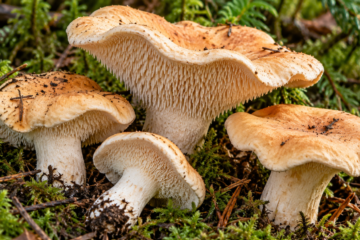
Hedgehog mushrooms (Hydnum species) growing in moss, showing apricot-colored caps and distinctive tooth-like spines beneath the caps.

Hedgehog Mushroom Identification Guide: Edibility, Lookalikes, Harvesting & Uses

There’s something wonderful about finding a mushroom that looks a little like a chanterelle, turning it over, and discovering hundreds of tiny teeth hanging beneath its cap. That’s often the moment you realize you’ve found a hedgehog mushroom. Hedgehog mushrooms are among the most rewarding wild edibles to learn. They have a delicious, slightly nutty flavor, a firm texture, and one of the most memorable identification features in the mushroom world. Instead of gills or pores, these mushrooms have soft, downward-pointing spines beneath their caps. They’re the little teeth that give hedgehogs their name. You’ll often find them tucked into moss, scattered among fallen needles, or growing along quiet forest trails. Here in the Pacific Northwest, they’re especially welcome because[…]

Read more
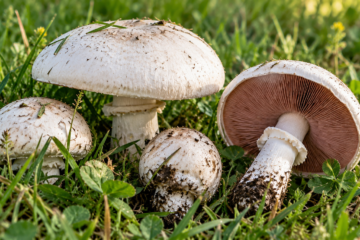
Meadow mushroom identification illustration showing white caps, pinkish-brown gills, and mushrooms growing in green grass.

Meadow Mushroom (Agaricus campestris): Identification, Lookalikes, Harvesting, and Complete Field Guide

There’s something special about walking through a grassy meadow after a good rain and discovering a cluster of fresh mushrooms scattered among the grass. Some are small, round buttons barely pushing above the ground. Others have already opened into broad white caps, revealing beautiful pink gills underneath. You may have just found meadow mushrooms, one of the classic wild edible mushrooms that foragers have enjoyed for generations. Known scientifically as Agaricus campestris, the meadow mushroom is closely related to the familiar button mushrooms sold in grocery stores. It has a rich, traditional mushroom flavor and often grows in places you might least expect, including pastures, old fields, and even backyard lawns. However, there’s an important catch. Several mushrooms share its[…]

Read more
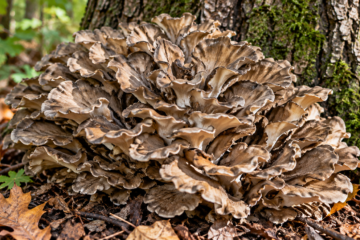
Hen of the woods mushroom (Grifola frondosa) growing in a large gray-brown rosette at the base of a tree

Hen of the Woods Identification Guide: Edibility, Lookalikes, Harvesting & Uses

Hen of the woods is one of those mushrooms that can make you stop in the middle of a fall walk and stare. At first glance, a large cluster looks almost like a pile of gray and brown leaves gathered around the base of a tree. Get closer, though, and the structure becomes much more interesting. Dozens of small, overlapping caps rise from one thick, branching base. Each cap looks like a little fan, spoon, or feather. Together, they form the ruffled shape that gives hen of the woods its name. The scientific name is Grifola frondosa. You may also know it as maitake, especially when you see cultivated versions in grocery stores or restaurants. For foragers, hen of the[…]

Read more
Lion’s mane mushroom growing on a hardwood tree with long white hanging teeth

Lion’s Mane Mushroom Identification Guide: Edibility, Lookalikes, Harvesting, and Complete Field Guide

Lion’s mane (Hericium erinaceus) is one of the most distinctive wild edible mushrooms you can find. Instead of a traditional cap and gills, a fresh lion’s mane looks like a white shaggy ball growing directly from wood, covered with long, soft teeth that hang downward like tiny icicles. For beginning mushroom foragers, that unusual structure is useful. Once mature enough to show its characteristic long teeth, lion’s mane has relatively few convincing lookalikes. The species most likely to be confused with it are other members of the genus Hericium, including comb tooth and bear’s head tooth mushrooms. Fortunately, these close relatives are also generally regarded as edible when young and fresh. That does not mean you should identify lion’s mane[…]

Read more
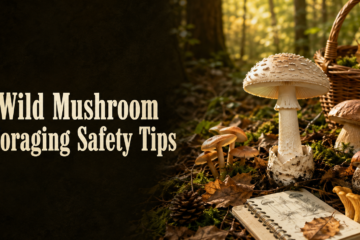
Wild mushroom foraging safety tips with mushrooms, field guide, and foraging basket in a forest

Wild Mushroom Foraging Safety: Why “Pretty Sure” Is Never Good Enough

There is one phrase I never want to hear when someone is about to put a wild mushroom in the frying pan: “I’m pretty sure.” Perhaps you are pretty sure it is a chanterelle. Maybe the identification app seems confident. The gills might look right. You may even remember picking the same mushroom last year. Still, when it comes to wild mushroom foraging safety, “pretty sure” is exactly where we stop. At The Hunter Gatherer Society, we have a simple rule: When it comes to wild food, never say “I think,” “I believe,” or “I’m pretty sure.” That does not mean we should be afraid of mushroom foraging. Quite the opposite. Learning wild mushrooms is one of the best excuses[…]

Read more
Social Share Buttons and Icons powered by Ultimatelysocial