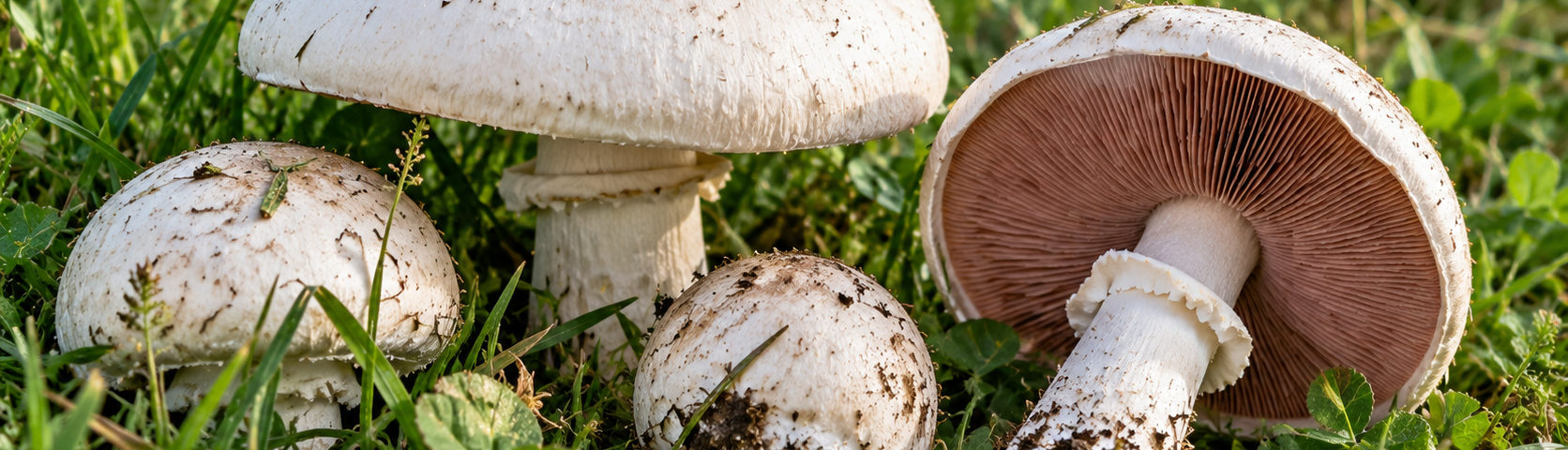
There’s something special about walking through a grassy meadow after a good rain and discovering a cluster of fresh mushrooms scattered among the grass.
Some are small, round buttons barely pushing above the ground. Others have already opened into broad white caps, revealing beautiful pink gills underneath.
You may have just found meadow mushrooms, one of the classic wild edible mushrooms that foragers have enjoyed for generations.
Known scientifically as Agaricus campestris, the meadow mushroom is closely related to the familiar button mushrooms sold in grocery stores. It has a rich, traditional mushroom flavor and often grows in places you might least expect, including pastures, old fields, and even backyard lawns.
However, there’s an important catch.
Several mushrooms share its general appearance, including poisonous species and some deadly white mushrooms. That means proper meadow mushroom identification requires much more than finding a white cap growing in the grass.
In this guide, we’ll explore how to recognize meadow mushrooms, understand their dangerous lookalikes, find productive habitat, harvest responsibly, and prepare them for the table.
Meadow Mushroom at a Glance
| Feature | Description |
|---|---|
| Common name | Meadow mushroom, field mushroom |
| Scientific name | Agaricus campestris |
| Family | Agaricaceae |
| Cap | White to cream, sometimes pale brown or slightly scaly |
| Cap width | Usually 1–4 inches (3–10 cm) |
| Gills | Pink when young, turning chocolate brown with maturity |
| Gill attachment | Free from the stem |
| Stem | White, fairly short, with a delicate ring that may disappear |
| Spore print | Dark chocolate brown |
| Flesh | White, sometimes developing faint pinkish tones |
| Smell | Mild, pleasant mushroom scent |
| Habitat | Grasslands, meadows, pastures, and lawns |
| Season | Usually summer through fall, depending on region |
| Growth pattern | Alone, scattered, in groups, or forming fairy rings |
| Edibility | Edible when positively identified and properly cooked |
| Main concern | Poisonous Agaricus species and potentially deadly white Amanita lookalikes |
What Is the Meadow Mushroom?
The meadow mushroom belongs to the genus Agaricus, a group that includes many familiar edible mushrooms as well as several poisonous species.
Its close relative, Agaricus bisporus, is the species commonly cultivated and sold as white button, cremini, and portobello mushrooms.
That’s one reason meadow mushrooms seem so familiar. Their appearance, texture, and flavor resemble mushrooms you’ve probably cooked many times before.
However, wild meadow mushrooms have something their cultivated relatives don’t: a life spent growing naturally in open grassland.
Unlike many woodland mushrooms, meadow mushrooms aren’t dependent on a particular tree species. Instead, they get their nutrients by breaking down dead organic material in the soil.
This makes them important natural recyclers.
It also explains why rich pastures, established lawns, and old meadows can provide such productive habitat.
One detail worth remembering is that Agaricus campestris can be difficult to separate from certain closely related species. In some cases, detailed microscopic examination or DNA analysis may be needed for a precise identification.
For beginners, the goal should always be understanding the complete identification pattern rather than relying on a name suggested by an app.
How to Identify Meadow Mushrooms
Meadow mushroom identification becomes much easier when you examine the entire mushroom.
The cap, gills, stem, smell, staining reactions, and growing location all provide valuable clues.
Let’s look at each one.
1. The Cap: White, Rounded, and Often Smooth
When young, meadow mushrooms have rounded caps that resemble small white buttons.
As they grow, the caps gradually expand, becoming broadly rounded and eventually almost flat.
Most measure approximately 1–4 inches across, although size varies with age and growing conditions.
The surface is generally white or creamy white. However, some mushrooms develop pale brownish tones or small scales as they mature.
You may also notice that the cap edges curl slightly downward, particularly on younger specimens.
The flesh should feel fairly firm and substantial rather than thin, fragile, or watery.
Still, cap appearance alone tells you very little about whether a mushroom is safe.
Many poisonous mushrooms also have smooth white caps.
2. The Gills: Pink Becoming Chocolate Brown
If there’s one feature every beginner should study carefully, it’s the gills.
Young meadow mushrooms typically have beautiful pink gills beneath their caps.
As the mushrooms mature, those gills gradually darken.
They move from pink to reddish brown, then eventually become deep chocolate brown.
This color change is one of the most recognizable characteristics of the meadow mushroom.
The gills are also closely spaced and free from the stem.
In other words, they stop just short of attaching to the stalk rather than running directly into it.
Important: White gills are not consistent with a typical mature meadow mushroom. Some deadly Amanita mushrooms have white gills that remain white throughout their development.
However, pink or brown gills do not automatically mean a mushroom is edible. Several poisonous Agaricus species share the same general gill color progression.
3. The Stem: White with a Delicate Ring
Meadow mushrooms usually have a relatively short, sturdy white stem.
Depending on age, the surface may be smooth or slightly fibrous.
Young specimens often have a thin membrane covering their developing gills. As the cap expands, this membrane tears and may leave a delicate ring around the upper stem.
However, that ring is often temporary.
On mature mushrooms, it may be broken, barely visible, or completely gone.
Another important feature is the base.
The meadow mushroom does not have the saclike cup found at the base of certain deadly Amanita species.
Whenever you’re examining a possible meadow mushroom, carefully remove the entire stem base from the ground.
Never cut off the bottom before checking it.
A buried cup or bulb could be an important warning sign.
4. The Flesh: White Without Bright Yellow Staining
Fresh meadow mushroom flesh is generally white.
When cut or damaged, it may remain white or develop a faint pinkish discoloration.
What you should not expect is an immediate, vivid yellow stain.
This distinction matters because some poisonous Agaricus mushrooms develop bright yellow coloring when scratched or cut, especially near the base of the stem.
One particularly important example is the yellow stainer, Agaricus xanthodermus.
To examine staining, cut the mushroom lengthwise through the stem and base, then watch for color changes.
However, be careful not to treat the absence of yellow staining as proof of edibility.
Some poisonous mushrooms stain weakly, inconsistently, or not at all.
5. The Smell: Mild and Mushroom-Like
Fresh meadow mushrooms generally have a familiar, pleasant mushroom scent.
It may remind you of the mushrooms you buy at the grocery store.
In contrast, certain poisonous Agaricus species produce unpleasant chemical odors.
People often describe these smells as ink, disinfectant, iodine, or phenol.
The odor may become stronger when the stem base is crushed or cut.
Unfortunately, not everyone detects these chemical smells equally well.
For that reason, smell should support your identification, never determine it by itself.
6. The Spore Print: Dark Chocolate Brown
A spore print can provide another useful identification clue.
Meadow mushrooms produce dark brown spores, which collect beneath the cap as a chocolate-brown deposit.
To make a spore print:
- Select a mature mushroom with developed gills.
- Remove the stem.
- Place the cap, gill side down, on clean white paper or another suitable surface.
- Cover it with a bowl to reduce air movement.
- Leave it undisturbed for several hours or overnight.
- Lift the cap and examine the deposited spores.
A meadow mushroom should leave a dark chocolate-brown print.
A white spore print is a serious reason to reconsider the identification, particularly because deadly white Amanita mushrooms produce white spores.
Still, many unrelated mushrooms also produce brown spore prints.
Therefore, spore color is only one part of the identification process.
Where Do Meadow Mushrooms Grow?
One of the most interesting things about meadow mushrooms is how different their preferred habitat is from that of many popular wild mushrooms.
While chanterelles and king boletes are often associated with particular trees, meadow mushrooms usually prefer open grassy areas.
Common locations include:
- Old meadows and pastures
- Grassy fields
- Established lawns
- Open parkland
- Grazed countryside
- Undisturbed grassy areas with rich soil
They often appear where organic material has accumulated over time.
Historically, pastures grazed by livestock were especially productive locations. However, mushrooms growing in these areas may also be exposed to animal waste, so harvesting conditions require care.
Do Meadow Mushrooms Grow Near Trees?
They can grow in lawns or grassland where trees are nearby.
However, typical meadow mushroom habitat is open grassland rather than the forest floor.
If you find a similar white mushroom growing among tree roots or in woodland litter, don’t automatically assume it’s Agaricus campestris.
The habitat may point toward another species.
Fairy Rings: One of Nature’s Interesting Patterns
Sometimes meadow mushrooms appear in a curved line or nearly perfect circle.
These formations are known as fairy rings.
Although they may look mysterious, there’s a straightforward explanation.
The underground fungal network grows outward through the soil as it consumes available nutrients.
When conditions are right, mushrooms can appear along parts of that expanding network.
Over time, the ring may become larger.
However, meadow mushrooms don’t always form fairy rings. They may also appear individually or in scattered groups.
And remember, fairy rings are not unique to edible mushrooms. Many different fungi produce them.
When Is Meadow Mushroom Season?
Meadow mushrooms generally appear from summer through fall.
However, the exact timing depends heavily on local weather and regional climate.
In many areas, late summer and autumn are particularly productive.
After a stretch of warm weather followed by substantial rainfall, mushrooms may begin appearing across grassy areas.
Moist soil and suitable temperatures are often more useful clues than the calendar alone.
Meadow Mushrooms in the Pacific Northwest
In western Washington and the surrounding Pacific Northwest, meadow mushrooms and related grassland Agaricus species are often encountered during fall.
Cooler temperatures and returning autumn rains can create favorable conditions.
Productive areas may continue fruiting into late fall or early winter when the weather remains mild.
However, western North America has numerous Agaricus species, including poisonous lookalikes.
Regional identification is especially important.
If you discover a productive meadow, record the location, date, rainfall, and habitat in your foraging journal.
You may find mushrooms returning during future seasons.
Meadow Mushroom Lookalikes: What You Must Know
This is the most important section of the guide.
Although meadow mushrooms are edible, several similar-looking species can cause serious illness. A few unrelated white mushrooms are potentially deadly.
Never identify a meadow mushroom from the white cap alone.
Destroying Angels (Amanita Species)
Danger level: Deadly poisonous
Destroying angels are among the most dangerous mushrooms in North America.
They include several species of white Amanita mushrooms that contain toxins capable of causing severe liver damage and death.
A young destroying angel can have a smooth, white, rounded cap that superficially resembles an immature meadow mushroom.
However, important differences exist.
Destroying angels generally have white gills that remain white as the mushroom matures.
They also produce white spore prints.
Many have a bulbous stem base surrounded by a saclike structure called a volva.
By contrast, meadow mushrooms develop pink gills that darken to chocolate brown and produce dark brown spores.
Critical safety rule: Always examine the entire stem base and gills. Never eat an immature white button mushroom whose identifying structures are not fully visible.
The consequences of confusing these mushrooms can be fatal.
Yellow Stainer (Agaricus xanthodermus)
Danger level: Poisonous
The yellow stainer is one of the most important meadow mushroom lookalikes.
It belongs to the same genus and often grows in similar grassy habitats, including lawns, parks, and gardens.
Its cap can be white or cream-colored, while the gills begin pink and darken with maturity.
That makes it particularly easy to confuse with edible Agaricus species.
Fortunately, several features can help distinguish it.
The yellow stainer often develops a bright yellow discoloration when bruised or cut.
This reaction can be especially noticeable at the base of the stem.
It may also produce a sharp, unpleasant chemical odor, often compared with ink or disinfectant.
Eating yellow stainers can cause significant gastrointestinal illness, including abdominal discomfort, nausea, vomiting, and diarrhea.
However, neither the yellow stain nor chemical smell is always obvious.
If the identification remains uncertain, leave the mushroom behind.
Other Poisonous Agaricus Species
Danger level: Poisonous or potentially harmful
The yellow stainer isn’t the only toxic member of the genus.
Species such as Agaricus moelleri and certain other yellow-staining Agaricus mushrooms can cause gastrointestinal illness.
Some develop darker scales on their caps, while others have distinctive odors or staining reactions.
Unfortunately, these characteristics may overlap with edible species.
This is why identifying a mushroom only as Agaricus is not enough to establish that it’s safe to eat.
The exact species matters.
White Dapperling (Leucoagaricus leucothites)
Danger level: Important identification hazard
White dapperlings sometimes grow in lawns and other grassy habitats.
Their white caps can resemble meadow mushrooms, especially when young.
However, they have pale gills and produce a white spore print rather than the characteristic dark brown print of mature Agaricus mushrooms.
Although white dapperlings are described as edible in some sources, they are not a good beginner harvest because they can be confused with dangerous white mushrooms.
When in doubt, avoid them.
Horse Mushroom (Agaricus arvensis)
Danger level: Similar edible species requiring separate identification
The horse mushroom is another edible member of the Agaricus genus.
It often grows in grassy areas and can resemble a large meadow mushroom.
However, horse mushrooms usually have larger caps, a more substantial ring, and a distinctive sweet smell sometimes compared to anise.
They may also develop yellowish staining, although the reaction differs from that of the poisonous yellow stainer.
Because several edible and poisonous Agaricus species can overlap in appearance, horse mushrooms deserve their own identification process.
Don’t assume a mushroom is safe simply because it resembles either species.
Meadow Mushroom Identification Checklist
When examining a possible meadow mushroom, consider all of the following:
- It is growing in an appropriate grassy habitat.
- The cap is white to cream or lightly brownish.
- The gills are free from the stem.
- Young gills are pink, turning chocolate brown with maturity.
- The stem is relatively short and sturdy.
- A delicate ring may be present or may have disappeared.
- The complete stem base has been examined.
- There is no saclike volva.
- The flesh does not rapidly develop vivid yellow staining.
- The smell is mild rather than chemical.
- A mature specimen produces a dark brown spore print.
- Poisonous lookalikes have been carefully considered.
Remember: This checklist is a learning tool, not proof that a mushroom is edible.
Even when these features appear to match, some closely related species can be difficult to separate.
Have a knowledgeable local mushroom expert confirm your identification before considering a wild Agaricus mushroom for food.
Are Meadow Mushrooms Edible?
Yes. Agaricus campestris is a well-known edible mushroom with a long history of culinary use.
However, that statement applies only to mushrooms that have been correctly identified.
A white mushroom with pink or brown gills should never automatically be considered edible.
The Agaricus genus contains both edible and poisonous species, and several of them grow in similar environments.
For beginners, I recommend treating meadow mushrooms primarily as an identification-learning species until you have gained experience examining gills, staining reactions, stem bases, and spore prints.
Once the identification has been reliably confirmed, fresh meadow mushrooms can be an excellent addition to the kitchen.
Nutritional Benefits of Meadow Mushrooms
Like their cultivated relatives, meadow mushrooms offer nutrients while remaining relatively low in calories.
Although their exact nutritional makeup changes with growing conditions and mushroom maturity, they can provide several useful components of a balanced diet.
B Vitamins
Mushrooms contain a variety of B vitamins that help the body process food and support normal cellular functions.
These may include riboflavin, niacin, and pantothenic acid.
B vitamins play important roles in energy metabolism, healthy tissues, and nervous system function.
Important Minerals
Meadow mushrooms contain minerals such as potassium, phosphorus, and smaller amounts of other essential nutrients.
Potassium supports muscle function and fluid balance.
Phosphorus helps maintain healthy bones and contributes to energy production.
Like other foods, mushrooms are best appreciated as one part of a varied diet rather than as a single source of essential nutrients.
Protein and Dietary Fiber
Mushrooms provide some protein, along with dietary fiber and other carbohydrates.
However, their high water content means fresh mushrooms are not a particularly concentrated protein source.
Still, they can add flavor, texture, and nutritional variety to meals.
Natural Antioxidants
Mushrooms also contain naturally occurring compounds that researchers study for their antioxidant properties.
These include compounds such as ergothioneine, although amounts vary among mushroom species and growing conditions.
Antioxidants are an interesting area of nutrition research, but their presence doesn’t mean meadow mushrooms prevent or treat disease.
What About Vitamin D?
Mushrooms can produce vitamin D2 when exposed to ultraviolet light.
However, vitamin D levels depend on species, sunlight exposure, and handling.
Because wild mushrooms grow under different conditions, you shouldn’t assume that every meadow mushroom contains a substantial amount.
Overall, meadow mushrooms are best viewed as a flavorful, nutritious vegetable-style addition to a balanced diet.
How to Harvest Meadow Mushrooms Responsibly
Before gathering any wild mushroom for food, make sure harvesting is permitted and the species has been positively identified.
Once that’s established, choose only fresh specimens in good condition.
Look for mushrooms with firm flesh, intact caps, and healthy-looking gills.
Avoid specimens that are slimy, decomposing, badly damaged, or heavily infested with insects.
Examine Before Harvesting
For identification purposes, carefully remove a complete specimen so you can examine the entire stem and base.
This is particularly important when ruling out Amanita mushrooms.
Once you’ve finished your identification work, you can trim away soil and debris.
Choose Clean Growing Areas
Mushrooms can absorb or accumulate certain substances from their environment.
For that reason, avoid harvesting from areas exposed to pesticides, herbicides, industrial contamination, polluted runoff, or roadside pollution.
Lawns are not automatically safe just because the grass looks healthy.
Always consider how the property has been maintained.
Leave Some Behind
Take only what you can reasonably use.
Leaving some mushrooms in place allows them to continue releasing spores and provides food for insects and other organisms.
Also, avoid unnecessarily disturbing the surrounding soil.
The mushroom above ground is only the visible reproductive structure. Most of the fungus lives below the surface as an extensive network of mycelium.
How to Clean and Store Meadow Mushrooms
Fresh wild mushrooms are best handled gently.
Start by brushing away loose soil and grass with a soft brush or clean cloth.
If necessary, rinse briefly with cool water and dry thoroughly.
Avoid soaking them for extended periods because they can absorb moisture and become less pleasant to cook.
Refrigerating Fresh Mushrooms
Keep fresh, clean mushrooms refrigerated in a breathable paper bag or loosely covered container.
Use them as soon as practical, preferably within a few days.
If they become slimy, develop an unpleasant odor, or show signs of decay, discard them.
Can You Freeze Meadow Mushrooms?
Yes, but cooking them first generally produces better results.
Sauté fresh mushrooms until much of their moisture has evaporated.
Allow them to cool, then portion them into freezer-safe containers.
Frozen cooked mushrooms work well in soups, sauces, stews, and other cooked dishes.
Can Meadow Mushrooms Be Dried?
Yes. Properly identified meadow mushrooms can be sliced and dehydrated using appropriate food preservation methods.
Dry them completely before storing in airtight containers.
For longer storage, follow tested drying and packaging guidance. Discard anything that develops mold or moisture during storage.
How to Cook Meadow Mushrooms
Meadow mushrooms have a pleasant, familiar flavor.
Their taste is often described as earthy, savory, and slightly nutty.
Young specimens tend to have a firmer texture, while more mature mushrooms may develop a stronger flavor.
One of the easiest ways to enjoy them is also one of the simplest.
Simple Garlic Butter Meadow Mushrooms
This easy recipe allows the natural mushroom flavor to stand out.
Servings: 2–3
Preparation time: 10 minutes
Cooking time: 10–15 minutes
Ingredients
- 2 cups of positively identified, cleaned meadow mushrooms
- 2 tablespoons butter
- 2 cloves garlic, minced
- 1 tablespoon fresh parsley, chopped
- Salt and black pepper to taste
- Optional squeeze of fresh lemon juice
Instructions
- Carefully clean the mushrooms and trim away damaged portions.
- Slice the larger caps into evenly sized pieces.
- Heat the butter in a skillet over medium heat.
- Add the mushrooms and cook, stirring occasionally, until they release their moisture and begin to brown.
- Continue cooking until the mushrooms are thoroughly heated and tender.
- Add the minced garlic and cook for another minute.
- Season with salt and pepper.
- Finish with fresh parsley and a squeeze of lemon juice if desired.
Serve alongside eggs, potatoes, pasta, or grilled meats.
You can also add the cooked mushrooms to soups, omelets, and savory pies.
Important: Cooking does not make a poisonous mushroom safe. Never use preparation methods as a substitute for positive identification.
The Ecological Role of Meadow Mushrooms
One of the most interesting things about meadow mushrooms is the important work they do beneath our feet.
Unlike mushrooms that form partnerships with tree roots, meadow mushrooms are decomposers.
Their underground mycelium breaks down dead plant material and other organic matter in the soil.
As that material decomposes, nutrients become available to other living organisms.
This process contributes to the natural recycling that keeps grassland ecosystems functioning.
Meadow mushrooms can also provide food and habitat for insects and other small organisms.
So even when you don’t harvest them, they’re worth appreciating.
They’re doing valuable work simply by growing where they belong.
Frequently Asked Questions About Meadow Mushrooms
How Can You Tell If a Meadow Mushroom Is Edible?
A genuine Agaricus campestris is edible when properly prepared, but determining whether you’ve found that species requires careful identification.
Check the gills, spore print, stem base, staining reactions, smell, and habitat.
Because dangerous lookalikes exist, beginners should seek confirmation from an experienced local mushroom identifier.
Do Meadow Mushrooms Have Pink Gills?
Yes. Young meadow mushrooms typically have pink gills that gradually darken to chocolate brown as they mature.
However, pink gills alone do not establish edibility.
Do Meadow Mushrooms Turn Yellow When Cut?
Typical Agaricus campestris specimens do not develop the strong, bright yellow staining associated with the poisonous yellow stainer.
However, staining reactions vary among related species, and the absence of yellow is not sufficient proof of identification.
Can Meadow Mushrooms Grow in My Backyard?
Absolutely.
Meadow mushrooms and other grassland Agaricus species can appear in established lawns after favorable weather.
However, never assume a lawn mushroom is edible based on its growing location.
Are Meadow Mushrooms the Same as Grocery Store Button Mushrooms?
Not exactly.
Meadow mushrooms are Agaricus campestris, while most commercially cultivated button mushrooms are Agaricus bisporus.
They’re closely related and share some characteristics, but they are different species.
Can You Eat Meadow Mushrooms Raw?
Although correctly identified meadow mushrooms are sometimes described as edible raw, cooking is the more conservative choice.
Cooking improves texture and digestibility and reduces some food-safety concerns.
For beginners, thoroughly cooked mushrooms are the better option.
Do Meadow Mushrooms Return Every Year?
They can.
If the underground fungal network remains healthy, mushrooms may appear again when moisture and temperature conditions are favorable.
However, annual fruiting is never guaranteed.
Are Meadow Mushrooms Good for Beginner Foragers?
They’re excellent mushrooms to study, but not the easiest edible mushrooms for beginners to collect for food.
Their poisonous lookalikes make them more challenging than many people realize.
Learning to recognize Agaricus characteristics is valuable. Eating a wild specimen should wait until an expert has confirmed the identification.
Final Thoughts: Learning to Appreciate the Meadow Mushroom
There’s something rewarding about finding a mushroom growing in a place you might normally walk right past.
A familiar pasture, a grassy hillside, or an old meadow can suddenly become a place worth exploring more carefully.
Meadow mushrooms remind us that good foraging isn’t limited to deep forests or remote mountain trails.
Sometimes, interesting wild foods are growing right out in the open.
However, they also offer an important lesson.
Knowing that a mushroom resembles something edible is not the same as knowing what it is.
The difference comes from slowing down, examining the details, and learning to recognize both the mushroom you’re looking for and the species you need to avoid.
Take the time to study the gills. Examine the complete stem. Make a spore print. Pay attention to staining, smell, and habitat.
Most importantly, never rush an identification because a mushroom looks familiar.
The more you learn, the more rewarding those discoveries become.
And even when you decide to leave a mushroom right where you found it, you’ve still gained something valuable.
A little more knowledge, a little more experience, and another reason to get outside.
Get outside and do something wild.
Continue Exploring Wild Mushrooms
Want to keep building your mushroom identification skills?
Visit The Hunter Gatherer Society’s Wild Mushroom Identification Guides to explore additional edible species, important lookalikes, harvesting tips, and mushroom safety information.
You can also learn about another popular wild edible in our Hen of the Woods Identification Guide.
For more field skills, plant guides, and responsible foraging information, explore our complete Foraging Identification Guides library.
Research and Further Reading
The following resources provide additional identification details, regional information, and important safety guidance.
- Missouri Department of Conservation: Meadow Mushroom — Identification features, habitat, season, and deadly lookalike warnings.
- Kitsap Peninsula Mycological Society: Meadow Mushroom — Pacific Northwest identification, gill color, staining, and spore print information.
- MushroomExpert: Agaricus xanthodermus — Detailed information on the poisonous yellow stainer.
- First Nature: Agaricus campestris — Identification, ecological role, season, and culinary background.


