Why Responsible Foraging Matters
By now, you have learned how to identify plants and mushrooms safely. You have also prepared your first simple wild meal.
If you need a refresher before continuing, review Week 5 here:
How to Build Your First Simple Wild Meal With Confidence
https://thehgsociety.com/first-wild-meal-beginner-guide/
Now it is time to shift your focus.
Responsible foraging protects the ecosystem while allowing you to continue learning and harvesting safely. Without stewardship, skill eventually causes damage.
Foraging is not just gathering food. Instead, it is participating in a living system.
That distinction changes how you move through the landscape.
The Beginner Forager Framework
New articles every Thursday at 6:00 PM
This article is part of our 12-week Beginner Forager Framework. Each week builds practical skill while reinforcing safety and sustainability.
Today, you will learn how to forage responsibly without harming the ecosystem.
Start With the “Leave More Than You Take” Rule
Many beginners ask how much they are allowed to harvest. A better question is how much they should harvest.
Wild ecosystems depend on balance. Plants reproduce through seeds and roots. Mushrooms spread spores. Wildlife depends on those same food sources.
When harvesting exceeds regeneration, long-term damage follows.
Therefore, apply a simple principle:
Leave more than you take.
For example, if you find a patch of edible greens, harvest lightly from several plants rather than clearing one entirely. Likewise, if you encounter mushrooms, avoid stripping an entire cluster unless abundance is clearly overwhelming.
Restraint protects future harvests.
Understand How Plants and Mushrooms Regenerate
Different species recover in different ways.
Leafy greens often regrow when harvested above the root system. However, uprooting the entire plant prevents recovery.
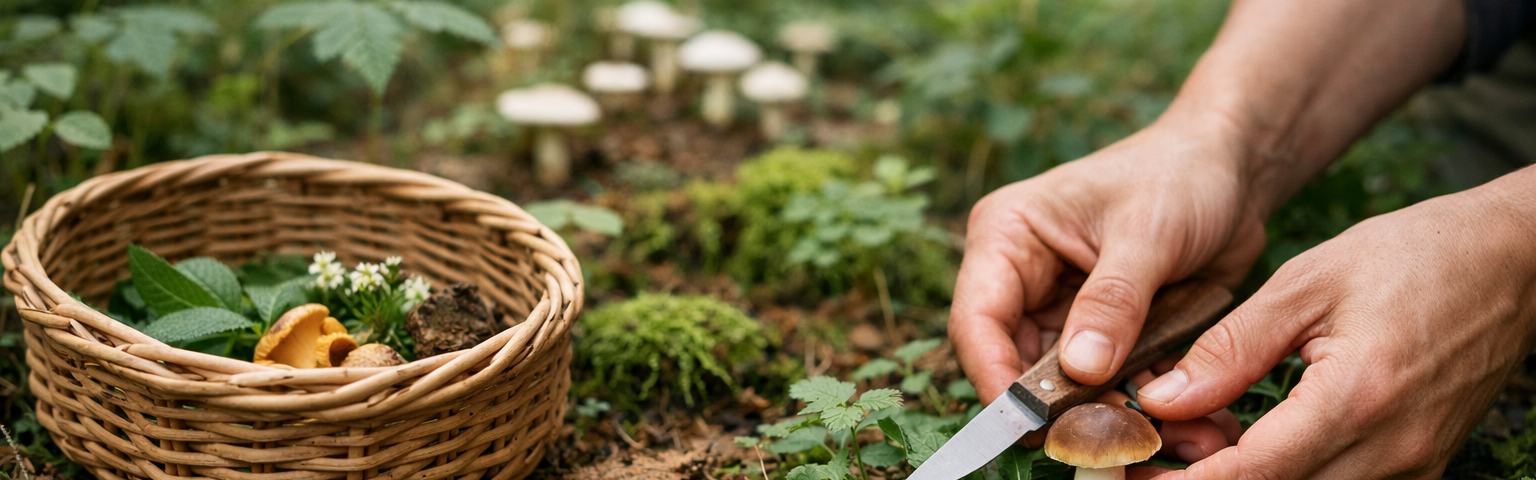
Mushrooms function differently. The visible mushroom is only the fruiting body. The underground mycelium remains alive when mushrooms are cut cleanly. Still, excessive trampling can damage that network.
Because regeneration varies, technique matters.
Cut instead of rip.
Harvest selectively rather than aggressively.
Step carefully around surrounding growth.
Awareness protects what you cannot see.
Know Local Foraging Laws and Regulations
Responsible foraging includes legal awareness.
Public lands often establish rules regarding:
Harvest quantity limits
Protected species
Seasonal restrictions
Commercial collection
Before harvesting, check official guidelines for the area you are visiting. Regulations differ between national forests, state parks, and private land.
Following the law protects access for everyone.
Avoid Fragile or Sensitive Habitats
Even when a species appears abundant, location matters.
Avoid harvesting in:
Recently burned areas
Erosion-prone slopes
Wetlands or fragile ecosystems
High-traffic recreation zones
Additionally, leave rare or unfamiliar species untouched.
When uncertainty arises, observation is the wiser choice.
Observation still builds skill.
Minimize Your Physical Impact
Foraging impact extends beyond what you harvest.
Foot traffic can compact soil. Digging can disrupt root systems. Careless movement can crush surrounding plants.
Instead, move deliberately.
Walk on durable surfaces when possible.
Avoid unnecessary digging.
Refrain from disturbing nearby growth.
Small behavioral adjustments prevent long-term damage.
Harvest Cleanly and Respectfully
Technique reflects stewardship.
Use a knife instead of pulling aggressively. Avoid scattering debris. If you move leaves to inspect a patch, return them gently.
After harvesting, the site should appear natural and undisturbed.
A well-foraged area should not reveal heavy impact.
Think Beyond Your Own Harvest
Wild food supports more than people.
Birds, insects, and mammals depend on berries, seeds, and fungi. Other foragers may visit the same area. Future seasons depend on current restraint.
Ask yourself:
If ten people harvested the way I am harvesting today, would this patch still thrive?
If the answer feels uncertain, reduce your take.
Long-term thinking protects opportunity.
Create a Personal Foraging Code
As your experience grows, formalize your standards.
For example, you might commit to:
Never harvesting rare species
Limiting take to a small percentage of any patch
Avoiding fragile habitats entirely
Always cutting instead of pulling
Documenting stressed areas
A personal code transforms ethics into habit.
Habits protect ecosystems.
Why Responsible Foraging Builds Confidence
Interestingly, stewardship strengthens confidence.
When you know you are harvesting carefully, hesitation decreases. Instead of worrying about damage, you move forward with clarity.
Confidence does not come from taking more.
It comes from taking responsibly.
Frequently Asked Questions About Responsible Foraging
How much should beginners harvest when foraging?
Beginners should harvest lightly and leave the majority of any patch intact. A common rule is to take only a small portion from multiple plants rather than clearing one area.
Is cutting mushrooms better than pulling them?
Yes. Cutting mushrooms reduces disturbance to the surrounding soil and helps protect the underground mycelium network.
Why is responsible foraging important?
Responsible foraging protects plant and fungal populations, supports wildlife, and ensures future harvesting opportunities.
Continue the Beginner Forager Framework
This week, you learned how to forage responsibly and protect the ecosystem.
Next week, we will explore:
How to Build Seasonal Awareness and Track Nature’s Patterns
A new article goes live every Thursday at 6:00 PM.
Until then, harvest lightly. Move carefully. Leave the land better than you found it.
I will see you next Thursday at 6:00 PM.
Foraging Safety Disclaimer
The information provided on this website and in this article is for educational and informational purposes only. Wild plant and mushroom identification carries inherent risks, including the possibility of serious illness, injury, or death if misidentification occurs.
Always verify identification using multiple reliable sources before harvesting or consuming any wild species. Never rely on a single source, photograph, or description. If you are uncertain about the identity of any plant or mushroom, do not harvest or consume it.
Foraging laws and regulations vary by location. You are responsible for understanding and complying with all local, state, and federal regulations before harvesting wild species.
The Hunter Gatherer Society and its authors assume no responsibility or liability for any injury, illness, loss, or damage resulting from the use or misuse of the information provided.
By using this content, you acknowledge that all decisions related to harvesting and consumption of wild foods are made at your own risk.


