Turning Identification Into Action
Up to this point in the Beginner Forager Framework, you have built knowledge step by step.
First, you created a structured plan. Then, you established clear safety rules. After that, you practiced plant identification. Most recently, you applied that same system to mushrooms.
If you would like to revisit mushroom structure and verification before cooking, review:
How to Identify Beginner-Friendly Wild Mushrooms With Confidence
https://thehgsociety.com/how-to-identify-wild-edible-plants-without-guessing/
Now, it is time to move forward.
Cooking transforms information into experience. Once you complete the full cycle from identification to preparation, confidence begins to feel earned rather than theoretical.
The Beginner Forager Framework
New articles every Thursday at 6:00 PM
This article continues our 12-week progression. Each week builds logically so growth remains steady and intentional.
Today, we focus on preparing your first simple wild meal safely and thoughtfully.
Why Simplicity Accelerates Learning
Many beginners feel pressure to create something impressive. However, complex recipes often hide important feedback.
When a wild ingredient is prepared simply, you can clearly observe its characteristics. As a result, learning happens faster.
With minimal seasoning, you can notice flavor intensity, texture changes, moisture release, aroma development, and even bitterness levels.
In contrast, heavy sauces and multiple spices mask those signals. Therefore, simplicity is not dull. Instead, it is strategic.
Clarity builds competence.
Step 1: Select a Species You Truly Understand
Before harvesting anything, evaluate your readiness honestly.
Have you confirmed this species multiple times?
Do you understand its look-alikes?
Have you observed it in different locations?
If hesitation appears, pause. Confidence should feel calm and supported by repetition.
Common beginner-friendly examples may include dandelion greens, chickweed, lamb’s quarters, oyster mushrooms, morels, or chanterelles.
Even so, familiarity must precede cooking. For that reason, choose the species you have studied most thoroughly.
Step 2: Harvest With Intention
Once you feel confident, harvest responsibly.
Take only what you need. Leave healthy growth behind. Avoid damaging roots unnecessarily. Rather than pulling mushrooms aggressively, cut them cleanly at the base.
In addition, select fresh specimens.
Tender greens cook better than mature leaves. Likewise, firm mushrooms perform better than waterlogged ones. By choosing wisely in the field, you improve the outcome in the kitchen.
Stewardship strengthens confidence.
Step 3: Clean Carefully and Reconfirm
Cleaning does more than remove soil. It provides one final identification checkpoint.
For greens, rinse under cool water and gently agitate to release debris. While doing so, examine leaf structure again.
With mushrooms, brush away dirt and trim the base if needed. Rinse briefly only when necessary. Avoid soaking delicate varieties, as they absorb water quickly.
During this stage, reconfirm key features. If something appears inconsistent, stop and reassess.
That extra review layer adds security.
Step 4: Use a Minimal Cooking Method
Keep your first preparation straightforward.
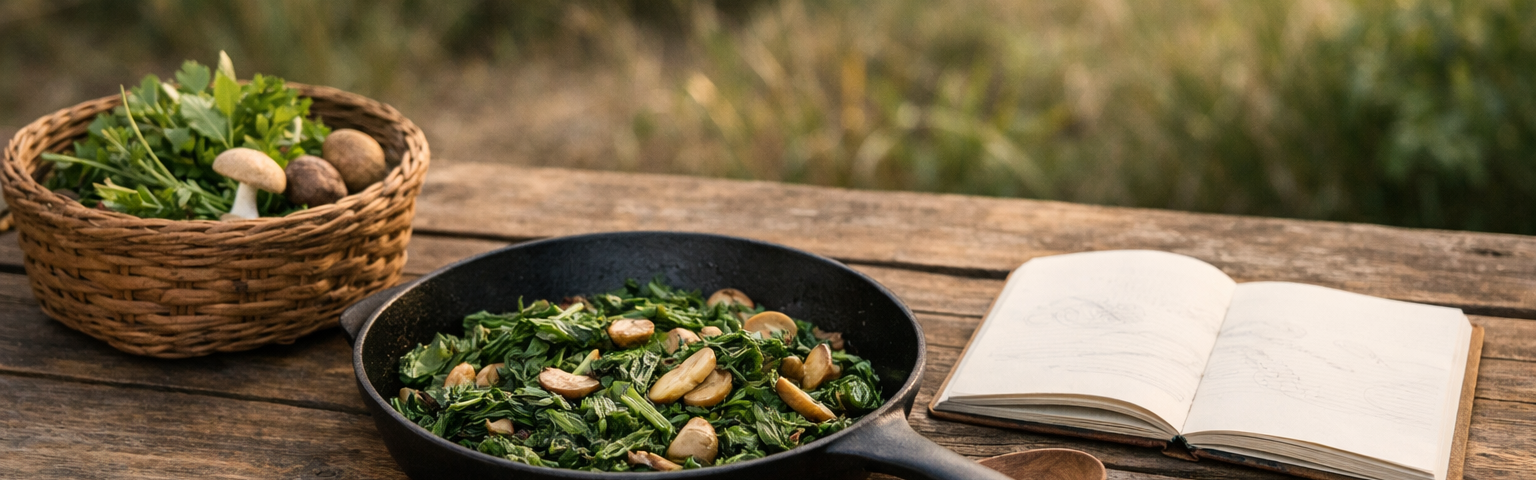
For wild greens, heat olive oil over medium heat. Add the greens once warm. Cook briefly until wilted. Then season lightly with salt and finish with lemon if desired.
For mushrooms, begin in a dry pan. Allow moisture to release naturally. After evaporation, add oil or butter. Season modestly and cook until lightly browned.
While cooking, observe closely. Notice how aroma changes. Watch moisture levels. Pay attention to texture shifts.
These observations teach more than any complicated recipe.
Step 5: Introduce Gradually
Even when identification is certain, moderation matters.
Start with a modest portion. Additionally, avoid combining the new ingredient with several unfamiliar foods. After eating, allow time to notice how your body responds.
Although reactions are uncommon with properly identified edible species, sensitivities can vary. Therefore, gradual introduction is wise.
Patience builds trust.
Step 6: Reflect and Document
After your meal, record what you experienced.
Write down flavor impressions, texture, cooking duration, portion size, digestive response, and possible adjustments for next time.
Over time, these notes create a practical record. Patterns begin to emerge. Consequently, your decisions become more refined.
Documentation transforms experience into skill.
Recognize Seasonal Variation
Wild foods change throughout the year.
Young leaves often taste milder. In contrast, mature greens may become tougher or more bitter. Similarly, mushrooms vary depending on rainfall, age, and temperature.
If a meal tastes overly fibrous or unpleasant, consider seasonal timing before assuming failure.
Often, waiting improves quality.
Avoid Predictable Beginner Errors
To progress efficiently, avoid common mistakes.
Cooking excessive quantities
Over-seasoning immediately
Skipping final identification confirmation
Harvesting beyond your comfort level
Instead, move deliberately. As you repeat the process, skill strengthens naturally.
Confidence Comes From Completion
When you complete the entire cycle, something shifts internally.
You identified carefully.
You harvested responsibly.
You cooked intentionally.
You observed attentively.
You documented honestly.
Through repetition, that structure becomes natural.
Confidence is not boldness. Rather, it is repetition supported by evidence.
Continue the Beginner Forager Framework
This week, you transformed knowledge into nourishment.
Next week, we will expand your perspective and explore:
How to Forage Responsibly and Protect the Ecosystem
A new article goes live every Thursday at 6:00 PM.
Until then, keep it simple. Cook thoughtfully. Document consistently.
I’ll see you next Thursday at 6:00 PM.
Foraging Safety Disclaimer
The information provided on this website and in this article is for educational and informational purposes only. Wild plant and mushroom identification carries inherent risks, including the possibility of serious illness, injury, or death if misidentification occurs.
Always verify identification using multiple reliable sources before harvesting or consuming any wild species. Never rely on a single source, photograph, or description. If you are uncertain about the identity of any plant or mushroom, do not harvest or consume it.
Foraging laws and regulations vary by location. You are responsible for understanding and complying with all local, state, and federal regulations before harvesting wild species.
The Hunter Gatherer Society and its authors assume no responsibility or liability for any injury, illness, loss, or damage resulting from the use or misuse of the information provided.
By using this content, you acknowledge that all decisions related to harvesting and consumption of wild foods are made at your own risk.


