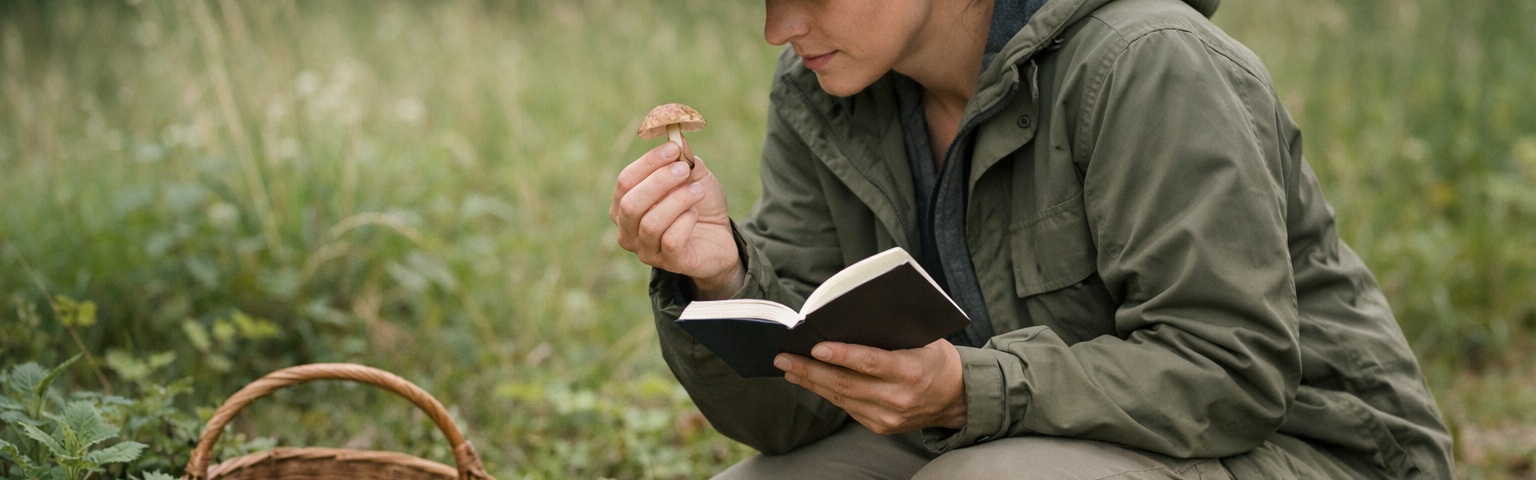
Why Field Confidence Feels So Hard at First
By now, you understand the most common beginner foraging mistakes and how to avoid them.
If you missed that article, review it here:
Common Beginner Foraging Mistakes and How to Avoid Them
https://thehgsociety.com/beginner-foraging-mistakes/
However, even when you do everything correctly, doubt often lingers.
That hesitation is normal.
Field confidence does not come from memorizing more facts. Instead, it develops through repetition, structure, and calm verification.
Today, you will learn how to trust your identification skills without rushing or guessing.
The Beginner Forager Framework
New articles every Thursday at 6:00 PM
This article continues our 12-week progression. Each week builds another layer of confidence and competence.
Now we focus on trusting your process in the field.
What Field Confidence Really Means
Field confidence is not boldness.
Rather, it is the ability to walk through a structured identification process without panic.
When you find a plant or mushroom, confidence allows you to:
Slow down
Examine multiple features
Compare habitat context
Confirm seasonal timing
Make a clear decision
Importantly, confidence also allows you to walk away when uncertainty remains.
Trusting your process includes trusting your hesitation.
Why Doubt Is Not the Enemy
Many beginners interpret doubt as failure.
In reality, doubt is protective.
It signals that you care about accuracy. Moreover, it encourages careful verification.
Instead of trying to eliminate doubt entirely, use it as a prompt:
Which features have I confirmed?
What still feels uncertain?
Can I verify this with one more data point?
When doubt leads to action instead of panic, confidence increases naturally.
Use a Repeatable Identification Checklist
Confidence grows through structure.
Rather than relying on memory alone, move through a checklist every time.
For plants:
Leaf arrangement
Leaf shape
Stem structure
Growth pattern
Habitat
Season
For mushrooms:
Cap structure
Gills, pores, or ridges
Stem characteristics
Spore surface color
Habitat association
Moisture conditions
When multiple features align, decision-making becomes clearer.
Consistency reduces hesitation.
Practice Confirmation Without Harvesting
One of the best ways to build confidence is to confirm species without taking them home.
While hiking, identify plants and mushrooms as practice. Walk through your checklist. Then leave them undisturbed.
Later, review your notes and compare with reliable references.
This exercise removes pressure.
Because no harvest is at stake, your brain focuses on learning rather than outcome.
Repetition builds trust.
Review Before You Go Into the Field
Preparation strengthens field confidence.
Before an outing, review the one plant and one mushroom you are studying that month.
Refresh key identification features. Revisit habitat notes. Look at photographs from different growth stages.
Entering the field prepared reduces uncertainty.
Preparation prevents second-guessing.
Understand the Difference Between Confidence and Overconfidence
True confidence feels steady.
Overconfidence feels rushed.
If you feel the urge to prove something or harvest quickly, pause. Slow your pace deliberately. Recheck your features.
Confidence respects process.
Overconfidence ignores it.
Build Confidence Through Documentation
After each outing, write down what you identified and why.
Record:
Which features matched
Which features required extra verification
What habitat details supported identification
How certain you felt
Over time, your journal becomes evidence.
You are not guessing. You are building a documented track record.
Evidence builds trust.
Accept That Walking Away Is Progress
Some days you will leave without harvesting.
That outcome is not failure.
Choosing not to harvest when uncertainty remains demonstrates maturity. In fact, restraint often reflects stronger confidence than bold action.
Walking away today increases certainty tomorrow.
Why Field Confidence Develops Gradually
Confidence does not arrive all at once.
Instead, it accumulates quietly.
Each correct identification strengthens neural patterns. Each careful decision reinforces trust in your process.
Eventually, hesitation decreases because experience replaces fear.
Patience accelerates growth.
Frequently Asked Questions About Foraging Confidence
How do beginners build confidence in identifying wild plants?
Beginners build confidence by using a repeatable identification checklist, confirming multiple features, and documenting each outing.
Should I harvest if I feel unsure?
No. If uncertainty remains after verification, leave the specimen and continue observing.
How long does it take to feel confident in foraging?
Confidence develops gradually through repetition, documentation, and seasonal experience.
Continue the Beginner Forager Framework
This week, you learned how to build field confidence and trust your identification skills.
Next week, we will explore:
How to Create a Personal Foraging Map and Track Productive Locations
A new article goes live every Thursday at 6:00 PM.
Until then, move slowly. Verify carefully. Trust your process.
I will see you next Thursday at 6:00 PM.
Foraging Safety Disclaimer
The information provided on this website and in this article is for educational and informational purposes only. Wild plant and mushroom identification carries inherent risks, including the possibility of serious illness, injury, or death if misidentification occurs.
Always verify identification using multiple reliable sources before harvesting or consuming any wild species. Never rely on a single source, photograph, or description. If you are uncertain about the identity of any plant or mushroom, do not harvest or consume it.
Foraging laws and regulations vary by location. You are responsible for understanding and complying with all local, state, and federal regulations before harvesting wild species.
The Hunter Gatherer Society and its authors assume no responsibility or liability for any injury, illness, loss, or damage resulting from the use or misuse of the information provided.
By using this content, you acknowledge that all decisions related to harvesting and consumption of wild foods are made at your own risk.


