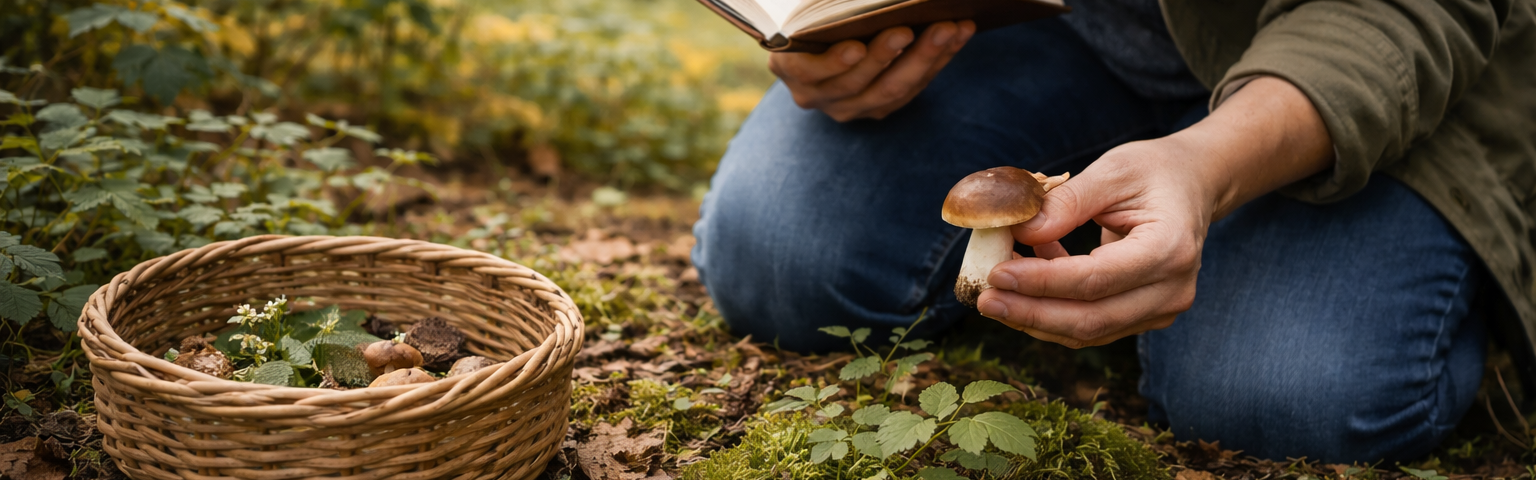
Why Most Foraging Mistakes Are Preventable
By now, you understand how seasonal awareness improves timing and confidence.
If you missed last week’s discussion, review it here:
Seasonal Awareness in Foraging
https://thehgsociety.com/seasonal-awareness-in-foraging/
However, even with good timing, beginners still make predictable mistakes.
Fortunately, most of those errors are avoidable.
The goal of this article is simple: identify common beginner foraging mistakes and show you exactly how to prevent them.
Because progress accelerates when you eliminate friction.
The Beginner Forager Framework
New articles every Thursday at 6:00 PM
This article continues our 12-week progression. Each week strengthens your foundation.
Today, we focus on removing the most common obstacles new foragers face.
Mistake 1: Trying to Learn Too Many Species at Once
Enthusiasm is powerful. However, spreading attention across dozens of species creates confusion.
Many beginners jump from plant to plant, hoping exposure will equal mastery. In reality, surface knowledge leads to hesitation in the field.
Instead, narrow your focus.
Study one plant and one mushroom per month. Research their features thoroughly. Observe them repeatedly in different locations and seasons.
Depth builds confidence faster than volume.
Over time, that steady rhythm produces meaningful competence.
Mistake 2: Relying on a Single Identification Feature
One characteristic is never enough.
For example, leaf shape alone does not confirm identity. Likewise, mushroom color alone does not ensure safety.
Proper identification requires multiple points of confirmation.
Examine:
Growth pattern
Leaf arrangement
Stem structure
Spore-producing surface in mushrooms
Habitat
Season
When all features align, confidence increases. If something feels inconsistent, pause.
Layered verification reduces risk dramatically.
Mistake 3: Ignoring Habitat Context
Habitat tells a story.
Certain plants prefer disturbed soil. Others thrive in forest shade. Similarly, many mushrooms associate with specific tree species.
Without habitat awareness, beginners often misidentify species that appear similar but grow in different environments.
Therefore, ask yourself:
Where is this growing?
What trees or plants surround it?
Is this habitat typical for the species I studied?
Context strengthens identification.
Mistake 4: Harvesting Before Full Confidence
Impatience leads to unnecessary risk.
Sometimes beginners feel pressure to bring something home. As a result, they harvest before achieving full certainty.
Confidence should feel calm, not rushed.
If hesitation appears, leave it behind. Observation still counts as progress.
Returning another day with clearer understanding is always the wiser choice.
Mistake 5: Overharvesting Out of Excitement
Finding a healthy patch can feel exhilarating. However, excitement sometimes overrides restraint.
Instead of harvesting heavily, apply the principle from Week 6: leave more than you take.
Small, selective harvesting preserves ecosystems and improves long-term opportunity.
Sustainability strengthens skill.
Mistake 6: Skipping Documentation
Many beginners trust memory alone.
Unfortunately, memory fades quickly.
Without documentation, patterns remain invisible. Timing lessons disappear. Growth stages blur together.
Keep records in a simple journal.
Note:
Date
Weather
Location
Growth stage
Quality observations
Over time, documentation reveals trends you would otherwise miss.
Patterns build predictability.
Mistake 7: Comparing Yourself to Experienced Foragers
Social media often showcases large harvests and advanced knowledge.
However, comparison slows learning.
Experienced foragers built their skill gradually. You are building yours now.
Focus on steady progress rather than speed.
One plant. One mushroom. One month.
That rhythm compounds.
Mistake 8: Forgetting That Observation Is Progress
Not every outing needs to produce food.
Some trips should focus entirely on observation.
Photograph unfamiliar plants. Watch how growth changes weekly. Study habitat variation.
Observation sharpens skill without pressure.
Learning does not require harvesting.
How to Build a Mistake-Resistant System
Instead of relying on willpower, build structure.
Choose one species at a time.
Confirm multiple identifying features.
Document everything.
Harvest lightly.
Observe often.
Systems prevent predictable errors.
Discipline simplifies growth.
Why Avoiding Mistakes Builds Confidence Faster
Confidence grows through repetition. However, repetition must be guided by correction.
When you remove common beginner foraging mistakes, progress becomes smoother.
Instead of second-guessing yourself, you move with clarity.
Skill develops naturally when friction decreases.
Frequently Asked Questions About Beginner Foraging Mistakes
What is the most common beginner foraging mistake?
Trying to learn too many species at once often leads to confusion and hesitation.
Why should beginners avoid relying on one identifying feature?
Single features can be misleading. Multiple confirmation points improve accuracy and safety.
Is it okay to leave without harvesting anything?
Yes. Observation builds skill and often provides more long-term benefit than rushed harvesting.
Continue the Beginner Forager Framework
This week, you learned how to identify and avoid common beginner foraging mistakes.
Next week, we will explore:
How to Build Field Confidence and Trust Your Identification Skills
A new article goes live every Thursday at 6:00 PM.
Until then, slow down. Narrow your focus. Build depth.
I will see you next Thursday at 6:00 PM.
Foraging Safety Disclaimer
The information provided on this website and in this article is for educational and informational purposes only. Wild plant and mushroom identification carries inherent risks, including the possibility of serious illness, injury, or death if misidentification occurs.
Always verify identification using multiple reliable sources before harvesting or consuming any wild species. Never rely on a single source, photograph, or description. If you are uncertain about the identity of any plant or mushroom, do not harvest or consume it.
Foraging laws and regulations vary by location. You are responsible for understanding and complying with all local, state, and federal regulations before harvesting wild species.
The Hunter Gatherer Society and its authors assume no responsibility or liability for any injury, illness, loss, or damage resulting from the use or misuse of the information provided.
By using this content, you acknowledge that all decisions related to harvesting and consumption of wild foods are made at your own risk.


