Puffballs are some of the most approachable wild mushrooms for beginners, but they also come with one rule that cannot be skipped:
Cut every puffball open before eating it.
That one step is what separates a safe puffball harvest from a dangerous mistake.
The common puffball, also known as the gem-studded puffball or warted puffball, is a small white mushroom that often appears on the forest floor, along trails, in open woods, and sometimes in disturbed grassy areas. Its scientific name is Lycoperdon perlatum, and it is one of the most widely recognized small puffballs in North America. MushroomExpert describes it as probably the most commonly seen woodland puffball in North America, while the Missouri Department of Conservation describes it as a common edible mushroom when young and fresh.
Unlike gilled mushrooms, puffballs do not have a classic cap, stem, and gills. Instead, the edible stage looks like a small rounded ball or pear-shaped fruiting body. When young, the inside should be solid, pure white, and soft, almost like a marshmallow. As puffballs mature, the inside changes color and eventually turns into a dusty mass of spores.
That mature stage is not for the table.
This guide will walk you through how to identify Lycoperdon perlatum, where to find it, when to harvest it, how to cook it, and how to avoid the dangerous mistakes beginners can make with puffball mushrooms.
What Is Lycoperdon perlatum?
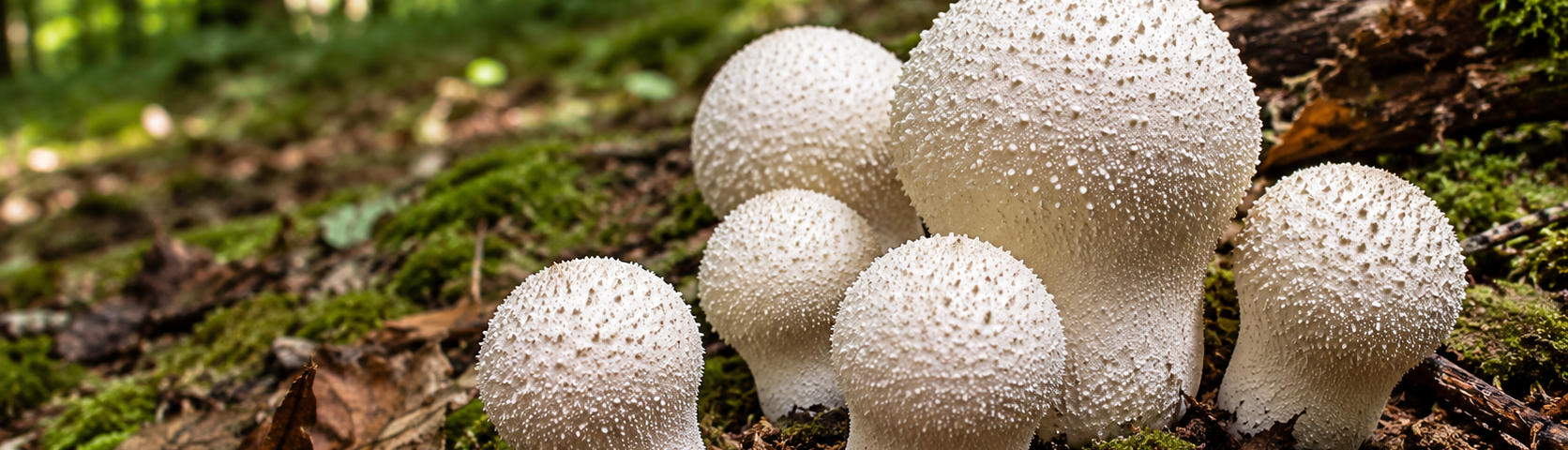
Lycoperdon perlatum is a small puffball mushroom commonly known as the common puffball, gem-studded puffball, warted puffball, or devil’s snuff-box. It usually has a rounded top, a slightly narrowed base, and a surface covered with small spiny bumps or “gems.” These tiny spines can rub off as the mushroom ages, often leaving a netlike pattern on the surface.
When young, the inside is white and solid. When mature, the inside turns yellowish, olive, brown, or powdery, and a small pore opens at the top. If touched, squeezed, hit by rain, or stepped on, the mature mushroom releases a puff of spores.
That puff is where the common name comes from.
However, puffballs are only edible in the young white stage. Once the inside begins to change color, the mushroom is no longer a good edible harvest.
Quick Field Summary
Common names: Common puffball, gem-studded puffball, warted puffball, devil’s snuff-box
Scientific name: Lycoperdon perlatum
Mushroom type: Small puffball
Gills: None
Cap and stem: No true cap and gills; rounded fruiting body with a narrowed base
Surface: White to cream when young, covered with small spiny warts or gems
Interior: Must be solid white and featureless when edible
Growth habit: Alone, scattered, or in groups on the ground
Best season: Usually late summer through fall
Best stage to harvest: Young, firm, white inside, and fresh
Edibility: Edible when young, solid white inside, correctly identified, and cooked
Critical safety rule: Slice every puffball from top to bottom before eating
How to Identify Puffball Mushrooms
Puffballs look simple, but good identification still requires careful inspection. Do not rely only on the round shape. Several dangerous mushrooms can look puffball-like when young.
Look for a small white to cream rounded mushroom
Young Lycoperdon perlatum is usually white to cream-colored, with a rounded or slightly pear-shaped body. It is not usually huge like a giant puffball. The Missouri Department of Conservation gives gem-studded puffball sizes of about 1 to 2½ inches wide and 1 to 3 inches tall.
As it ages, the mushroom may become yellowish, pinkish, tan, or brownish. Older color usually means the inside is changing too, so mature specimens should be skipped.
Check the surface for tiny spiny “gems”
The surface of Lycoperdon perlatum is one of its best identification clues. It is covered with small spiny warts or gem-like bumps, especially near the top. These little bumps can rub off, leaving a subtle netted or pitted pattern behind.
This “gem-studded” look is why one of its common names is gem-studded puffball.
Confirm that it grows on the ground
This part matters.
Lycoperdon perlatum typically grows on the ground, not directly from wood. You may find it in open woods, along roadsides, in disturbed areas, or in forested places with rich organic material. The Missouri Department of Conservation specifically notes that gem-studded puffball grows on the ground, while the similar pear-shaped puffball grows on decaying wood.
If you find small clustered puffballs growing directly from logs or stumps, you may be looking at pear-shaped puffballs instead.
Slice it open from top to bottom
This is the most important step in puffball identification.
Cut the mushroom completely in half from top to bottom. The inside should be:
Solid white
Soft and fresh
Featureless
Free of gills
Free of a developing cap
Free of a developing stem
Free of yellow, brown, olive, gray, or purple color
The Missouri Department of Conservation warns that some dangerous mushrooms, including young Amanita species, can look like puffballs in the button stage. Cutting the mushroom open should reveal whether it is truly a featureless puffball or an immature gilled mushroom developing inside.
If you see any sign of a baby mushroom shape inside, do not eat it.
The Interior Test: The Rule That Matters Most
The interior test deserves its own section because it is the rule beginners need to remember.
A puffball is only a candidate for eating if the inside is completely white and featureless.
Not mostly white.
Not white with yellow spots.
Not white with gray patches.
Not white except for a little brown.
Not white with a cap shape forming inside.
Completely white and featureless.
As puffballs mature, the inside becomes the spore mass. It may turn yellowish, olive, brown, or powdery. Once that process starts, the puffball is no longer a good edible mushroom. First Nature also notes that only young specimens should be collected and that once the spore mass begins turning yellow, the mushroom is unsuitable for eating.
When in doubt, leave it behind.
Where to Find Common Puffballs
Common puffballs are saprobic mushrooms, meaning they help break down decaying organic material. They are part of the forest cleanup crew.
Look for them in:
Open woods
Forest edges
Trail sides
Leaf litter
Disturbed ground
Old grassy areas
Road edges away from contamination
Waste areas with organic debris
Mossy or mixed woodland floors
The Missouri Department of Conservation describes gem-studded puffballs as growing singly or in clusters on the ground in open woods, along roads, and in waste areas.
Avoid harvesting from roadsides, sprayed lawns, industrial areas, heavily polluted sites, or any location where the soil may be contaminated. Mushrooms can absorb substances from their environment, and clean habitat matters when collecting wild food.
When Are Puffballs in Season?
Common puffballs usually appear in late summer through fall, with timing depending on region, elevation, rain, and temperature.
The Missouri Department of Conservation lists gem-studded puffball season as July through October, while its edible mushroom guide describes puffballs generally as appearing in late summer or fall.
In practical terms, start watching after late-summer rains and continue through fall mushroom season.
Is Lycoperdon perlatum Edible?
Yes, Lycoperdon perlatum is edible when young, fresh, and properly identified.
But the safe answer is more specific:
Common puffballs are edible only when the interior is solid white, soft, and featureless, with no sign of yellowing, browning, powder, gills, a developing cap, or a developing stem.
They should also be cooked before eating. The Missouri Department of Conservation recommends trying only a small amount the first time you eat any wild mushroom and making sure edible mushrooms are cooked.
Beginner Safety Rules
Cut every puffball open
Never eat a puffball whole without slicing it open first. This rule applies every time, even if you think you already know what it is.
Cut from top to bottom and inspect the full interior.
Only eat puffballs that are pure white inside
If the inside is yellow, brown, olive, gray, purple, powdery, marbled, or anything other than pure white, do not eat it.
Watch for hidden gills or a developing mushroom shape
Young Amanita mushrooms can appear round before they open. Some can be dangerously poisonous, and beginners may mistake them for puffballs. A true puffball should not show gills, a cap, a stem, or an organized baby mushroom structure inside.
Avoid earthballs
Earthballs, especially pigskin puffballs in the genus Scleroderma, can look puffball-like from the outside but are not edible. The Missouri Department of Conservation describes pigskin puffball as poisonous, with a thick rindlike skin and interior that becomes marbled, purplish, or blackish with age. It can cause nausea, vomiting, and stomach upset.
Do not inhale mature puffball spores
Mature puffballs release clouds of spores. Do not intentionally breathe them in, kick them into clouds, or use the spore powder as a folk remedy. The CDC describes lycoperdonosis as a rare respiratory illness caused by inhaling spores from Lycoperdon puffballs.
Try a small amount the first time
Even edible mushrooms can bother some people. Try a small cooked portion the first time and wait to see how your body responds.
Puffball Lookalikes
Immature Amanita mushrooms
This is the most serious concern.
Some Amanita mushrooms begin as rounded “buttons” enclosed in a universal veil. At that stage, they can look like small puffballs from the outside. When sliced open, however, an immature Amanita will show the structure of a developing mushroom inside.
You may see a cap, stem, gills, or an organized outline.
A true puffball should be white and featureless inside.
If there is any structure inside, do not eat it.
Pigskin puffball / common earthball
Pigskin puffball, also called common earthball, is usually thicker-skinned, tougher, yellowish brown, and more warted or scaly. The interior becomes marbled, purplish, blackish, or dark. It is poisonous and can cause gastrointestinal symptoms.
Beginners should avoid any puffball-like mushroom with a dark, marbled, firm, leathery, or thick-rinded interior.
Pear-shaped puffball
Pear-shaped puffball is another edible puffball when young and white inside, but it usually grows in clusters on decaying wood. Gem-studded puffball usually grows on the ground.
This is not necessarily a dangerous confusion, but it matters for accurate identification.
Other small puffballs
There are many small puffball-like mushrooms. Some are edible when young and white inside, while others are not good choices for beginners. For this guide, the safest approach is to focus on the full identification pattern of Lycoperdon perlatum and use the interior test every time.
How to Harvest Puffballs
Harvest puffballs when they are young, firm, and fresh.
Choose specimens that are:
White or cream on the outside
Firm but not hard
Fresh-looking
Not slimy
Not bug-riddled
Not cracked open and dusty
Not yellowing or browning heavily
Use a knife to cut or lift the puffball from the ground. Try to keep dirt out of your harvest container. A basket or paper bag works better than sealed plastic because mushrooms can sweat and degrade quickly.
Once harvested, slice each puffball open before it goes into the cooking pile.
How Much Should You Harvest?
Puffballs are often small, so it can take several to make a meal. Still, harvest selectively.
Take only fresh, young specimens that pass the interior test. Leave mature puffballs to release spores, feed insects, and continue their role in the ecosystem.
A handful of perfect puffballs is better than a basket of questionable ones.
Cleaning Puffballs
Puffballs usually collect dirt, grit, leaf bits, and insects around the base.
To clean them:
Brush away dirt and debris.
Trim off the dirty base.
Remove any tough or damaged outer skin if needed.
Slice each mushroom open from top to bottom.
Discard anything that is not pure white and featureless inside.
Some foragers peel puffballs before cooking, especially if the outer skin is tough, dirty, or warty. The Missouri Department of Conservation’s mushroom guide suggests removing the outer skin if it is tough.
For small, young, tender puffballs, peeling may not always be necessary, but cleaning and slicing are.
How to Cook Puffballs
Puffballs have a mild flavor and soft texture. They absorb seasoning well, which makes them useful in simple wild food recipes.
Good cooking methods include:
Sautéing in butter or oil
Pan frying
Breading and frying
Adding to eggs
Cooking into soups
Adding to pasta
Using in stir-fries
Adding to wild mushroom gravy
Cooking with garlic and herbs
For a simple first meal, slice young puffballs into halves or rounds, then sauté them in butter or oil until they are fully cooked and lightly browned. Add salt, pepper, garlic, and a little thyme or parsley near the end.
Keep your first puffball meal simple. That makes it easier to know how your body responds.
What Do Puffballs Taste Like?
Common puffballs are mild, soft, and mushroomy, but not usually as bold as chanterelles, morels, or chicken of the woods. Their strength is texture and versatility.
They work well when paired with stronger flavors such as butter, garlic, onions, herbs, pepper, smoked salt, eggs, or cream sauces.
Small puffballs are especially good when pan-fried until the outside browns slightly.
How to Store Puffballs
Puffballs are best cooked soon after harvest.
For short-term storage, keep them in the refrigerator in a paper bag or breathable container and use them within a couple of days. Do not store questionable puffballs and hope they improve. They will not.
For longer storage, you can cook puffballs first and then freeze them. Some foragers also dehydrate puffballs, but texture can vary, and young fresh puffballs are usually best enjoyed quickly.
Discard puffballs that become slimy, sour-smelling, discolored inside, or soft in an unpleasant way.
Ethical Harvesting Tips
Puffballs play an important role in breaking down organic material and returning nutrients to the soil. They are not just food; they are part of the forest system.
Harvest responsibly by following a few simple rules:
Take only what you will use.
Leave mature puffballs to release spores.
Avoid trampling the surrounding habitat.
Do not harvest from sprayed or polluted areas.
Respect public land rules and private property.
Photograph questionable mushrooms instead of taking them.
Teach beginners the interior test before discussing recipes.
A good forager does not just find food. A good forager learns the organism, the habitat, and the limits of their own certainty.
Field Checklist: Common Puffball
Before eating a puffball, confirm every point:
It is a small rounded or pear-shaped puffball.
It is white to cream and fresh-looking outside.
It has small spiny warts or gem-like bumps.
It is growing on the ground, not directly from wood.
It has been sliced from top to bottom.
The inside is solid white.
The inside is soft and fresh.
There are no gills.
There is no developing cap.
There is no developing stem.
There is no yellow, brown, gray, olive, purple, or powdery spore mass.
It is not thick-skinned, marbled, leathery, or dark inside.
It will be cooked before eating.
You will try a small amount the first time.
If any point fails, do not eat it.
Common Beginner Questions
Can beginners forage puffballs?
Yes, puffballs can be beginner-friendly mushrooms, but only if the beginner follows the interior test every time. A safe edible puffball must be white, solid, and featureless inside.
Is Lycoperdon perlatum edible?
Yes, Lycoperdon perlatum is edible when young and fresh, but it should only be eaten when the inside is pure white and featureless. It should also be cooked.
How do I know if a puffball is too old?
A puffball is too old to eat if the inside is yellow, olive, brown, gray, powdery, soft in a rotten way, or no longer solid white. Mature puffballs are spore sacs, not good edible mushrooms.
What is the biggest danger with puffballs?
The biggest danger is mistaking an immature gilled mushroom, especially a young Amanita, for a puffball. Cutting the mushroom open from top to bottom helps reveal whether there is a developing cap, stem, or gills inside.
Are puffball spores dangerous?
Mature puffball spores should not be intentionally inhaled. Rare respiratory illness has been reported after inhalation of Lycoperdon spores, especially when large amounts are inhaled.
Do puffballs grow on wood?
Some puffball species grow on wood, but Lycoperdon perlatum usually grows on the ground. Pear-shaped puffball is one similar edible species that commonly grows on decaying wood.
Final Thoughts
Puffballs are a great reminder that beginner-friendly does not mean rule-free.
The common puffball, Lycoperdon perlatum, can be an excellent wild edible when found young, fresh, and properly identified. It is small, approachable, easy to cook, and exciting to find along a trail or forest edge.
But the safety rule is non-negotiable.
Cut every puffball open. Look for a solid white, featureless interior. Avoid anything with gills, a developing mushroom shape, dark marbling, yellowing, browning, or powdery spores. Cook it well and try a small amount the first time.
Learn that habit early, and puffballs can become one of the most confidence-building mushrooms in your wild food journey.
Get outside. Do something wild.
References and Further Reading
- Missouri Department of Conservation: Gem-Studded Puffball
- MushroomExpert: Lycoperdon perlatum
- Missouri Department of Conservation: A Guide to Missouri’s Edible and Poisonous Mushrooms
- Missouri Department of Conservation: Pigskin Puffball / Common Earthball
- Missouri Department of Conservation: Pear-Shaped Puffball
- CDC: Respiratory Illness Associated With Inhalation of Lycoperdon Spores


