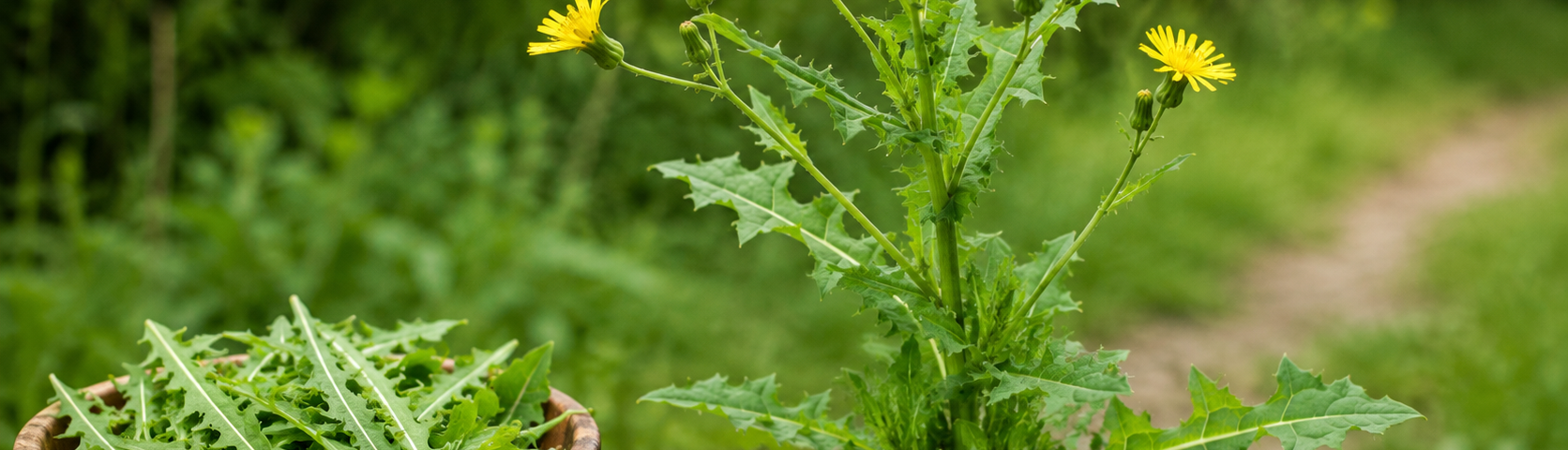
Sow thistle is one of those wild edible plants that hides in plain sight.
You may see it in a garden bed, along a trail edge, beside a driveway, or growing in disturbed soil near the places people walk every day. At first glance, it may look like a dandelion, a wild lettuce, or just another yellow-flowered weed. However, once you learn a few key traits, sow thistle becomes much easier to recognize.
That is what makes it such a useful plant for beginner foragers.
This sow thistle identification guide covers the most important things to know before you harvest it. We will look at key identification traits, common species, edible parts, flavor, harvesting tips, preparation methods, lookalikes, safety notes, modern uses, traditional uses, and simple ways to bring sow thistle into the kitchen.
Sow thistle also fits well with other beginner-friendly wild plants. If you are building your foraging knowledge one plant at a time, you may also enjoy our guides to plantain identification and edibility, dandelion identification and uses, and pineapple weed identification.
Quick Sow Thistle Identification
Sow thistle usually has soft green leaves, yellow dandelion-like flowers, and milky white sap when the plant is broken.
Look for this combination of traits:
- Yellow flower heads in clusters or branching stems
- Soft, lobed leaves that may have lightly prickly edges
- Leaves that clasp the stem, especially higher on the plant
- Milky white sap when stems or leaves are broken
- Upright growth after the young rosette stage
- Hollow or soft stems
- White fluffy seed heads after flowering
- Disturbed soil habitat, including gardens, lawns, fields, and trail edges
The full combination matters. Milky sap alone does not prove a plant is sow thistle, and yellow flowers alone are not enough for identification.
What Is Sow Thistle?
Sow thistle is a common name for plants in the Sonchus genus. These plants are in the Asteraceae family, which also includes dandelions, lettuce, chicory, daisies, and sunflowers.
The two annual species many foragers notice are:
- Common sow thistle, also called annual sow thistle or smooth sow thistle
- Prickly sow thistle, also called spiny sow thistle
There is also perennial sow thistle, sometimes called field sow thistle. It can look similar, but it spreads differently and can become more persistent because of its underground root system.
Although sow thistle has “thistle” in the name, it is not the same as true thistles. It is also not the same plant as milk thistle, the well-known supplement plant with purple flower heads and very spiny leaves.
That name confusion matters. Sow thistle has its own identity, flavor, and uses.
Common Types of Sow Thistle
Several sow thistle species may grow in North America. For beginner foragers, these are the main ones to understand.
Common Sow Thistle
Common sow thistle is often listed as Sonchus oleraceus.
It is usually an annual plant, which means it grows, flowers, sets seed, and dies in one growing season. It often appears in gardens, fields, waste areas, roadsides, disturbed soil, and other open habitats.
Common sow thistle typically has:
- Softer leaves than prickly sow thistle
- Lobed leaves with weakly prickly edges
- Upper leaves that clasp the stem
- Yellow flower heads
- Milky sap
- Wind-carried seeds with fluffy white hairs
This is often the sow thistle beginner foragers prefer because the younger leaves tend to be tender and easier to use.
Prickly Sow Thistle
Prickly sow thistle is often listed as Sonchus asper.
It has many of the same general traits as common sow thistle, but the leaves are usually glossier, firmer, and more prickly along the edges. The base of the leaf often clasps the stem with rounded lobes, sometimes described as ear-like or ram’s-horn-shaped.
Prickly sow thistle is still edible when properly identified, but the texture can be less pleasant. Because of that, many foragers prefer to harvest it young, cook it, or blanch it before using it in a meal.
Perennial Sow Thistle
Perennial sow thistle is often listed as Sonchus arvensis.
It is different because it spreads by both seed and underground roots or rhizomes. That makes it more persistent in fields, gardens, and disturbed soil. It can also produce larger flower heads than common sow thistle.
For most beginner foragers, the key point is simple: perennial sow thistle may be edible like related sow thistles, but it can be more aggressive in the landscape. Harvest carefully, avoid spreading root pieces, and do not move plant material to new areas.
Where Sow Thistle Grows
Sow thistle is a plant of disturbance.
That means it often grows where soil has been turned, compacted, cleared, exposed, enriched, or disrupted. If people, animals, vehicles, gardens, tools, or weather have disturbed the ground, sow thistle may show up.
You may find it in:
- Garden beds
- Lawns
- Field edges
- Trail margins
- Vacant lots
- Farms
- Compost-rich soil
- Road edges
- Parks
- Campgrounds
- Sidewalk cracks
- Recently cleared ground
It likes open areas with enough light. However, it can also grow in partial shade, especially in gardens or moist disturbed soil.
Because sow thistle often grows near people, location matters. Avoid plants growing near roadsides, sprayed lawns, pet areas, industrial sites, or any place that may be contaminated.
When to Find Sow Thistle
Sow thistle can appear through much of the growing season, depending on your region.
In many areas, young plants show up in spring. They may also germinate in fall, overwinter as small rosettes, and grow quickly when warmer weather returns. In mild climates, you may find young sow thistle during several parts of the year.
The best eating stage is usually before flowering.
Young leaves are tender, mild, and easier to prepare. As the plant matures, the leaves often become tougher, more bitter, and less enjoyable raw.
That does not mean older plants are useless. They can still be cooked, chopped, blanched, or used in small amounts. However, for the best eating experience, harvest young plants before they become tall and heavily flowered.
Sow Thistle Identification by Growth Stage
Sow thistle changes as it grows. Learning the stages makes identification much easier.
Seedling Stage
Young sow thistle plants often begin as small rosettes near the ground.
At this stage, look for:
- Soft green leaves
- A low growth habit
- Lobed or toothed leaf edges
- Leaves that may be wider near the tip
- A central growing point
This is often the best stage for food use. However, young plants can also be the hardest to identify with confidence. Take your time and watch the plant through the season if you are unsure.
Rosette Stage
As the plant develops, it forms a more obvious rosette.
Look for leaves that are:
- Soft or slightly prickly
- Lobed or irregularly toothed
- Green to slightly bluish green
- Growing from a central point
- Often smooth or mostly hairless
At this stage, sow thistle can look somewhat like dandelion, wild lettuce, or prickly lettuce. The later stem and flower structure will help confirm the identification.
Upright Stem Stage
Once sow thistle bolts, it sends up an upright stem.
This is when the plant becomes easier to identify.
Look for:
- Alternate leaves along the stem
- Upper leaves that clasp the stem
- Milky sap when broken
- A soft or hollow-feeling stem
- Branching near the top
- Developing yellow flower buds
The clasping leaves are an important field mark. In many sow thistles, the leaf base wraps partly around the stem.
Flowering Stage
Sow thistle produces yellow flower heads that look somewhat like small dandelion flowers.
However, the arrangement is different.
Dandelions usually produce one flower per hollow stalk. Sow thistle often produces several flower heads on branching stems.
Look for:
- Multiple yellow flower heads
- Flower buds in clusters
- Branching upper stems
- Green bracts around each flower head
- Later seed heads with white fluff
After flowering, sow thistle produces wind-carried seeds. If you are harvesting in an area where you do not want the plant to spread, avoid shaking mature seed heads around.
Key Sow Thistle ID Traits
Here are the most useful identification traits in the field.
Yellow Dandelion-Like Flowers
Sow thistle flowers are yellow and made of many small ray flowers. From a distance, they can look like small dandelion flowers.
However, sow thistle usually has multiple flowers on branching stems, while dandelion usually has one flower per stalk.
Milky White Sap
When you break a sow thistle leaf or stem, you will usually see milky white sap.
This is a helpful clue, but it is not enough by itself. Many plants have milky sap, including dandelions, lettuces, spurges, and others. Some plants with milky sap are not edible.
Use this trait only as part of the full identification.
Leaves That Clasp the Stem
One of the best sow thistle traits is the way upper leaves clasp the stem.
The leaf base may wrap around the stem with small lobes or ear-like projections. In prickly sow thistle, those clasping lobes can be rounded and more obvious.
Soft to Prickly Leaf Edges
Sow thistle leaves may be soft, lightly prickly, or more sharply prickly depending on the species and age of the plant.
Common sow thistle often feels softer. Prickly sow thistle feels firmer and more spiny around the leaf edges.
Even when the margins are prickly, sow thistle usually does not feel like a true thistle. True thistles are generally much more armored.
Hollow or Soft Stems
Sow thistle stems are often hollow or soft, especially as the plant grows upright.
The stems may break easily and release white sap.
Fluffy Seed Heads
After flowering, sow thistle forms fluffy seed heads that help seeds travel on the wind.
This is another reason to harvest before seed maturity if you want to avoid spreading the plant.
Sow Thistle Lookalikes
Sow thistle has several lookalikes. Some are edible, some are unpleasant, and some should simply be avoided unless you are completely confident.
Dandelion
Dandelion is one of the most common lookalikes.
Both plants have yellow flowers, milky sap, and edible leaves. However, dandelion usually grows as a basal rosette with one flower per hollow stalk. Sow thistle grows upright and commonly produces several flowers on branching stems.
Dandelion leaves also do not clasp an upright stem in the same way.
If you want to compare the two, read our full dandelion identification guide.
Prickly Lettuce
Prickly lettuce can look very similar to sow thistle, especially before flowering.
One of the best clues is the underside of the leaf midrib. Prickly lettuce often has a noticeable row of stiff prickles along the underside of the midrib. Sow thistle may have prickly leaf margins, but it does not usually have that same strong row of midrib prickles.
Prickly lettuce also tends to become taller, tougher, and more bitter.
Wild Lettuce
Wild lettuces in the Lactuca genus can overlap with sow thistle in habitat, leaf shape, milky sap, and yellow flowers.
Because of that, avoid relying on one trait. Look at the leaf base, flower arrangement, underside of the midrib, overall growth habit, and plant texture.
True Thistles
True thistles usually have purple or pinkish flower heads and much stronger spines. Their leaves and stems are often more heavily armed than sow thistle.
Sow thistle may have prickly edges, but it is not as aggressively spiny as many true thistles.
Spurge and Other Milky-Sap Plants
Some unsafe plants also have milky sap.
For that reason, never identify sow thistle by sap alone. The plant should match the full set of sow thistle traits, including leaf shape, clasping leaves, yellow composite flowers, branching habit, and habitat.
Is Sow Thistle Edible?
Yes, properly identified sow thistle is edible.
Young leaves are the most commonly used part. They can be eaten raw when tender, although many people prefer them cooked. Older leaves are usually better cooked because they become more bitter and fibrous.
The tender upper stems and growing tips may also be used when young. Some foragers peel young stems or cook the tender tops.
The flower buds are sometimes cooked, but they are not usually the main reason people harvest sow thistle.
For beginner foragers, the young leaves are the best place to start.
What Does Sow Thistle Taste Like?
Young sow thistle can taste mild, green, and slightly lettuce-like.
As it matures, the flavor often becomes more bitter. That bitterness is not necessarily a problem. Many good wild greens have a bitter edge, including dandelion, chicory, and some wild lettuces.
The trick is to balance it.
Sow thistle tastes better with:
- Olive oil
- Butter
- Bacon fat
- Garlic
- Lemon
- Vinegar
- Salt
- Eggs
- Potatoes
- Beans
- Rice
- Pasta
- Smoked fish
- Sausage
Fat, acid, salt, and starch all help turn bitter greens into food that feels complete.
How to Reduce Bitterness
Some people taste young sow thistle and immediately like it. Others find it bitter, especially when the plant is older.
That is normal.
To reduce bitterness, try these methods:
- Harvest young leaves before flowering.
- Remove tougher stems and older leaves.
- Soak greens briefly in cool water.
- Blanch leaves in boiling water for 30 to 90 seconds.
- Drain and rinse before cooking.
- Sauté with fat, garlic, and salt.
- Add lemon juice or vinegar at the end.
- Mix sow thistle with milder greens.
- Serve it with potatoes, rice, beans, eggs, or meat.
Blanching is especially helpful for older or pricklier leaves. It softens texture and lowers the bitter edge.
How to Harvest Sow Thistle
Harvesting sow thistle is simple, but clean location and correct timing matter.
Choose plants from clean areas away from roadsides, sprayed lawns, pet waste, industrial runoff, and polluted soil.
Then harvest only what you need.
Best Parts to Harvest
The best parts are:
- Young leaves
- Tender rosette leaves
- Young upper leaves
- Tender growing tips
- Young peeled stems, if desired
Avoid older, tough, heavily prickly, or seed-heavy plants unless you are using them for learning identification only.
Harvesting Method
Use scissors, a knife, or clean fingers.
You can:
- Snip individual young leaves
- Cut the tender top from a young plant
- Gather a few rosette leaves
- Remove young plants from a garden bed if they are being weeded anyway
If the plant has mature seed heads, handle it carefully. Do not shake seeds into places where you do not want sow thistle to grow.
Ethical Harvesting
Sow thistle is common and often weedy, but responsible harvesting still matters.
Harvest from abundant patches, leave some plants for insects and wildlife, and avoid spreading seeds or roots into new areas. Also, follow local rules, especially in parks, preserves, public lands, and private property.
How to Clean Sow Thistle
Wash sow thistle well before eating.
Because it often grows close to the ground or in disturbed areas, the leaves may hold soil, grit, insects, or debris.
A simple method works well:
- Sort the greens and remove damaged leaves.
- Rinse in a bowl of cool water.
- Lift the greens out instead of pouring the dirty water over them.
- Repeat until the water stays clean.
- Pat dry or spin dry.
- Chop before cooking if the leaves are large.
For prickly sow thistle, you may want to trim tougher leaf edges or cook the leaves instead of using them raw.
How to Use Sow Thistle in the Kitchen
Sow thistle is a flexible wild green.
Use young leaves raw in small amounts, or cook them like spinach, dandelion greens, chicory, or other bitter greens.
Simple Kitchen Ideas
Try sow thistle in:
- Egg scrambles
- Omelets
- Potato skillets
- Soups
- Stir-fries
- Rice bowls
- Lentil dishes
- Bean stews
- Pasta
- Wild green pesto
- Savory pancakes
- Breakfast hash
- Trail meals
The easiest method is to sauté chopped sow thistle with garlic, oil, salt, and a splash of lemon or vinegar.
Raw Uses
Young, tender leaves can be added to salad. However, use them as an accent green rather than the entire salad base.
Mix them with milder greens, such as lettuce, chickweed, young plantain leaves, or spinach.
Cooked Uses
Cooking is often the best way to use sow thistle.
Sautéing, steaming, blanching, or adding it to soup can improve both texture and flavor.
Older leaves are best cooked. Prickly sow thistle is also better cooked because the leaf edges can be sharper and tougher.
Modern Uses for Sow Thistle
Modern foragers value sow thistle because it is common, useful, and often easy to find.
It is not a rare trophy plant. Instead, it is a dependable everyday green.
That is exactly what makes it worth learning.
Today, people use sow thistle as:
- A wild salad green when young
- A cooked green
- A bitter green for sautés
- A soup green
- A garden weed turned into food
- A trail-side identification lesson
- A wild ingredient for eggs, potatoes, rice, and pasta
It also pairs well with other common edible wild plants. In the “four edible plants in four feet” idea, sow thistle works as the cooked green, while pineapple weed brings tea flavor, plantain adds mild greens, and oxeye daisy adds a small herbal accent.
Historical and Traditional Uses
Sow thistle has a long history as a practical food plant.
Its value comes from its availability. It grows quickly, appears in disturbed areas, and can provide tender greens when harvested young.
In New Zealand, edible greens known as pūhā or rauriki are traditional Māori foods. Common sow thistle is also known as pūhā in New Zealand and is eaten as a vegetable, although sources note that the original native pūhā used before colonization was a different Sonchus species, Sonchus kirkii. Over time, common sow thistle became a more available related green used in similar ways.
Pūhā is traditionally cooked, often with pork, and the bitter flavor may be reduced by rubbing the plants under running water before cooking.
Sow thistle has also been used as animal forage. The name itself points in that direction, since the plant was associated with pigs and other animals eating it.
As with many wild plants, older sources mention traditional medicinal uses. However, this guide focuses on identification, food use, and safe harvesting rather than medical claims.
Safety Considerations
Sow thistle is edible when correctly identified, but there are still safety points to keep in mind.
Confirm the Identification
Do not eat sow thistle unless you can identify it with confidence.
Use several traits together:
- Yellow composite flowers
- Milky sap
- Lobed leaves
- Clasping upper leaves
- Branching flower stems
- Disturbed-soil habitat
- Lack of a strong row of prickles under the leaf midrib
Do not rely on one trait alone.
Avoid Contaminated Areas
Sow thistle often grows where people disturb the soil. Unfortunately, those areas may also be contaminated.
Avoid plants from:
- Roadsides
- Parking lots
- Sprayed lawns
- Pet areas
- Industrial sites
- Old dump areas
- Farm fields with unknown chemical use
- Drainage ditches
- Polluted urban soil
Clean habitat matters just as much as correct identification.
Start Small
Try a small amount the first time you eat sow thistle.
This is good practice with any new wild food. People react differently to plants, especially plants in the Asteraceae family.
Use extra caution if you are sensitive to dandelion, chicory, lettuce, daisies, ragweed, chamomile, or related plants.
Do Not Use as Medical Treatment
Sow thistle has traditional uses, but this article is not medical advice. Do not use it to treat a health condition without guidance from a qualified professional.
Simple Sow Thistle Recipes
Sow thistle works best in simple food.
You do not need a complicated recipe. A handful of young leaves can turn a basic meal into a wild food meal.
Recipe 1: Garlic Sautéed Sow Thistle Greens
This is the easiest way to try sow thistle.
Ingredients
- 2 cups young sow thistle leaves
- 1 tablespoon olive oil or butter
- 1 garlic clove, minced
- Salt and pepper
- Lemon juice or vinegar
- Optional: chili flakes, bacon, or parmesan
Instructions
- Wash the sow thistle leaves well.
- Chop large leaves into smaller pieces.
- Heat oil or butter in a skillet.
- Add garlic and cook briefly.
- Add the sow thistle greens.
- Sauté until wilted and tender.
- Season with salt and pepper.
- Finish with lemon juice or vinegar.
Serve with eggs, potatoes, rice, beans, fish, or grilled meat.
Recipe 2: Sow Thistle Potato and Egg Hash
This is a filling at-home meal that blends wild greens with starch and protein.
Ingredients
- 2 medium potatoes, diced
- 3 eggs
- 1 tablespoon butter or olive oil
- 1 small onion, diced
- 1 garlic clove, minced
- 1 to 2 cups young sow thistle leaves, chopped
- Salt and pepper
- Optional: sausage, bacon, smoked salmon, beans, cheese, or mushrooms
Instructions
- Boil or pan-fry the potatoes until tender.
- Heat butter or oil in a skillet.
- Add onion and cook until soft.
- Add garlic and cook briefly.
- Stir in the potatoes.
- Add chopped sow thistle and cook until wilted.
- Beat the eggs and pour them into the skillet.
- Cook gently until the eggs are set.
- Season with salt and pepper.
This recipe works for breakfast, lunch, or dinner. It also pairs well with dandelion greens, plantain, or other mild wild greens.
Recipe 3: Trail Couscous with Sow Thistle Greens
This is an easy camp meal for a day hike, fishing stop, or overnight trip.
Ingredients
- 1 packet plain couscous
- 1 small handful young sow thistle leaves, chopped fine
- 1 tuna, salmon, chicken, or chickpea packet
- 1 tablespoon olive oil
- Salt and pepper
- Lemon packet or vinegar packet
- Optional: garlic powder, dried mushrooms, parmesan, or chili flakes
Instructions
- Boil water.
- Add hot water to the couscous and cover.
- Let it sit until soft.
- Stir in olive oil and protein.
- Add chopped sow thistle while the couscous is still hot.
- Season with salt, pepper, and lemon or vinegar.
The heat from the couscous softens the greens without overcooking them.
How to Preserve Sow Thistle
Sow thistle is usually best fresh, but you can preserve it in small amounts.
Refrigerating
Wrap clean leaves in a slightly damp towel and place them in a bag or container in the refrigerator.
Use them within a few days.
Blanching and Freezing
Blanch the greens briefly, drain them well, and freeze in small portions.
This works best if you plan to add them later to soups, stews, egg dishes, or cooked meals.
Drying
Sow thistle can be dried, but it is not usually the best preservation method for food use. The leaves are more useful fresh, cooked, or frozen.
Sow Thistle FAQ
Is sow thistle the same as dandelion?
No. Sow thistle and dandelion are related through the daisy family, and both have yellow flowers and milky sap. However, dandelion usually has one flower per stalk, while sow thistle commonly has multiple yellow flowers on branching stems.
Is sow thistle the same as milk thistle?
No. Sow thistle is not the same as milk thistle. Milk thistle is a different plant with purple flower heads and very spiny leaves. Sow thistle has yellow flowers and softer leaves.
Can you eat sow thistle raw?
Yes, young tender sow thistle leaves can be eaten raw when correctly identified and harvested from a clean area. However, many people prefer sow thistle cooked because cooking improves texture and mellows bitterness.
Why is sow thistle bitter?
Sow thistle becomes more bitter as it matures, especially after it bolts or flowers. Harvesting young leaves, blanching, and cooking with fat, salt, and acid can help balance the flavor.
What part of sow thistle is best to eat?
Young leaves are the best part for most foragers. Tender growing tips and young peeled stems may also be used, but the leaves are the easiest place to start.
Does sow thistle have poisonous lookalikes?
Sow thistle has several lookalikes, including dandelion, prickly lettuce, wild lettuce, and true thistles. Some are edible, but you should never assume a plant is safe based on general appearance. Identify sow thistle using multiple field marks before eating it.
Where should I avoid harvesting sow thistle?
Avoid roadsides, sprayed lawns, pet areas, industrial sites, polluted soil, farm fields with unknown chemical use, and drainage areas. Sow thistle often grows in disturbed places, so clean location is especially important.
Final Thoughts
Sow thistle is not a dramatic wild food. It does not look rare, mysterious, or especially impressive.
That is part of its value.
This is a common edible wild plant that can help beginner foragers build real identification skills. It teaches you to notice leaf shape, flower structure, sap, habitat, growth stage, and lookalikes. It also reminds us that useful wild food is often growing in ordinary places.
Start with young plants. Harvest from clean ground. Cook it simply. Then, pay attention to how the flavor changes through the season.
Sow thistle may be easy to overlook, but once you learn it, you will start seeing it everywhere.
Get Outside. Do Something Wild.
Additional Resources
- UMass Extension: Common Sowthistle Identification
- Cornell Weed Science: Annual Sowthistles
- Go Botany: Spiny-Leaved Sow-Thistle
- WSU Hortsense: Annual and Perennial Sowthistle
- Massey University: Sow-Thistle and Pūhā
Foraging Disclaimer
This article is for educational purposes only. Always identify wild plants with certainty before eating them. Use multiple trusted sources, regional field guides, and expert guidance when needed. Avoid contaminated areas, follow local laws, harvest responsibly, and try new wild foods in small amounts. Use extra caution if you have allergies, medical conditions, are pregnant, or take medications.


