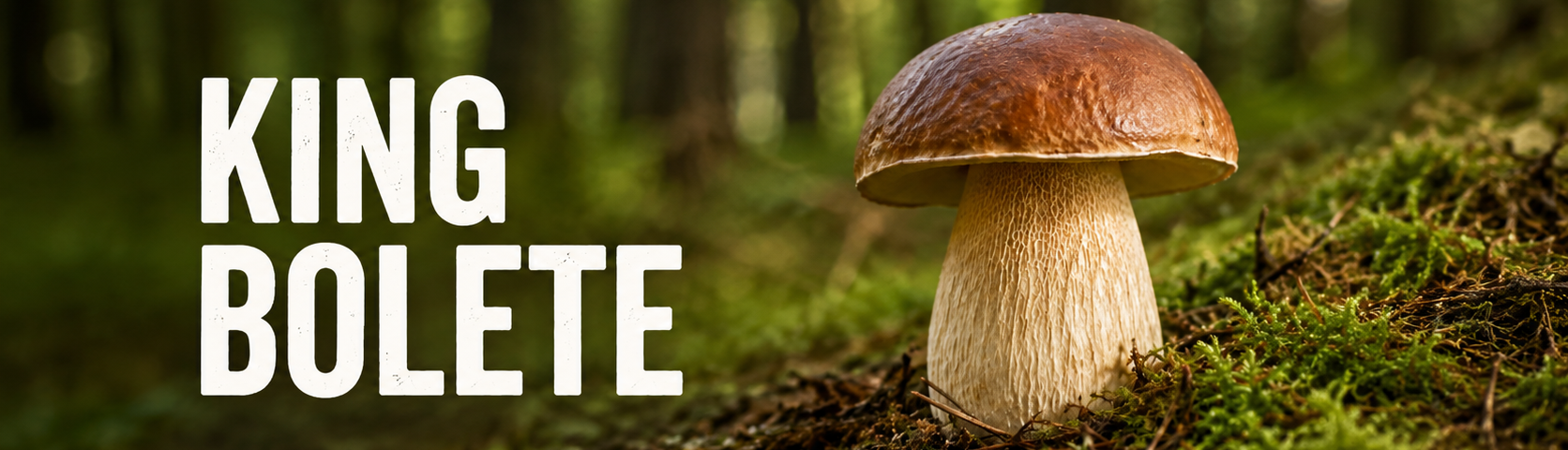
This king bolete identification guide explains how to recognize Boletus edulis and closely related North American porcini. It also covers habitat, lookalikes, harvesting, cooking, preservation, and safety. Because several mushrooms share the classic porcini shape, confirm the full combination of pores, stem netting, flesh color, staining, habitat, and maturity before eating one.
Quick Answers
Is king bolete edible?
Yes. King bolete is a highly prized edible mushroom. However, cook it thoroughly before eating it.
What is its scientific name?
The traditional scientific name is Boletus edulis. In North America, however, “king bolete” and “porcini” may also refer to several closely related species.
What does a king bolete look like?
Look for a rounded brown cap, a thick pale stem, fine white netting near the stem’s top, and a sponge-like pore surface instead of gills.
What color are the pores?
Young pores are white or cream. As the mushroom matures, they turn pale yellow, yellow-olive, and eventually olive-brown.
Do king boletes stain blue?
Typical king boletes do not stain strongly blue when cut or bruised. Therefore, rapid blue staining should trigger a more careful identification.
What is the most important lookalike?
The bitter bolete, Tylopilus felleus, closely resembles a king bolete. Mature bitter boletes often develop pinkish pores and coarse, dark stem netting.
Where do king boletes grow?
They grow on the ground near compatible living trees. Common partners include spruce, pine, fir, Douglas-fir, hemlock, and some oaks.
When do king boletes fruit?
Depending on the species, location, host tree, elevation, and weather, North American king boletes may appear from spring through fall. Mild coastal climates may also produce winter fruitings.
Can old king boletes be eaten?
Firm mature specimens may still be usable. However, leave mushrooms that are soft, waterlogged, moldy, sour-smelling, heavily infested, or decomposing.
Quick King Bolete Identification
Use this field checklist before harvesting:
- The underside has pores rather than gills.
- Young pores are white or cream.
- Mature pores turn yellow and then olive.
- No red or orange pores are present.
- The cap is usually tan, cinnamon, chestnut, reddish brown, or dark brown.
- Young caps often look rounded, domed, or bun-shaped.
- The stem is thick, solid, and usually swollen or club-shaped.
- Fine pale netting appears near the stem’s upper portion.
- Interior flesh is white and dense.
- Cut flesh does not rapidly turn deep blue.
- The mushroom has no ring or cup around the stem.
- It grows from soil near a compatible living tree.
- The odor is mild, earthy, nutty, or pleasant.
- The spore print is olive-brown.
No single feature proves that a mushroom is a king bolete. Instead, confirm the entire pattern.
Quick King Bolete Safety Check
Before eating any bolete, confirm that:
- It has pores rather than gills.
- No red or orange pores appear beneath the cap.
- The stem has no vivid red or purple coloration.
- Cut flesh does not rapidly stain deep blue.
- Mature pores do not turn distinctly pink.
- Pale reticulation appears near the stem’s top.
- The flesh is white, dense, and fresh.
- The mushroom grew near a compatible living tree.
- A reliable regional source supports the identification.
- You have ruled out local toxic and bitter boletes.
- You will cook it thoroughly.
- Your first serving will be small.
For more field resources, visit The Hunter Gatherer Society’s Wild Mushroom Identification Guides.
What Is a King Bolete?
King bolete is one of several common names for Boletus edulis. Other names include:
- Porcini
- Cep
- Penny bun
- Steinpilz
- Edible bolete
The mushroom belongs to the family Boletaceae. Unlike gilled mushrooms, boletes produce spores inside small vertical tubes beneath the cap. Therefore, the underside looks porous or sponge-like rather than bladed.
The MycoBank record for Boletus edulis recognizes the name and traces it to its original 1782 description. However, North American porcini do not all belong to one uniform species. Older field guides often use B. edulis broadly, while modern regional treatments separate several closely related mushrooms.
For practical field use, many foragers identify these mushrooms as members of the king bolete group unless regional characteristics clearly support a particular species.
King Bolete Taxonomy and Naming
Scientific Classification
- Kingdom: Fungi
- Phylum: Basidiomycota
- Class: Agaricomycetes
- Order: Boletales
- Family: Boletaceae
- Genus: Boletus
- Species: Boletus edulis
Modern research has separated several North American porcini that older books grouped under Boletus edulis. Consequently, cap color, host tree, fruiting season, and regional distribution may vary across the group.
Nevertheless, the classic king bolete combination remains useful:
- A robust form
- White young pores
- Yellow-to-olive mature pores
- Pale stem reticulation
- White flesh
- Little or no blue staining
The MushroomExpert guide to boletes describes the Boletus edulis group as medium to large, reticulate boletes with stuffed young pores, olive or yellow-brown spores, and little or no blue staining.
Common King Bolete Identification Guide
King Bolete Cap
A young king bolete usually has a rounded, dome-shaped, or bun-like cap. As it expands, the cap becomes broadly convex. Older specimens may eventually flatten.
Cap colors include:
- Pale tan
- Buff
- Cinnamon brown
- Chestnut brown
- Reddish brown
- Dark brown
Some young mushrooms show a narrow pale margin around the cap. In addition, the surface may feel smooth, slightly velvety, greasy, or tacky.
Moisture strongly affects texture. For example, a dry-weather cap may feel smooth, while the same species may feel tacky after rain.
Cap size varies considerably. Small buttons may measure only a few inches across, whereas mature specimens can become exceptionally large.
Although cap color helps narrow the possibilities, it never confirms the identification by itself.
King Bolete Pore Surface
King boletes have pores instead of gills.
In young specimens, the pore surface is usually:
- White
- Cream
- Firm
- Densely packed
- Almost sealed or “stuffed” in appearance
As the mushroom matures, the pores become:
- Pale yellow
- Yellow-green
- Olive
- Olive-brown
This color progression provides one of the best field clues. The MushroomExpert description of North American Boletus cf. edulis likewise describes pores that begin whitish and stuffed, then become pale yellow and finally olive-yellow without bruising.
Typical king bolete pores do not strongly bruise blue. Therefore, immediate or dramatic blue staining suggests a different bolete and requires further study.
Older pore layers often become thick and spongy. Although they may still support an identification, they usually have lower culinary quality.
Tubes
The tubes form the sponge-like tissue beneath the cap. When viewed from the side, they resemble tightly packed vertical straws.
Young tubes remain pale. Later, they turn yellow and olive along with the pore surface.
Because the tube layer separates fairly easily from the cap flesh, cooks often remove it from mature specimens. Firm young pores, however, can remain attached.
King Bolete Stem
The stem, also called the stipe, is usually:
- Thick
- Solid
- Dense
- White to pale tan
- Bulbous when young
- Club-shaped or swollen
- More cylindrical with age
A young king bolete often looks top-heavy because of its broad cap and thick stem.
The stem should not have:
- A ring
- A skirt
- A cup-like volva
- A hollow center
Stem Reticulation
Reticulation is a raised, net-like pattern on the stem.
In king boletes, the reticulation is usually:
- White
- Cream
- Pale tan
- Fine-meshed
- Most visible near the stem’s top
The pattern may extend farther down the stem. However, dirt, age, handling, and moisture can make it difficult to see.
Pale reticulation supports a king bolete identification. By contrast, a coarse dark-brown net covering much of the stem may point toward a bitter bolete.
King Bolete Flesh
Fresh flesh is usually:
- White
- Thick
- Solid
- Dense
- Firm
After slicing, the interior generally remains white. It may darken slightly with age or exposure, but it should not rapidly become deep blue.
In addition, the flesh should not contain vivid red bands or unusually bright yellow zones.
Odor
Fresh king boletes usually smell:
- Mild
- Earthy
- Nutty
- Mushroom-like
- Pleasant
Young mushrooms may have only a faint odor.
Reject specimens that smell:
- Sour
- Fermented
- Fishy
- Ammonia-like
- Putrid
- Moldy
Even when the cap still looks acceptable, a bad odor often indicates decay.
Spore Print
The spore print is normally olive-brown.
A spore print can support an identification. However, it rarely distinguishes every member of the king bolete group. Therefore, combine it with pore color, reticulation, staining, habitat, and regional information.
King Bolete Habitat
King boletes grow on the ground near living trees. They do not normally fruit from dead logs or stumps.
These mushrooms form ectomycorrhizal relationships with tree roots. Through that partnership, fungal tissue helps the tree absorb water and nutrients. Meanwhile, the tree supplies the fungus with carbohydrates.
Common host trees include:
- Spruce
- Pine
- Fir
- Hemlock
- Douglas-fir
- Oak
- Beech
- Birch
- Chestnut
Host preference varies by species and region. Therefore, learning local trees can greatly improve both identification and success.
Search in:
- Mature conifer forests
- Mixed forests
- Grassy areas beneath trees
- Mossy openings
- Mountain forests
- Coastal pine forests
- Forest edges
- Parks with mature compatible trees
King boletes may grow alone, scattered, or in groups. Because underground mycelium can extend far beyond the trunk, mushrooms may appear several yards from the host tree.
The U.S. Forest Service overview of commercially harvested forest fungi lists Boletus edulis as an ectomycorrhizal partner of spruces, pines, Douglas-fir, true firs, and some oaks in the Pacific Northwest.
King Bolete Season
Fruiting season varies across North America.
Depending on location and species, king boletes may appear:
- In spring
- During summer monsoons
- In late summer
- During fall rains
- In mild coastal winters
Moisture and soil temperature strongly influence fruiting. Consequently, a productive forest may remain empty until rain, temperature, and seasonal timing align.
Western spring kings often fruit as mountain snow recedes. Meanwhile, many fall porcini appear after soaking rains and cooler temperatures.
The U.S. Forest Service reports that Pacific Northwest Boletus edulis fruits most abundantly in early autumn, although spring and early-summer fruitings also occur in some areas.
North American King Bolete Species
North America contains several porcini in the broader king bolete group. Regional names and classifications may differ, so location and host trees matter.
Boletus edulis in the Broad Sense
In older field guides, Boletus edulis may refer broadly to robust brown-capped porcini with:
- Pale stem reticulation
- White young pores
- Olive mature pores
- White non-staining flesh
However, current North American treatments recognize several distinct regional species.
Eastern North American Porcini
Eastern North America contains several Boletus edulis-like mushrooms. Some grow mainly with spruce, while others associate with oaks and other hardwoods.
For example, eastern Boletus cf. edulis commonly grows with spruce and may have a cinnamon, orange-brown, or darker brown cap. Its young pore surface appears whitish and stuffed before turning pale yellow and olive-yellow.
Other eastern members of the group may fruit under hardwoods during summer. Therefore, tree association and regional references remain essential.
Spring King Bolete
Western spring kings fruit in mountain forests during spring or early summer, depending on elevation and snowmelt.
Typical traits include:
- Brown to reddish-brown caps
- Thick pale stems
- Fine reticulation
- White young pores
- White non-staining flesh
- Spring or early-summer fruiting
Red-Capped Western Kings
Some western mountain porcini develop reddish-brown or dark red-brown caps, especially when fresh.
Despite the stronger color, they retain the classic combination of:
- Pale young pores
- Fine stem netting
- Thick white flesh
- Little or no blue staining
Pale King Boletes
Certain southwestern or western porcini have pale cream, grayish, or tan caps instead of the familiar dark brown.
Barrows’ bolete, for example, is a pale western member of the Boletus edulis group. It commonly grows with ponderosa pine in the Southwest and coast live oak farther west. The mushroom also has a robust reticulate stem and a non-bruising pore surface.
Therefore, do not reject a mushroom solely because its cap looks unusually light. Instead, evaluate the pores, stem, flesh, staining, and host tree.
King Bolete Lookalikes
Bitter Bolete, Tylopilus felleus
The bitter bolete is the most important culinary lookalike.
It can resemble a king bolete because it has:
- A brown cap
- A thick stem
- Stem reticulation
- Pale young pores
- Similar forest habitat
However, several features help separate it.
Pore Color
King bolete pores mature from white to yellow and then olive.
By contrast, bitter bolete pores often develop a pink or flesh-colored cast.
Stem Netting
King bolete reticulation is usually pale and fine near the stem’s top.
Bitter bolete netting often appears darker, coarser, and more brownish. In addition, it may cover more of the stem.
Flavor
Tylopilus felleus is intensely bitter. Even one specimen can ruin an entire dish.
Older identification methods sometimes recommend nibbling and spitting out a tiny raw piece. However, this guide does not recommend raw taste testing. Instead, rely on pore color, netting, habitat, regional references, and expert confirmation.
The MushroomExpert account of Tylopilus felleus describes it as a substantial, reticulate bolete with extremely bitter flesh.
Boletus huronensis
Boletus huronensis is a toxic bolete from northeastern North America. It has caused severe gastrointestinal reactions in some people.
Compared with a king bolete, it may show:
- Yellowish flesh
- Yellow pores
- Blue or greenish bruising
- Yellow stem coloration
- Darker or reddish areas
- Little classic pale reticulation
- Association with hemlock
Because its features can vary, northeastern foragers should learn this species separately. The North American Mycological Association review of Boletus huronensis provides a detailed examination for field identifiers and poison-control professionals.
Red-Pored Boletes
Several North American boletes have red, orange, or burgundy pores. Some cause gastrointestinal illness, while others have uncertain or disputed edibility.
For beginning foragers, follow this conservative rule:
Do not eat red- or orange-pored boletes unless an experienced regional identifier confirms the exact species.
Many red-pored boletes also stain blue rapidly. For example, Boletus rubroflammeus combines red pores, a red cap, and strong blue staining.
Blue-Staining Boletes
Numerous boletes have yellow pores and flesh that turns blue.
This group includes:
- Edible species
- Bitter species
- Poorly documented species
- Toxic species
Typical king boletes lack strong blue staining. Therefore, beginners should keep rapidly staining boletes out of the king bolete basket.
Bay Boletes and Similar Brown-Capped Species
Some non-king boletes have brown caps and pale-to-yellow pores.
They may differ through:
- A more slender stem
- Little or no reticulation
- Yellowish flesh
- Blue bruising
- A less robust shape
Because brown caps occur across many bolete genera, cap color alone has little diagnostic value.
Other Bitter Boletes
Several boletes taste sharply bitter even when they do not match Tylopilus felleus perfectly.
For example, some species have yellow flesh, strong reticulation, or other king-like features but remain unsuitable for the table. Therefore, complete regional identification matters.
King Bolete and Bitter Bolete Comparison
| Feature | King Bolete | Bitter Bolete |
|---|---|---|
| Young pores | White or cream | White or cream |
| Mature pores | Yellow to olive | Pinkish or flesh-colored |
| Stem netting | Pale and usually fine | Often dark and coarse |
| Flesh | White | White |
| Strong blue staining | Usually absent | Usually absent |
| Flavor | Mild and nutty | Intensely bitter |
| Spore print | Olive-brown | Pinkish-brown |
| Culinary value | Choice edible | Unpalatable |
Use this table as a comparison tool, not as a stand-alone identification method.
King Bolete Edibility
King boletes rank among the world’s most valued wild mushrooms. Their firm flesh, rich aroma, and savory flavor work well in many dishes.
However, edible status does not guarantee that every person will tolerate them. Therefore, cook wild mushrooms thoroughly and try only a small amount of any species that is new to you.
Never eat king boletes raw.
For another beginner-friendly edible mushroom guide, compare this species with the Oyster Mushroom Identification Guide.
King Bolete Flavor and Texture
Fresh king boletes have a rich, savory flavor. Common descriptions include:
- Nutty
- Earthy
- Meaty
- Woodsy
- Deeply mushroom-like
- Slightly sweet
Young specimens have dense, firm flesh. As the mushroom matures, however, the cap softens and the pore layer becomes spongier.
Drying intensifies the aroma. Therefore, dried porcini often taste stronger than fresh mushrooms and work especially well in risotto, soup, gravy, and sauces.
Harvesting King Boletes
Best Stage to Harvest
The best specimens are usually:
- Firm
- Dense
- Young to moderately mature
- Free from sour odors
- Minimally damaged by insects
- White or pale beneath the cap
- Solid when sliced
Young buttons often offer the best texture. Nevertheless, larger mushrooms can still be excellent when the flesh remains firm and clean.
How to Harvest
Either cut the stem near ground level or gently twist the mushroom free.
Afterward:
- Cover the disturbed soil.
- Trim away the dirty stem base.
- Inspect the pore surface.
- Slice the stem lengthwise.
- Check the flesh for larvae.
- Keep clean specimens separate from damaged ones.
Harvesting a mushroom does not remove the entire fungus. The underground mycelium remains associated with the host tree.
Check for Insects
King boletes frequently attract fungus gnats and other insects. Their larvae tunnel through both the stem and cap.
Minor insect damage does not automatically make a mushroom unsafe. However, heavily tunneled or decomposing specimens offer poor culinary quality.
Slice each mushroom soon after harvesting. Otherwise, larvae may continue moving through the flesh.
Leave Overmature Specimens
Old mushrooms still release spores and feed forest organisms.
Leave specimens that are:
- Waterlogged
- Collapsing
- Moldy
- Badly tunneled
- Sour-smelling
- Extremely soft
- Decomposing
Doing so supports the forest and keeps low-quality food out of your basket.
Responsible King Bolete Foraging
Follow these practices:
- Learn local harvest regulations.
- Obtain permission on private land.
- Follow permit rules on public land.
- Avoid trampling tree roots and forest vegetation.
- Refill disturbed holes.
- Leave old or damaged specimens in place.
- Keep unidentified boletes separate.
- Use a breathable basket or rigid container.
- Photograph the cap, pores, stem, base, and habitat.
- Record host trees and fruiting season.
- Harvest only what you can process promptly.
Wild mushroom harvesting has a long recreational and commercial history in the Pacific Northwest. The U.S. Forest Service overview of wild edible mushrooms identifies king bolete as one of the region’s commercially significant edible mushrooms.
For additional species comparisons, explore the Puffball Mushroom Identification Guide and the complete Wild Mushroom Identification Guides.
Cleaning King Boletes
King boletes absorb water easily. Therefore, avoid soaking them.
Instead:
- Brush off soil and forest debris.
- Trim the dirty stem base.
- Wipe the cap with a damp cloth.
- Scrape away stubborn dirt.
- Slice the mushroom open.
- Remove damaged areas.
- Inspect the pore layer.
A brief rinse is acceptable when necessary. However, dry the mushrooms promptly afterward.
Should You Remove the Pores?
Keep the pore layer when it is:
- Young
- Firm
- White
- Cream
- Pale yellow
Remove it when it is:
- Thick
- Olive-green
- Slimy
- Soft
- Waterlogged
- Heavily infested
Mature pores may still add flavor to stock or sauce when they remain fresh. Nevertheless, they often create a soft texture.
Cooking King Boletes
Cook wild mushrooms thoroughly before eating them.
Basic Sautéed King Bolete
- Clean and slice the mushrooms.
- Place them in a dry pan over medium heat.
- Allow excess moisture to cook away.
- Add butter or oil.
- Continue cooking until browned and tender.
- Season with salt, pepper, garlic, or herbs.
Avoid crowding the pan. Otherwise, the mushrooms steam instead of browning.
King Bolete With Eggs
Cook sliced porcini before adding them to:
- Scrambled eggs
- Omelets
- Frittatas
- Breakfast potatoes
Because their flavor is strong, a modest amount can season the whole dish.
Porcini Risotto
Fresh or dried king boletes pair especially well with rice.
For dried mushrooms:
- Soak them in warm water.
- Strain the liquid through a fine filter.
- Add the filtered liquid to the stock.
- Chop and cook the rehydrated mushrooms.
- Stir them into the risotto.
The soaking liquid contains concentrated flavor. However, filtering removes grit and forest debris.
Soups and Sauces
King boletes work well in:
- Cream sauces
- Brown sauces
- Mushroom gravy
- Broth
- Beef stew
- Wild rice soup
- Pasta sauce
Dried porcini can deepen a dish without becoming its main ingredient.
Grilling
Firm young caps can be grilled.
Brush them lightly with oil, then cook until fully tender and browned. Because large caps may cook unevenly, cut them into thick slices first.
Preserving King Boletes
Refrigeration
Store clean, dry mushrooms in a paper bag or loosely covered container.
Use them promptly. Fresh king boletes deteriorate quickly, especially when larvae are present.
Drying
Drying is one of the best preservation methods.
- Clean the mushrooms without soaking them.
- Slice them evenly.
- Arrange the pieces in a single layer.
- Use a dehydrator or another reliable drying method.
- Continue until the slices are completely crisp.
- Store them in an airtight container.
If a slice bends instead of snapping, it may still contain moisture. Incomplete drying can encourage mold.
Freezing
For better texture, cook king boletes before freezing them.
Sauté or blanch the pieces first. Then, cool, portion, label, and freeze.
Raw freezing often produces a softer texture after thawing.
Porcini Powder
Completely dried mushrooms can be ground into powder.
Use porcini powder in:
- Soup
- Gravy
- Sauce
- Rubs
- Seasoning blends
- Risotto
- Pasta fillings
Store the powder away from heat, light, and moisture.
King Bolete Nutrition
King boletes provide protein, fiber, minerals, and several naturally occurring compounds. However, exact levels vary with growing conditions, maturity, storage, preparation, and whether the mushrooms are fresh or dried.
Drying concentrates nutrients and flavor by removing water. At the same time, dried serving sizes are much smaller.
Treat king boletes as food rather than as medicine or a treatment for disease.
King Bolete Safety
Cook Thoroughly
Thorough cooking improves digestibility and reduces the chance of reactions from raw or undercooked mushrooms.
Accordingly, sauté, roast, simmer, or grill king boletes until fully cooked. Do not simply warm them.
Start With a Small Serving
Even a correctly identified edible mushroom can cause an individual reaction.
For the first meal:
- Eat only a small portion.
- Do not combine several new wild species.
- Keep an uncooked specimen for identification.
- Stop eating if the flavor seems bitter or unusual.
Keep Species Separate
Do not place unidentified boletes loose among confirmed king boletes.
Instead, use separate bags or containers until every mushroom has been examined. One bitter bolete can ruin a meal, while a toxic species creates a more serious hazard.
Never Rely on Folklore
These methods do not prove that a mushroom is edible:
- Watching whether insects eat it
- Cooking it with silver
- Testing it on animals
- Peeling the cap
- Trusting a pleasant odor
- Assuming all boletes are safe
- Assuming cooking destroys every toxin
Correct identification remains essential.
What to Do After a Reaction
Possible mushroom-poisoning symptoms include:
- Nausea
- Vomiting
- Abdominal cramps
- Diarrhea
- Dizziness
- Weakness
The North American Mycological Association guide to mushroom-poisoning syndromes notes that gastrointestinal symptoms often begin within 20 minutes to four hours, although timing varies with the mushroom and toxin.
Seek medical or poison-control guidance if symptoms follow a wild mushroom meal. In addition, save leftovers, uncooked mushrooms, photographs, and location details.
In the United States, the NAMA mushroom-poisoning resource directs callers to Poison Control at 1-800-222-1222.
King Bolete Ecology
The visible mushroom is only the reproductive fruiting body. Most of the fungus exists underground as mycelium connected to tree roots.
Through the ectomycorrhizal partnership, the fungus increases the tree’s access to water and minerals. Meanwhile, the tree provides carbohydrates.
As a result, king boletes cannot be cultivated as easily as oyster mushrooms or button mushrooms. Their life cycle depends on a compatible living host and suitable forest conditions.
Fruiting bodies also feed:
- Insects
- Slugs
- Rodents
- Deer
- Other forest animals
Therefore, old and damaged mushrooms still serve important ecological roles.
King Bolete Identification Guide FAQ
Do King Boletes Have Gills?
No.
They have a sponge-like pore surface made from thousands of small tubes.
Do All King Boletes Have Brown Caps?
Most have tan, brown, or reddish-brown caps.
However, some related species appear cream, grayish, or unusually pale.
Do King Boletes Stain Blue?
Typical king boletes do not stain strongly blue.
Rapid blue staining indicates another bolete or a more complicated identification. Therefore, beginners should exclude strongly staining mushrooms from the food basket.
Can King Boletes Have Worms?
Yes.
Insect larvae commonly tunnel through the cap and stem. Consequently, slice every specimen open before cooking.
Are Olive-Green Pores Poisonous?
Not by themselves.
Olive pores usually reflect maturity. However, old pore layers often become soft, insect-damaged, or unpleasant.
Can You Eat King Bolete Stems?
Yes.
Young stems are dense and flavorful. Nevertheless, trim away the dirty base and remove damaged sections.
Are All Boletes Edible?
No.
The bolete group includes choice edibles, bitter species, poorly documented mushrooms, and species that cause gastrointestinal illness.
Is a Brown Cap Enough for Identification?
No.
Many unrelated boletes have brown caps. Confirm the pores, stem netting, flesh color, staining, habitat, and regional species.
Can King Boletes Grow in Lawns?
Yes, when compatible tree roots extend beneath the grass.
A mushroom growing in a lawn may still connect to a nearby spruce, pine, oak, or another host.
Should King Boletes Be Washed?
Brush and wipe them whenever possible.
A quick rinse is acceptable for stubborn dirt. However, avoid soaking the mushrooms.
Can King Boletes Be Eaten Raw?
No.
Cook them thoroughly before eating.
Final King Bolete Field Checklist
Use this final king bolete identification guide checklist before harvesting:
- The mushroom has pores rather than gills.
- The cap fits a recognized regional king bolete color.
- Young pores are white or cream.
- Mature pores progress toward yellow or olive.
- Mature pores do not become distinctly pink.
- No red or orange pores are present.
- The stem is thick, solid, and pale.
- Fine pale reticulation appears near the stem’s top.
- Interior flesh is white and dense.
- Cut flesh does not rapidly turn blue.
- The pore surface does not strongly bruise blue.
- No ring or volva appears.
- The mushroom grew on soil near a compatible living tree.
- The odor is mild and pleasant.
- The mushroom is firm and fresh.
- Regional references support the identification.
- Bitter and toxic local boletes have been ruled out.
- The mushroom will be thoroughly cooked.
- The first serving will be small.
Record the cap color, pore color, stem pattern, staining, host trees, elevation, season, and weather in a foraging journal. As a result, future finds become easier to compare.
Final King Bolete Safety Rule
A brown cap and sponge-like underside do not automatically make a mushroom a king bolete.
Instead, confirm the full combination:
- Pale young pores
- Yellow-to-olive mature pores
- A thick pale stem
- Fine light reticulation
- White non-staining flesh
- Compatible living trees
- No red pores
- No strong blue bruising
- No pink mature pores
Most importantly, learn the bitter bolete and the toxic boletes of your region before gathering king boletes for food.
When the identification, freshness, habitat, or preparation remains uncertain, leave the mushroom in the forest.


