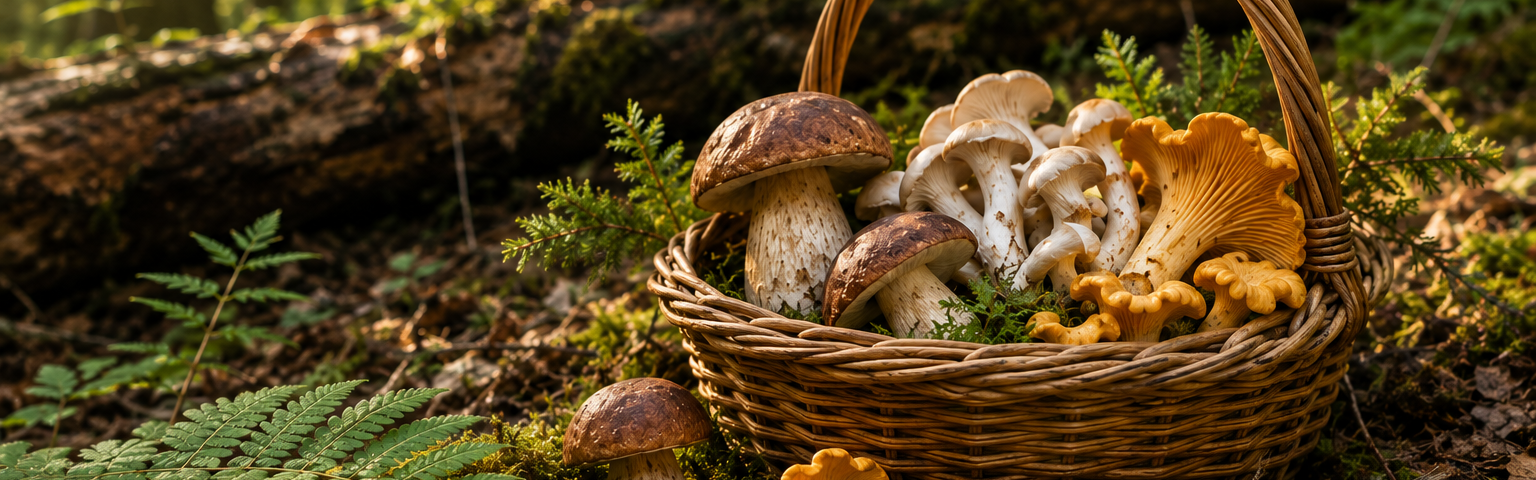
Finding a productive patch of wild mushrooms can turn an ordinary walk into a very good day.
One moment you are wandering through the woods. The next, you are kneeling beside a flush of chanterelles, oyster mushrooms, boletes, or puffballs while mentally planning dinner.
That excitement is part of mushroom foraging. However, a productive patch is more than an outdoor grocery shelf. It belongs to a larger fungal system connected to soil, trees, decaying wood, insects, wildlife, and the surrounding habitat.
Responsible mushroom foraging means enjoying the harvest without damaging the conditions that helped create it.
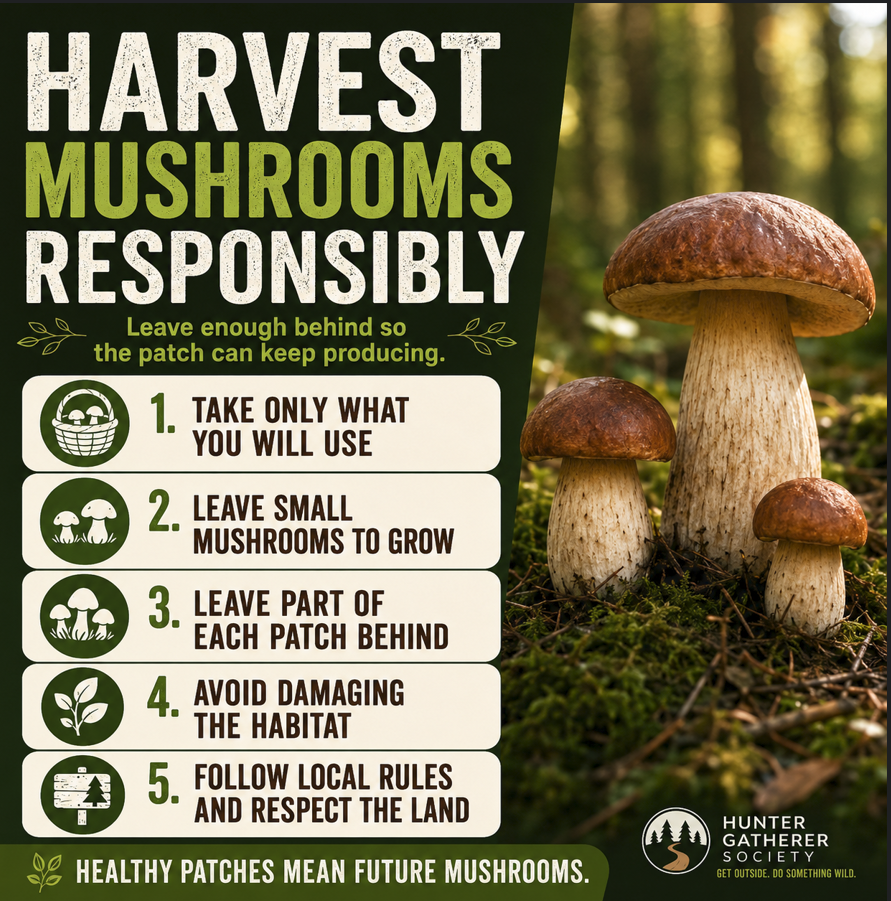
Harvest mushrooms responsibly. Take what you will use, protect the habitat, and leave enough for others to enjoy.
Quick Answers About Responsible Mushroom Foraging
Does picking mushrooms damage the underground mycelium?
Carefully harvesting mushrooms generally does not destroy the larger fungal organism. A long-term Swiss study found that regular cutting or picking did not reduce future mushroom production or fungal species diversity. However, repeated trampling did reduce the number of mushrooms appearing in the study plots.
Is it better to cut or pull wild mushrooms?
Research has not shown a meaningful difference between careful cutting and careful picking. When identification requires the entire stem base, gently remove the whole mushroom. Once you know the species, cutting or carefully twisting it free can both work.
How much of a mushroom patch should you leave?
There is no scientifically established percentage that applies to every species and habitat. Take only what you can use, avoid clearing an entire fruiting, and leave some young, mature, old, or unnecessary mushrooms behind.
Should small mushrooms be left to grow?
Usually, yes. Small mushrooms may become a better harvest after another day or two, and immature specimens may not yet display the features needed for confident identification.
Do mushrooms grow back after they are picked?
The individual mushroom you remove will not grow back. However, the underlying fungus may produce additional fruiting bodies when moisture, temperature, substrate, and other conditions remain favorable.
Can you harvest every mushroom from a large flush?
Removing the fruiting bodies may not kill the fungus, but clearing an entire flush is rarely necessary. Leaving some mushrooms supports wildlife, allows further maturation and spore release, and gives other people an opportunity to enjoy the patch.
Do mesh bags help spread mushroom spores?
A mesh bag may allow some spores to fall while you walk, but its greater advantage is ventilation. It does not replace careful harvesting, habitat protection, or leaving mushrooms behind.
Is mushroom harvesting allowed on public land?
Rules vary by property and managing agency. Some public lands allow limited personal-use gathering, while others require permits or prohibit collection entirely. Check the rules for the exact forest, park, preserve, or management unit before harvesting.
What Is Responsible Mushroom Foraging?
Responsible mushroom foraging is the practice of identifying and gathering wild mushrooms while minimizing damage to the fungus, its habitat, and the surrounding ecosystem.
A responsible mushroom forager:
- Confirms that harvesting is legal.
- Collects only confidently identified edible species.
- Takes only what can be eaten, preserved, or studied.
- Avoids damaging soil, moss, leaf litter, logs, trees, and other vegetation.
- Leaves small, old, rare, damaged, and unnecessary specimens behind.
- Keeps unknown mushrooms separate from edible collections.
- Respects other foragers, landowners, and recreational visitors.
- Packs out everything brought into the woods.
The basic idea is simple: enjoy the harvest without treating the forest as though it owes you a full basket.
Why Responsible Mushroom Harvesting Matters
The mushrooms we see are the fruiting bodies of a much larger organism.
Most of the fungus exists as mycelium, a network of microscopic filaments growing through soil, buried wood, leaf litter, living roots, or decaying trees. The visible mushroom is often compared to an apple growing on a tree. Picking the apple does not remove the tree, just as carefully harvesting a mushroom usually leaves the larger fungal organism in place.
However, that does not mean mushroom foraging has no environmental impact.
Soil moisture, shade, tree health, decaying wood, temperature, and an intact forest floor all help determine whether a fungus can survive and continue producing mushrooms. Repeated trampling, soil compaction, raking, digging, and damage to logs or trees can alter those conditions.
Responsible harvesting protects:
- Underground fungal networks
- Host trees and surrounding plants
- Decaying wood and nutrient cycles
- Soil structure and moisture
- Insects and other small organisms
- Wildlife food sources
- Future mushroom fruitings
- Opportunities for other foragers
A full basket feels good. A full basket gathered without leaving the area looking ransacked feels even better.
Does Picking Mushrooms Reduce Future Harvests?
Scientific evidence suggests that careful mushroom harvesting does not automatically reduce future production.
A long-running Swiss study compared plots where mushrooms were cut, carefully picked, or left unharvested. Researchers found no significant reduction in future mushroom yields or fungal species richness from either harvesting method. However, trampling reduced the number of fruiting bodies that appeared.
You can review the published research through ScienceDirect.
This study does not prove that every mushroom species, habitat, or level of harvesting will respond identically. Nevertheless, it does suggest that careful collection is less harmful than many foragers once believed.
The larger lesson is important:
Pay as much attention to what your boots and tools are doing as you do to the number of mushrooms entering your basket.
Leaving mushrooms behind still has value. It allows young specimens to develop, leaves food and habitat for other organisms, shares the resource, and keeps the area looking healthy.
How Much of a Mushroom Patch Should You Harvest?
You may hear general rules such as “take one-third,” “leave half,” or “never harvest more than two-thirds.”
These rules can encourage restraint, but none works equally well for every species or location.
A large flush of oyster mushrooms growing on a substantial fallen tree is different from three scattered chanterelles in a heavily visited forest. A common mushroom fruiting across several acres is different from one unusual specimen growing beside a trail.
Before harvesting, consider:
- How many mushrooms are present
- How large the fruiting area appears
- Whether the species is common or unusual
- The age and condition of the mushrooms
- Evidence of previous harvesting
- The sensitivity of the surrounding habitat
- How much you can realistically use
- Whether other people are likely to visit the area
A practical rule is:
Take what you will use while leaving the patch looking abundant and undisturbed.
Spread your harvest across a large fruiting area instead of clearing one concentrated cluster. Leave young mushrooms, mature specimens, old mushrooms, and anything you do not need.
When only a few mushrooms are present, photographs may be the better harvest.
Why Leave Small Mushrooms to Grow?
Small mushrooms are often clean, firm, and free of insects, which makes them tempting. Even so, leaving at least some young specimens is usually the better choice.
They May Become a Better Harvest
Many mushrooms grow quickly when moisture and temperature conditions are favorable. A small mushroom today may become a meal-sized specimen shortly afterward.
Returning later also gives you another excuse to get outside, which is rarely a bad thing.
Mature Features Help With Identification
Young mushrooms may not yet display the characteristics needed for reliable identification. The cap may remain closed, the gills may still be hidden, and important veils, rings, colors, or staining reactions may not be fully developed.
When learning a species, examine specimens at several stages of maturity rather than assuming a tiny mushroom will look exactly like a smaller version of the adult.
Other Organisms Use Them
Slugs, insects, rodents, deer, and other animals may eat or occupy wild mushrooms. A mushroom that is too old or damaged for your frying pan can still have considerable ecological value.
Other People May Enjoy Them
Public lands are shared spaces. Leaving a few attractive mushrooms behind gives another visitor the chance to experience the same excitement you felt when you discovered the patch.
The forest does not have a clearance sale. You do not need to empty the shelves.
Should You Cut or Pull Wild Mushrooms?
The cut-versus-pull debate has probably consumed more time than the actual harvesting of mushrooms.
Fortunately, long-term research has not shown a significant difference in future fruiting between careful cutting and careful picking. Both methods can be appropriate.
When to Collect the Entire Mushroom
Carefully remove the full specimen when identification requires examination of the stem base or underground structures.
This is especially important with unfamiliar gilled mushrooms. Features such as a bulb, sac, volva, staining reaction, or buried stem structure may be essential for identification.
Loosen the mushroom carefully, examine the base, and replace any disturbed soil or leaf litter.
When Cutting Works Well
Once you have confidently identified a familiar edible mushroom, cutting it at or near the base may:
- Keep soil out of your basket
- Reduce unnecessary disturbance
- Make field cleaning easier
- Protect bark and wood around attached mushrooms
For mushrooms growing from logs or trees, remove the usable portion without hacking into the wood, stripping bark, or tearing apart the substrate.
The Most Important Rule
Whether you cut, twist, or gently pull, avoid using force that damages the surrounding habitat.
A careful harvest matters more than winning the cut-versus-pull argument.
Protect the Mushroom Habitat
The forest floor is part of the mushroom patch.
Mycelium may extend through soil, roots, buried wood, logs, and layers of decomposing organic material far beyond the visible mushrooms.
Do Not Rake the Forest Floor
Raking away leaves, needles, moss, or forest duff can damage plants, expose soil, disturb small organisms, and alter the moisture conditions fungi require.
Some USDA Forest Service mushroom-harvesting rules specifically prohibit rakes, leaf blowers, and other ground-disturbing methods. Local rules vary, but the principle is useful everywhere: uncover mushrooms carefully and return moved material when possible.
Current harvesting and permit information can be found through the USDA Forest Service.
Watch Where You Step
Once you discover a productive patch, it is natural to walk back and forth searching for more. Unfortunately, repeated foot traffic can flatten vegetation and compact the soil.
Move slowly, use existing paths when practical, and avoid repeatedly stepping through the center of a fruiting area.
The mushrooms are unlikely to run away.
Protect Logs and Trees
Wood-decaying mushrooms often grow from logs, stumps, branches, or standing trees. Avoid:
- Pulling bark from living trees
- Breaking apart logs
- Chopping deeply into wood
- Rolling heavy logs unnecessarily
- Removing large sections of substrate
- Damaging the same fruiting surface during repeated visits
The log is not simply a shelf holding the mushroom. In many cases, it is the fungus’s habitat and food source.
Replace Disturbed Material
When you move soil, moss, or leaf litter to inspect the base of a mushroom, return the material as closely as practical to its original position.
Nobody expects a perfect reconstruction involving three pine needles and a leaf. Simply avoid leaving open holes and scattered debris.
Take Only What You Will Use
Wild mushrooms can deteriorate quickly, and a large harvest creates immediate work.
They must be identified, sorted, cleaned, refrigerated, cooked, dried, frozen, or otherwise preserved. Gathering more than you can process often results in mushrooms becoming soggy, insect-filled, or forgotten in the refrigerator.
Before filling your basket, ask:
- What meal am I planning?
- How much can I clean today?
- Do I have room to store the harvest?
- Can this species be dried, frozen, or preserved?
- Am I taking more because I need it—or because finding it is exciting?
That final question catches nearly every mushroom forager eventually.
A smaller basket of clean, high-quality mushrooms is more useful than a huge pile that turns mushroom night into an unexpected processing shift.
Leave Old, Damaged, and Unnecessary Mushrooms Behind
Not every edible mushroom needs to come home.
Leave mushrooms that are:
- Waterlogged or badly decayed
- Heavily infested with insects
- Too old to use safely or enjoyably
- Growing in a questionable location
- Unnecessary for identification
- Rare or represented by only a few specimens
- Attached where removal would damage the tree or log
- Beyond your ability to process
Older mushrooms may continue releasing spores while also providing food and habitat for insects and other wildlife.
A mushroom does not become worthless simply because it missed its chance to meet butter and garlic.
Follow Local Mushroom-Foraging Rules
Mushroom-harvesting laws vary considerably between properties and land-management agencies.
One national forest may allow limited personal-use gathering without a permit, while another may require a free or paid permit. Collection limits can also vary by species, season, daily quantity, annual quantity, and intended use.
Before harvesting, confirm:
- Who owns or manages the property
- Whether mushroom collecting is permitted
- Whether a permit is required
- Daily or annual possession limits
- Species-specific restrictions
- Commercial-use rules
- Wilderness or preserve regulations
- Parking and access requirements
Always obtain permission before entering or harvesting on private property.
Finding a perfect patch does not erase property lines, even when the chanterelles are being extremely persuasive.
Positive Identification Is Part of Responsible Foraging
Responsible harvesting begins before anything enters your basket.
Never eat a wild mushroom based only on its color, a single photograph, an identification app, or an online comment. Reliable mushroom identification may require examination of:
- Cap shape, color, and texture
- Gills, pores, teeth, or other undersurface structures
- Stem characteristics
- The complete stem base
- Veils, rings, bulbs, or sacs
- Bruising and staining reactions
- Odor
- Spore-print color
- Substrate or host tree
- Habitat and season
Photo matching alone is unreliable because unrelated species can look remarkably similar, while the appearance of a single mushroom species may change considerably with age and weather.
The Wild Mushroom Identification Guides provide beginner-friendly information about identification features, lookalikes, habitats, harvesting, and safety.
Local mycological clubs and experienced identifiers can also be valuable. The North American Mycological Association provides mushroom education and connections to affiliated clubs.
Keep Different Mushrooms Separated
A mixed basket may make a great photograph, but it can create identification problems later.
Keep unfamiliar mushrooms separate from confirmed edible species by using paper bags, waxed paper, rigid containers, or separate basket sections. Label unknown specimens and prevent broken pieces from mixing with mushrooms intended for cooking.
For each unfamiliar mushroom, record:
- The substrate it was growing from
- Nearby tree species
- Whether it grew alone or in a cluster
- Cap, stem, and underside details
- Any color changes after handling
- The date and general habitat
- Photographs taken before removal
When you cannot confidently reconnect a loose mushroom piece to its original specimen, do not eat it.
Avoid Contaminated Mushroom-Harvesting Areas
Some fungi can accumulate substances from the soil or substrate in which they grow. Therefore, harvest only from locations with a reasonably clean and trustworthy history.
Avoid mushrooms growing near:
- Busy roads
- Industrial properties
- Old dumping sites
- Treated lawns
- Railroad corridors
- Chemically managed landscapes
- Polluted waterways
- Areas treated with herbicides or pesticides
- Locations with uncertain contamination histories
Washing can remove soil, insects, and surface debris, but it cannot reliably remove substances absorbed while the mushroom was growing.
When the location feels questionable, leave the mushrooms where they are.
There will be other patches—and hopefully fewer abandoned tires beside them.
Responsible Harvesting for Different Mushroom Types
The same basic principles apply to most mushrooms, although harvesting techniques may vary according to how and where they grow.
Ground-Growing Mushrooms
Move carefully to avoid crushing young specimens hidden beneath leaves. Remove the entire mushroom when the stem base is necessary for identification, then replace disturbed soil and forest duff.
Clustered Mushrooms
When harvesting oyster mushrooms or other clustered species, remove usable sections without tearing away bark or large pieces of wood. Leave young clusters that still have room to develop.
For species-specific identification and lookalike information, visit the Oyster Mushroom Identification Guide.
Shelf Mushrooms
Use a knife to remove individual brackets or tender outer portions without chopping deeply into the host tree or log. Older, woody sections can usually remain in place.
Puffballs
Collect only specimens you can inspect individually. Cut every potential edible puffball vertically and confirm that the interior is solid, uniform, and completely white before considering it for food.
Morels
Move slowly because young morels may remain hidden beneath leaves and can be crushed easily. Never scrape or rake the forest floor in an attempt to uncover more.
Chanterelles and Other Mycorrhizal Mushrooms
Protect the soil and tree-root environment around the fruiting area. Carefully cut or remove usable mushrooms without excessive digging, repeated trampling, or disturbance to the surrounding forest floor.
Responsible Mushroom-Foraging Checklist
Before harvesting, ask yourself:
- Is mushroom collection legal here?
- Do I need a permit?
- Do I have permission to access the property?
- Am I completely confident in the identification?
- Have I examined the complete mushroom when necessary?
- Is the patch abundant enough to support a harvest?
- Am I taking only what I can use?
- Have I left small and unnecessary mushrooms behind?
- Can I harvest without damaging soil, moss, wood, or bark?
- Am I avoiding repeated trampling?
- Is the location free from obvious contamination?
- Are unknown mushrooms separated from edible species?
- Will the area still look healthy when I leave?
When several answers are uncertain, take photographs and notes rather than mushrooms.
Observation is still foraging. You are simply bringing home knowledge instead of dinner.
Final Thoughts: Healthy Habitats Mean Future Mushrooms
Responsible mushroom foraging does not require turning a peaceful walk into a complicated scientific survey.
It simply requires paying attention.
Take only what you will use. Leave young and unnecessary mushrooms behind. Protect the soil, moss, trees, logs, and leaf litter supporting the fungus. Follow local rules, identify every edible collection carefully, and leave the area looking as though a thoughtful person passed through—not a small harvesting tornado.
Scientific evidence suggests that careful picking does not automatically destroy a productive mushroom patch. Even so, healthy fungal communities depend on healthy habitats, and those habitats deserve our respect.
Harvest mushrooms responsibly so the woods can continue surprising you, feeding wildlife, supporting fungal diversity, and giving the next forager a reason to stop in their tracks.
Healthy patches mean future mushrooms.
Get outside. Do something wild.
Mushroom Foraging Safety and Legal Disclaimer
This article is provided for general educational purposes and is not a substitute for expert mushroom identification, medical advice, or location-specific legal guidance. Never eat a wild mushroom unless you are completely confident in its identification and have verified it through multiple reliable sources. Some poisonous mushrooms can cause severe illness, organ failure, or death, and cooking does not make every toxic species safe. Check current land-management rules and obtain permission before harvesting.


