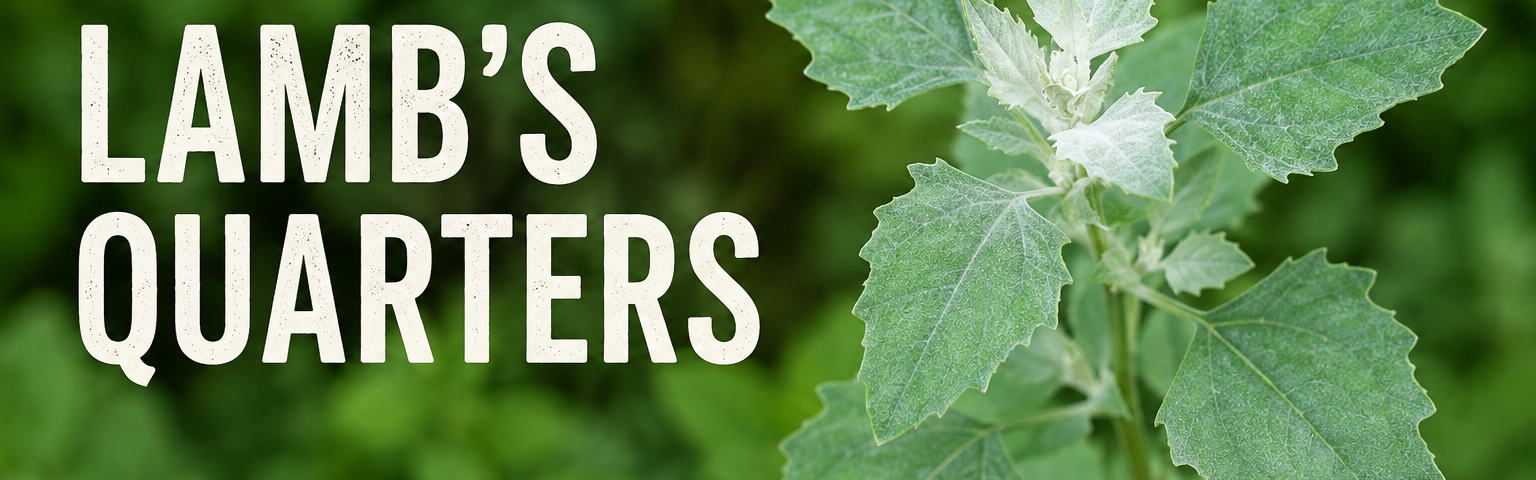
This lamb’s quarters identification guide explains how to recognize common lamb’s quarters and related edible North American goosefoots. It also covers lookalikes, harvesting, cooking, nutrition, and safety. Because lamb’s quarters varies widely in shape and appearance, reliable identification depends on several matching traits rather than one familiar-looking leaf.
Quick Answers
Is lamb’s quarters edible?
Yes. The young leaves and tender shoots can be cooked like spinach. In addition, several well-documented goosefoot species produce edible seeds.
What is the scientific name?
Common lamb’s quarters is Chenopodium album.
What are the best identification features?
Look for alternate leaves, irregular teeth, triangular or diamond-shaped lower leaves, pale mealy growth, tiny green flowers, and dense clusters of small seeds.
What parts can you eat?
Foragers commonly use the young leaves, tender shoots, immature flower clusters, and mature seeds of documented edible species.
Should lamb’s quarters be cooked?
Cooking is the more conservative choice. In particular, boiling and discarding the water can reduce soluble oxalates.
What are the most important lookalikes?
Black nightshade, hairy nightshade, pigweeds, orache, groundcherries, and poisonous jimsonweed deserve careful comparison.
When should you harvest it?
Gather tender leaves and shoots before the stems become fibrous and heavy flowering begins.
Can you eat the seeds?
Yes, although they require cleaning and may need repeated rinsing to remove bitter saponins.
Quick Lamb’s Quarters Identification
Use this field checklist before harvesting:
- Leaves grow alternately along the stem.
- Each leaf is simple rather than compound.
- Lower leaves are often triangular, diamond-shaped, ovate, or rhombic.
- Leaf margins may be irregularly toothed or shallowly lobed.
- Upper leaves usually become narrower and less toothed.
- Young growth often has a pale, silvery, or mealy coating.
- Stems may show red, pink, or purple streaks.
- Flowers are tiny, green, and lack showy petals.
- Flower clusters develop at stem tips and in the upper leaf axils.
- Mature seeds are small, rounded, and usually dark.
- The plant produces no berries, trumpet-shaped flowers, or spiny capsules.
- Crushed foliage lacks a strong medicinal, resinous, or turpentine-like odor.
Never identify lamb’s quarters from leaf shape alone.
Quick Safety Check
Before using any plant from this lamb’s quarters identification guide, confirm that:
- Several independent traits support the identification.
- The plant produces no milky sap.
- No berries or showy flowers are present.
- The foliage smells mild and green.
- A reliable source documents the exact species as edible.
- The plant grows in clean, unsprayed soil.
- The location is away from roads, railways, runoff, and polluted ground.
- You know which plant part to use.
- You understand the preparation method.
- Your first serving will be small and cooked.
For more beginner-friendly field resources, visit The Hunter Gatherer Society’s Foraging Identification Guides.
What Does “Lamb’s Quarters” Mean?
In everyday foraging language, lamb’s quarters usually means common lamb’s quarters, Chenopodium album. However, people also use the name for several related goosefoots.
That broad use can create confusion. North America contains numerous Chenopodium species, while botanists now place some former members of the genus in Blitum, Oxybasis, or Dysphania. Furthermore, researchers have not documented every species equally well as food.
For that reason, learn common lamb’s quarters first. Afterward, study each regional species separately.
This lamb’s quarters identification guide focuses on species with reasonably strong botanical, historical, or ethnobotanical documentation. Nevertheless, it does not claim that every goosefoot or every member of Chenopodium is equally suitable for eating.
Taxonomy and Naming
Scientific classification
- Family: Amaranthaceae
- Primary genus: Chenopodium
- Primary species: Chenopodium album
- Common names: Lamb’s quarters, lambsquarters, common goosefoot, fat hen, wild spinach
Older references may place these plants in Chenopodiaceae. Modern botanical systems, however, usually include the former goosefoot family within Amaranthaceae.
Botanists have also reassigned several related plants. For example:
- Strawberry blite, formerly Chenopodium capitatum, is now generally called Blitum capitatum.
- Red goosefoot, formerly Chenopodium rubrum, is now Oxybasis rubra.
- California goosefoot, formerly Chenopodium californicum, is widely treated as Blitum californicum.
Because classifications change, field guides, herbaria, plant databases, and foraging books may use different scientific names for the same plant. The Flora of North America treatment of Chenopodium provides a technical overview of the North American genus.
Common Lamb’s Quarters Identification Guide
Common lamb’s quarters, Chenopodium album
Lamb’s quarters is the species most people mean when they use the name. This annual frequently grows in gardens, farms, compost piles, vacant lots, riverbanks, trail edges, construction sites, and recently disturbed soil.
Even so, the plant varies considerably. Leaf shape, height, branching, coloration, and mealiness can change with age, moisture, soil fertility, genetics, and growing conditions. Therefore, do not expect every specimen to match one photograph perfectly.
The Flora of North America account for Chenopodium album describes the species as highly variable.
Lamb’s quarters leaves
Lower and middle leaves usually grow alternately. Their shape may appear:
- Triangular
- Diamond-shaped
- Rhombic
- Ovate
- Broadly lance-shaped
- Somewhat goosefoot-shaped
Most leaves broaden near the base and taper toward the tip. Their margins may have irregular teeth, shallow lobes, or a mixture of both.
Noticeable stalks, called petioles, connect the lower and middle leaves to the stem. Meanwhile, leaf color ranges from green to gray-green, and the undersides may appear paler.
Upper leaves often become:
- Smaller
- Narrower
- Less deeply toothed
- More lance-shaped
- Nearly smooth-edged
Young growth frequently carries a white, gray, or silvery coating. Tiny bladder-like hairs create this layer, which can resemble flour, frost, dust, or fine meal.
Some of the coating may transfer to your fingers. However, it usually does not wipe away as cleanly as ordinary dirt or dust.
Lamb’s quarters stems
Stems generally grow upright and may feel angled, grooved, or ridged. Their color ranges from pale green to dark green.
Depending on the plant, you may also see:
- Red streaks
- Pink striping
- Purple markings
- Reddish leaf joints
As the plant matures, the main stem often develops several branches. In addition, the stem usually remains solid rather than hollow.
Poor or dry soil may keep the plant under one foot tall. By contrast, rich garden soil can support plants several feet high.
Although red striping can support an identification, it is not required. Some individuals remain almost entirely green.
Lamb’s quarters flowers
The flowers are extremely small, green, and inconspicuous. Unlike many familiar garden plants, they lack showy petals.
Clusters commonly form:
- At branch tips
- Along the upper stem
- In upper leaf axils
At first, a flowering head may look like a compact, granular green mass. Later, it becomes more branched and fills with developing seed.
Lamb’s quarters seeds
Mature seeds are:
- Small
- Rounded or lens-shaped
- Usually black or dark brown
- Often about 1 to 1.5 millimeters across
- Enclosed within thin floral tissue
Although lamb’s quarters is related to quinoa, its wild seeds are generally much smaller.
A mature plant may produce thousands of seeds. Consequently, common lamb’s quarters can spread quickly through gardens and disturbed ground.
Roots
Common lamb’s quarters develops a taproot with branching lateral roots. Foragers do not normally gather the roots as food.
Smell
Crushed foliage usually produces a mild green, earthy, or spinach-like odor.
Reject the ordinary lamb’s quarters identification pathway when a plant smells strongly:
- Resinous
- Medicinal
- Citrus-like
- Turpentine-like
- Similar to cleaning products
A powerful aromatic odor may point toward a Dysphania species instead.
Flavor
Young leaves usually taste mild and green, with a flavor similar to spinach or chard.
Older growth may become:
- More mineral-tasting
- Slightly bitter
- Tougher
- More fibrous
Lamb’s quarters habitat
Common lamb’s quarters thrives in disturbed and nutrient-rich soil. Typical habitats include:
- Vegetable gardens
- Farm fields
- Compost-rich soil
- Barnyards
- Vacant lots
- Construction sites
- Roadsides
- Riverbanks
- Trail margins
- Waste ground
- Recently cultivated soil
In particular, it often appears soon after digging, clearing, construction, or cultivation exposes the ground.
Agricultural references describe it as a widespread summer annual of rich or disturbed soils. The Cornell Weed Science profile for common lamb’s quarters offers additional habitat and growth information.
Lamb’s quarters season
Young plants may emerge from spring through summer. Generally, the leaves remain most tender before heavy flowering begins.
Seed production usually follows from late summer into fall. However, local timing varies with latitude, elevation, rainfall, temperature, and disturbance.
Common lamb’s quarters identification summary
A typical plant has alternate triangular or diamond-shaped leaves, irregular teeth, pale mealiness on young growth, an upright green or red-striped stem, tiny green flowers, and clusters of small dark seeds.
Even so, this variable plant does not always match the classic appearance perfectly. Use the full lamb’s quarters identification guide checklist before gathering it for food.
Edible North American Goosefoots
The following plants rank among the better-documented edible members of the broader goosefoot group. Their traditional uses, flavors, preparation methods, and identification details differ.
Therefore, identify each one independently.
Pitseed goosefoot, Chenopodium berlandieri
Pitseed goosefoot is native across much of North America and extends south into Central America. More importantly, it is one of the continent’s most culturally significant goosefoots.
Archaeological evidence shows that Indigenous communities cultivated forms of this species before maize became widespread in many parts of eastern North America. Consequently, pitseed goosefoot deserves recognition as an ancient crop rather than merely a modern weed.
Identification features include:
- An upright annual growth habit
- Alternate leaves
- Mealy young foliage
- Dense green flower clusters
- Triangular, diamond-shaped, or lance-shaped leaves
- Small dark seeds
Under magnification, the seed surface often shows a distinctive pitted or honeycomb-like pattern.
Because the species includes several regional varieties, confident identification may require mature seeds and a regional botanical key.
Edible parts:
- Young leaves
- Tender shoots
- Seeds
Cook the leaves and shoots as greens. After careful cleaning, the seeds can be boiled, toasted, added to porridge, or ground and mixed with other flours.
The National Park Service provides additional historical context in its article on pitseed goosefoot and Indigenous agriculture.
Fremont’s goosefoot, Chenopodium fremontii
Fremont’s goosefoot primarily grows in western North America.
Typical habitats include:
- Dry slopes
- Open woodland
- Sagebrush country
- Disturbed ground
- Arid and semi-arid landscapes
Common identification features include an upright branching habit, alternate leaves, mealiness, compact flower clusters, and small dark seeds. Depending on the plant, the leaves may appear triangular, rhombic, or somewhat lance-shaped.
Historical food records emphasize the seeds. Some sources also record the cooked leaves as edible, although people often describe them as less appealing than common lamb’s quarters.
For practical foraging, treat Fremont’s goosefoot mainly as a seed plant rather than a preferred leafy vegetable.
Edible parts:
- Seeds
- Young cooked leaves
- Tender shoots
Slimleaf goosefoot, Chenopodium leptophyllum
Slimleaf goosefoot grows across much of western and central North America. It usually favors open, sandy, dry, disturbed, or lightly vegetated ground.
Unlike common lamb’s quarters, this species typically produces narrow, linear to narrowly lance-shaped leaves.
Nevertheless, it still has:
- Alternate leaves
- Upright branching stems
- Small clustered flowers
- Some mealiness on young growth
- Tiny dark seeds
Its narrow leaves make it less productive as a leafy vegetable. However, Indigenous peoples traditionally gathered and processed the seeds.
The Flora of North America account for slimleaf goosefoot describes its small black seeds and preference for open, often disturbed sandy habitats.
Edible parts:
- Seeds
- Young leaves
- Tender shoots
Mealy goosefoot, Chenopodium incanum
Mealy goosefoot occurs mainly in western and southwestern North America. As the name suggests, a heavy pale coating may cover the plant.
Typical features include:
- Gray-green or silvery foliage
- Substantial mealiness
- Alternate leaves
- Triangular, ovate, or somewhat lobed leaves
- Small green flower clusters
- Dry or disturbed habitat
Edible parts:
- Young cooked leaves
- Seeds
Traditional food records include both parts. However, people generally placed greater value on the seeds.
California goosefoot, Blitum californicum
Older references usually call this species Chenopodium californicum.
Unlike common lamb’s quarters, California goosefoot is a perennial. It develops a substantial underground root system and may produce several stems from the base.
Identification features include:
- Perennial growth
- Several basal stems
- Broad triangular to hastate leaves
- Green flower clusters
- A thickened underground root system
- Growth on slopes, ledges, plains, and open woodland
Traditional records include the use of:
- Young leaves
- Young shoots
- Seeds
- Roots prepared through culturally specific methods
However, this species requires specialized knowledge. Do not treat its root as an ordinary extension of common lamb’s quarters use.
Indigenous communities developed distinct preparation methods. Therefore, a general lamb’s quarters identification guide should not reduce those practices to one universal recipe.
Strawberry blite, Blitum capitatum
Strawberry blite, formerly Chenopodium capitatum, becomes easy to recognize when its flower and fruit clusters turn bright red.
Despite their berry-like appearance, these structures are fleshy clusters containing numerous small fruits and seeds rather than individual berries.
Look for:
- Alternate leaves
- Triangular or arrow-shaped blades
- Irregular leaf teeth
- Green flower clusters that later turn red
- Several red clusters along the upper stems
Edible parts:
- Young leaves
- Tender shoots
- Fleshy red clusters
- Seeds
Cook the young leaves and shoots as greens. The red clusters are also edible, although they usually taste mild rather than sweet or strawberry-like.
Red goosefoot, Oxybasis rubra
Older guides may list red goosefoot as Chenopodium rubrum.
It often grows in:
- Damp ground
- Muddy soil
- Saline areas
- Seasonally flooded places
- Nutrient-rich disturbed soil
Possible features include:
- Alternate leaves
- Triangular, diamond-shaped, or lobed leaves
- Green stems that often become reddish
- Red or purple late-season coloration
- Dense flower clusters
Edible parts:
- Young leaves
- Tender shoots
- Seeds
Foragers generally cook the young foliage. However, this species often grows in questionable environments. Muddy, sewage-affected, agricultural, or polluted ground can make an otherwise edible plant unsafe to gather.
Oakleaf goosefoot, Oxybasis glauca
Older references commonly call this species Chenopodium glaucum.
It often grows as a low or spreading plant in compacted, damp, disturbed, or saline soil.
Identification features include:
- Low or spreading stems
- Alternate leaves
- Irregularly lobed, oak-like leaves
- Pale or whitish leaf undersides
- Tiny green flower clusters
- Stems that may become reddish
Edible parts:
- Young cooked leaves
- Seeds
Most foragers consider oakleaf goosefoot a secondary edible rather than a high-yield staple.
Additional regional goosefoots
Other North American species have ethnobotanical or secondary reports of edible leaves or seeds, including:
- Chenopodium atrovirens
- Chenopodium desiccatum
- Chenopodium hians
- Chenopodium pratericola
- Chenopodium simplex
- Chenopodium strictum
- Chenopodium watsonii
However, some require mature seeds, magnification, regional keys, or herbarium comparison for confident identification. Food-use documentation also varies.
For that reason, never assume that an unfamiliar goosefoot is edible merely because it resembles common lamb’s quarters.
Species That Need Separate Treatment
Quinoa, Chenopodium quinoa
Quinoa is a cultivated South American crop that may occasionally escape cultivation in North America.
Although people eat its seeds and young leaves, it does not qualify as a native North American wild lamb’s quarters species.
Cooks usually rinse commercial quinoa before cooking to remove bitter surface saponins. Likewise, escaped or homegrown plants may require similar preparation.
Tree spinach, Chenopodium giganteum
Tree spinach is an introduced cultivated green that may persist near gardens or former plantings.
It can grow much taller than ordinary lamb’s quarters and often develops vivid magenta coloration on young leaves.
People can eat it after confirming the identification. However, treat it as a cultivated introduction rather than an ordinary wild lamb’s quarters species.
Good King Henry, Blitum bonus-henricus
Good King Henry is a European perennial that may persist around old gardens and settlements.
Proper cooking makes it edible, but its perennial habit differs from common lamb’s quarters. Therefore, identify and research it separately.
Related Plants That Are Not Ordinary Lamb’s Quarters
Epazote, Dysphania ambrosioides
Botanists formerly classified epazote as Chenopodium ambrosioides.
It has:
- A strong medicinal or resinous odor
- Narrower toothed leaves
- Glandular foliage
- Aromatic oils
- Traditional use as a strong seasoning
Epazote does not make a mild spinach substitute. Furthermore, concentrated oil and excessive medicinal use can create serious safety risks.
A strong resinous odor should immediately remove the plant from the ordinary lamb’s quarters identification pathway.
Jerusalem oak goosefoot, Dysphania botrys
Older references may list this strongly aromatic plant as Chenopodium botrys.
Do not gather it as common lamb’s quarters simply because an older source places it in the same genus.
Other Dysphania species
Many Dysphania species produce strong aromatic compounds.
Accordingly, identify and research each species independently. Never apply a broad statement such as “all goosefoots are edible” to aromatic plants in this genus.
Lamb’s Quarters Lookalikes Guide
Several plants can resemble lamb’s quarters during part of their growth cycle. Fortunately, flower structure, leaf arrangement, surface texture, fruit type, and odor usually provide reliable separation.
Black nightshade, Solanum species
Beginners sometimes confuse young black nightshade with lamb’s quarters.
Black nightshade generally has:
- No mealy coating
- Star-shaped flowers with five visible petals
- Prominent yellow anthers
- Round, juicy berries
- A branching fruit cluster
Lamb’s quarters, by contrast, produces tiny green flowers and dry seeds rather than berries.
Because nightshade toxicity and edibility vary by species and maturity, never use berry color alone to judge safety.
Hairy nightshade, Solanum physalifolium
Hairy nightshade may grow in the same disturbed habitats.
Look for:
- Noticeable hairs
- Star-shaped white flowers
- Yellow anthers
- Round berries
- No natural flour-like coating
Once flowers or fruit appear, these characteristics clearly separate it from lamb’s quarters.
Pigweeds, Amaranthus species
Pigweeds are close relatives of lamb’s quarters, and many also have edible leaves or seeds. Nevertheless, identify them independently.
Pigweeds generally show:
- No mealy coating
- Oval or lance-shaped leaves
- Dense, sometimes bristly flower spikes
- Occasional spines at the leaf nodes
- Tiny shiny black seeds
Certain pigweeds can also accumulate nitrates under stressful or heavily fertilized conditions. Therefore, site quality still matters.
Orache and saltbush, Atriplex species
Orache and saltbush species may have pale or scurfy leaf surfaces.
Possible differences include:
- Opposite lower leaves and alternate upper leaves
- Bract-like structures around the fruits
- Silvery or succulent foliage
- Strong adaptation to saline or coastal habitats
Several Atriplex species are edible. However, the genus requires separate identification.
Jimsonweed, Datura stramonium
Jimsonweed is a dangerous poisonous lookalike of disturbed ground.
It has:
- Large, coarsely toothed leaves
- Thick branching stems
- A strong unpleasant odor
- Large trumpet-shaped flowers
- Spiny egg-shaped seed capsules
Lamb’s quarters produces neither trumpet flowers nor spiny seedpods.
All parts of jimsonweed contain dangerous tropane alkaloids. Consequently, leave the plant untouched whenever uncertainty remains.
Groundcherries, Physalis species
Groundcherries may have similarly shaped young leaves.
Mature plants develop:
- Five-petaled flowers
- Papery lantern-like husks
- A round fruit inside each husk
- No natural mealy coating
Young sunflowers
Some sunflower seedlings have broad or toothed leaves.
However, they usually show:
- Opposite lower leaves
- Coarse hairs
- Rough leaf surfaces
- Large composite flowers later in the season
Lamb’s quarters has alternate leaves and tiny green flowers.
Maple seedlings
Young maple seedlings can resemble broad-leaved goosefoots from a distance.
Maples have:
- Opposite leaves
- Palmately arranged veins
- Woody growth
- Paired winged seeds later in life
Lamb’s quarters remains herbaceous and produces alternate leaves.
For another example of a detailed edible-plant comparison, see the Creeping Bellflower Identification, Edibility, and Recipes Guide.
Lamb’s Quarters Edibility Guide
This lamb’s quarters identification guide covers four commonly used plant parts:
- Leaves
- Tender shoots
- Young flower clusters
- Mature seeds from documented edible species
Leaves
Young leaves are the easiest and most useful part to gather.
Use them:
- Boiled
- Steamed
- Sautéed
- In soup
- In egg dishes
- In pasta
- In grain bowls
- In savory fillings
- In pesto after blanching
- Mixed with milder greens
Some foragers eat very young leaves raw. Nevertheless, cooking offers the more conservative approach because it improves texture and may reduce soluble oxalates.
Tender shoots
Gather flexible stem tips before heavy flowering.
Choose shoots that snap easily. Older stems become fibrous, so strip their leaves rather than cooking the entire stem.
Flower clusters
Tender green flower clusters can be cooked with the upper leaves.
Once they become coarse and seed-filled, reserve them for seed harvest instead.
Seeds
People can prepare mature seeds from well-documented edible species by:
- Boiling
- Toasting
- Grinding
- Adding them to porridge
- Mixing them into crackers or bread
- Combining them with other grains
Wild goosefoot seeds are extremely small and require careful cleaning.
In addition, some contain bitter saponins. Therefore, rinsing, rubbing, soaking, winnowing, and cooking may all improve them.
Do not assume that every wild goosefoot seed requires exactly the same process as commercial quinoa.
Lamb’s Quarters Flavor and Texture
Young common lamb’s quarters leaves taste similar to spinach, chard, or other mineral-rich garden greens.
Possible flavor notes include:
- Mild
- Green
- Earthy
- Slightly nutty
- Mineral-like
- Occasionally salty
- Slightly bitter in older growth
After cooking, young leaves become tender. Mature leaves grow thicker, while old stems become stringy.
Lamb’s Quarters Nutrition
Lamb’s quarters leaves can provide:
- Carotenoids
- Vitamin C
- Vitamin K
- Folate
- Calcium
- Iron
- Magnesium
- Potassium
- Fiber
- Plant protein
However, nutrient content varies with species, plant age, growing conditions, soil, harvest timing, storage, and preparation.
The presence of a mineral also does not guarantee complete absorption. Oxalates, for example, can reduce the availability of some minerals.
Therefore, treat lamb’s quarters as a useful wild vegetable rather than a treatment for a medical condition or nutrient deficiency.
Lamb’s Quarters Safety and Preparation Guide
Oxalates
Like spinach, chard, beet greens, and sorrel, lamb’s quarters can contain oxalic acid and soluble oxalates.
A high-oxalate diet may not suit everyone. In particular, people with a history of calcium oxalate kidney stones, kidney disorders, or medical instructions to follow a low-oxalate diet may need to limit it.
Research on oxalates in lamb’s quarters and related greens found that boiling reduced oxalate levels more effectively than dry cooking.
For a conservative preparation:
- Place the leaves in boiling water.
- Cook until tender.
- Drain thoroughly.
- Discard the cooking liquid.
Cooking does not necessarily remove every oxalate. Therefore, eat lamb’s quarters as one of many rotating greens rather than consuming unusually large amounts every day.
Nitrates
Common lamb’s quarters can accumulate nitrates, particularly under certain agricultural or stressful growing conditions.
Potential contributing conditions include:
- Heavy nitrogen fertilization
- Manure-rich ground
- Agricultural runoff
- Drought stress
- Interrupted growth
- Herbicide injury
- Other environmental stress
Most widely reported poisonings involve livestock consuming large amounts of nitrate-rich forage. Nevertheless, this ability supports a cautious human-foraging approach.
Choose healthy young growth from clean soil. In addition, avoid plants growing beside manure piles, heavily fertilized fields, or severely stressed vegetation.
Cornell’s common lamb’s quarters weed profile discusses the plant’s nitrate-accumulating potential.
Saponins
Many Chenopodium species carry bitter saponins on or near their seeds.
For wild seeds:
- Remove the chaff.
- Rinse thoroughly.
- Rub or agitate the seeds in water.
- Drain the water.
- Repeat if the seeds remain bitter or the water becomes foamy.
- Cook before serving.
Saponin content varies among species and populations. As a result, one batch may require more rinsing than another.
Contaminated ground
Lamb’s quarters often grows where harvesting may be unsafe.
Avoid:
- Busy roadsides
- Railroad rights-of-way
- Industrial properties
- Former industrial sites
- Sprayed farm margins
- Chemically maintained landscapes
- Dog parks
- Stormwater drainage areas
- Septic fields
- Contaminated urban lots
- Dumping areas
- Utility corridors
- Soil exposed to lead paint or mining waste
A healthy-looking plant can still grow in contaminated soil. Consequently, site history matters just as much as plant identification.
Pesticides and herbicides
Farmers and property managers often spray lamb’s quarters because it competes with crops and landscaping.
Therefore, do not harvest from conventional farm fields, orchards, nurseries, landscaped beds, or utility corridors unless you know the treatment history and have permission.
Pregnancy, children, medications, and medical conditions
Ordinary cooked food portions differ from extracts, powders, tinctures, or medicinal doses.
Anyone who is pregnant, nursing, serving wild foods to very young children, managing kidney disease, taking anticoagulant medication, or following a medically restricted diet should seek individualized professional guidance.
Because lamb’s quarters can contain substantial vitamin K, it may matter to people taking warfarin or similar medication.
Allergies and first use
Try a small cooked serving the first time.
In addition, avoid introducing several unfamiliar wild foods in the same meal. Otherwise, identifying the cause of a reaction may prove difficult.
Lamb’s Quarters Harvesting Guide
Best time to harvest
Harvest when:
- Plants are young
- Growth looks lush and flexible
- Leaves show little insect damage
- Heavy flowering has not begun
- Tender stems snap easily
- The site is clean and untreated
The upper four to eight inches of a vigorous plant often provide the best material.
How to harvest lamb’s quarters
Use clean scissors or pinch off the tender stem tip above a leaf node.
This method:
- Keeps soil out of the basket
- Leaves the root in place
- Avoids tough lower stems
- Often allows the plant to branch and regrow
For abundant agricultural weeds, overharvest may not present the greatest ecological concern. However, landowner permission, site safety, local rarity, and seed control still matter.
Harvesting seeds
Wait until:
- Flower clusters are dry or nearly dry
- Seeds have darkened
- Rubbing releases them easily
- The plant shows no mold
- Recent weather has been dry
Place a bag or container beneath the seedhead. Next, bend the plant over the container and gently rub or shake the clusters.
Because one plant may scatter thousands of seeds, avoid carrying open seedheads through gardens, trails, or uninfested natural areas.
Cleaning seeds
- Dry the harvested seedheads.
- Rub them between gloved hands or across a screen.
- Remove the largest stems.
- Sieve the remaining material.
- Winnow away light chaff.
- Inspect for insects, mold, soil, and grit.
- Rinse or soak as appropriate.
- Cook before eating.
Complete chaff removal can be difficult because the seeds are tiny. Even so, careful cleaning greatly improves the finished food.
Responsible Lamb’s Quarters Foraging
Common lamb’s quarters often grows abundantly. Even so, responsible harvesting still applies.
- Obtain permission.
- Follow local harvesting rules.
- Avoid uncommon native species.
- Learn whether the local plant is native or introduced.
- Do not disturb archaeological or culturally sensitive sites.
- Prevent mature seeds from spreading.
- Leave surrounding habitat intact.
- Gather only from clean populations.
- Never assume an unused-looking patch belongs to no one.
Native seed-bearing goosefoots can hold considerable ecological and cultural importance.
Pitseed goosefoot and related plants have especially deep Indigenous agricultural histories. Therefore, treat plants near tribal, historical, or archaeological sites with particular respect.
The same principles apply across edible species. You can find more examples in the site’s wild plant identification guides.
Cooking Lamb’s Quarters
Basic cooked lamb’s quarters
- Sort the harvest.
- Remove tough stems, insects, damaged leaves, and unrelated plants.
- Wash the greens in several changes of water.
- Bring a pot of water to a boil.
- Add the leaves and tender shoots.
- Cook for about two to five minutes or until tender.
- Drain thoroughly.
- Season as desired.
Discard the cooking water when reducing soluble oxalates is a priority.
Sautéed lamb’s quarters
Blanch the leaves first. Then, drain them and press out excess water.
Sauté briefly with:
- Olive oil or butter
- Garlic
- Onion
- Salt
- Pepper
- Lemon juice
Blanching before sautéing usually produces a milder result than placing mature raw leaves directly into the pan.
Lamb’s quarters and eggs
Add chopped cooked greens to:
- Scrambled eggs
- Omelets
- Frittatas
- Breakfast potatoes
- Savory breakfast bowls
Because the leaves shrink considerably during cooking, gather more fresh material than the finished portion appears to require.
Lamb’s quarters pesto
Blanch and cool the leaves before blending them with:
- Nuts or seeds
- Garlic
- Olive oil
- Hard cheese or nutritional yeast
- Lemon juice
- Salt
Blanching creates a smoother, less mineral-tasting pesto.
Lamb’s quarters in soup
Add cleaned leaves near the end of cooking.
Tougher but healthy leaves work well in soups because moisture and additional cooking soften them. However, discard spoiled, heavily mined, or contaminated leaves rather than trying to rescue them through cooking.
Wild seed porridge
After cleaning and rinsing seeds from a documented edible species:
- Toast them lightly if desired.
- Add several parts water for each part seed.
- Simmer until softened.
- Add more water as necessary.
- Season or combine with other grains.
Seed size, bitterness, saponin content, and cooking time vary. Therefore, expect some experimentation.
Storing Lamb’s Quarters
Fresh leaves
Store fresh leaves in the refrigerator with controlled moisture.
Use them within several days. Excess moisture encourages decay, while very dry storage causes wilting.
Blanched greens
Blanch the greens, cool them quickly, drain them, and refrigerate them for short-term use.
Freezing
Blanch the leaves, cool them in cold water, remove excess moisture, divide them into portions, and freeze.
This method generally preserves them better than freezing them raw.
Drying
Dry young leaves completely before storing them in an airtight container away from heat, moisture, and light.
Use dried leaves in soups or seasoning blends.
However, drying does not necessarily resolve concerns related to oxalates or nitrates.
Seeds
Clean and dry seeds thoroughly.
Then, store them in an airtight container in a cool, dark, dry location. Check periodically for condensation, insects, or mold.
Lamb’s Quarters Ecology
Lamb’s quarters is a classic plant of disturbed ground.
Its seeds can remain dormant in the soil and germinate after cultivation, digging, clearing, or construction exposes them to favorable conditions.
Rapid growth, prolific seed production, and a strong response to fertile soil help common lamb’s quarters succeed as both an agricultural weed and a dependable wild green.
Wind and self-pollination account for much of its reproduction. Therefore, the tiny green flowers do not function as major nectar sources.
Nevertheless, insects, birds, and other wildlife may use the leaves and seeds.
Spinach leafminers also use lamb’s quarters as a host. Their larvae create pale trails or blotchy mines inside the leaves. Consequently, discard heavily mined leaves.
Is Lamb’s Quarters Native or Introduced?
The answer depends on the species and location.
Several goosefoots originated in North America, including:
- Pitseed goosefoot
- Fremont’s goosefoot
- Slimleaf goosefoot
- California goosefoot
- Some strawberry blite populations
Common lamb’s quarters has a more complicated history. Many authorities treat typical Chenopodium album as introduced across much of North America, while the broader species complex has caused confusion in older records and field guides.
Meanwhile, cultivation introduced quinoa, tree spinach, and several Eurasian goosefoots to North America.
Therefore, determine status by scientific species and region rather than labeling every lamb’s quarters plant as native or invasive.
Historical and Cultural Importance
Many Indigenous peoples across North America used goosefoot seeds as important foods.
Archaeologists have identified domesticated or semi-domesticated pitseed goosefoot as part of the Eastern Agricultural Complex. Communities cultivated it before maize became dominant in many regions.
In western North America, people also gathered native goosefoot seeds, removed the chaff, ground them, cooked them as mush, or combined them with other seed meals.
Traditional plant knowledge belongs to living cultures, not only to the archaeological past. Therefore, modern foragers should avoid reducing Indigenous practices to anonymous folklore or suggesting that one method represents every nation or community.
Lamb’s Quarters Identification Guide FAQ
Are lamb’s quarters and pigweed the same plant?
No.
Lamb’s quarters generally refers to Chenopodium album or related goosefoots. Pigweed most often refers to Amaranthus species.
Both groups belong to the amaranth family. However, each has distinct identification features.
Can lamb’s quarters be eaten raw?
Some people eat very young leaves raw in small amounts.
Nevertheless, cooking offers a more conservative choice because it improves texture and can reduce soluble oxalates.
Does the white coating mean the plant has mildew?
Usually not.
A fine white or silvery coating naturally covers young lamb’s quarters growth. Powdery mildew, by contrast, tends to form irregular or abnormal patches.
Does every plant have triangular leaves?
No.
Lower leaves may appear broad and triangular, while upper leaves often become narrower and less toothed.
Are red stems required?
No.
Red, pink, or purple streaks occur frequently, but some plants remain almost entirely green.
Are lamb’s quarters seeds the same as quinoa?
No, although the plants are related.
Quinoa comes from Chenopodium quinoa. Wild lamb’s quarters seeds usually remain much smaller and may require more cleaning.
Can I eat lamb’s quarters from my garden?
Possibly, provided that you:
- Identify it correctly
- Know the soil is clean
- Confirm that no unsuitable chemicals were used
- Avoid areas heavily used by pets
- Wash and prepare it correctly
Is lamb’s quarters poisonous to livestock?
The plant can accumulate nitrates under certain growing conditions.
Most reported poisonings involve livestock eating large amounts of nitrate-rich forage. That does not mean a moderate serving of correctly gathered and prepared greens is inherently poisonous to humans.
However, the risk supports avoiding heavily fertilized, manure-rich, or severely stressed plants.
Can lamb’s quarters be eaten every day?
Use it as one of many rotating greens.
Consuming unusually large amounts may increase exposure to oxalates, nitrates, or other naturally occurring compounds.
Is the powdery coating safe?
The natural mealy coating is part of the plant.
Nevertheless, wash the leaves thoroughly to remove soil, insects, animal contamination, and airborne residue.
How do I know whether a goosefoot species is edible?
Confirm:
- The exact species or a well-defined species group
- A credible species-specific food reference
- The edible plant part
- The correct preparation
- The harvest site’s safety
- The absence of poisonous or aromatic lookalikes
Do not rely on a broad claim that every member of a genus is edible.
Final Field Checklist
Use this final lamb’s quarters identification guide checklist before harvesting:
- Leaves grow alternately.
- Each leaf is simple.
- Lower leaves are triangular, rhombic, ovate, or diamond-shaped.
- Young growth shows characteristic mealiness.
- Flowers are tiny, green, and inconspicuous.
- No berries are present.
- No trumpet-shaped flowers appear.
- No spiny seed capsules appear.
- The plant produces no milky sap.
- The foliage lacks a strong medicinal or resinous odor.
- Several independent traits support the identification.
- A reliable source documents the species as edible.
- You know which part to use.
- The site is clean and unsprayed.
- The plant looks healthy rather than severely stressed.
- Harvesting is permitted.
- The first serving will be small and cooked.
Record the plant’s habitat, leaf shape, season, photographs, and preparation in a foraging journal. As a result, future comparisons become easier and your field skills become more consistent.
Final Safety Rule
“Lamb’s quarters” is a useful common name. However, it does not replace species-level knowledge.
Begin by learning common lamb’s quarters thoroughly. Next, study regional goosefoots individually, paying attention to their leaves, flowers, seeds, habitat, odor, food history, and preparation requirements.
Most importantly, confirm each plant through several independent characteristics.
Leave it in the field whenever the species, harvest site, edible part, or preparation remains uncertain.
A careful lamb’s quarters identification guide can organize the process. Nevertheless, no online article replaces direct observation, regional references, expert instruction, and personal responsibility.


