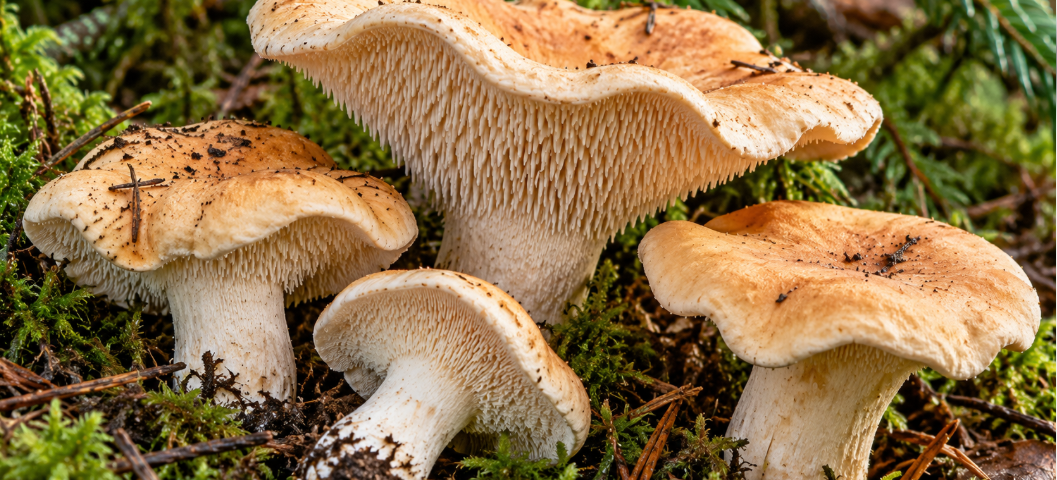
There’s something wonderful about finding a mushroom that looks a little like a chanterelle, turning it over, and discovering hundreds of tiny teeth hanging beneath its cap.
That’s often the moment you realize you’ve found a hedgehog mushroom.
Hedgehog mushrooms are among the most rewarding wild edibles to learn. They have a delicious, slightly nutty flavor, a firm texture, and one of the most memorable identification features in the mushroom world.
Instead of gills or pores, these mushrooms have soft, downward-pointing spines beneath their caps. They’re the little teeth that give hedgehogs their name.
You’ll often find them tucked into moss, scattered among fallen needles, or growing along quiet forest trails. Here in the Pacific Northwest, they’re especially welcome because some continue appearing well after the main fall mushroom season.
However, successful hedgehog mushroom identification involves more than simply spotting those little teeth.
Several unrelated fungi share that feature, and modern research has shown that North America has many closely related hedgehog species.
In this guide, we’ll explore how to identify hedgehog mushrooms, recognize their lookalikes, find productive habitat, harvest responsibly, and prepare them for the table.
Quick Field Identification & Foraging Tips
Found a possible hedgehog mushroom? Use this quick reference while you’re in the field.
- Look underneath: Soft, separate, downward-pointing teeth instead of gills or pores.
- Check the cap: Cream, pale yellow, apricot, or light orange, often with an irregular or wavy edge.
- Examine the stem: Solid, pale, and sometimes positioned slightly off-center.
- Check the flesh: White to cream, firm, and somewhat brittle.
- Look at the ground: Typical edible Hydnum mushrooms grow from forest soil rather than directly from logs.
- Check nearby trees: Commonly associated with conifers or hardwoods, depending on the species.
- Best season: Fall through winter in much of the Pacific Northwest, depending on weather.
- Harvesting tip: Choose fresh, firm mushrooms with clean caps and healthy teeth. Older specimens may become bitter.
- Spore print: White to cream.
- Important lookalikes: Scaly hedgehogs, cork tooth fungi, and other toothed mushrooms.
- Edibility: Culinary Hydnum species are considered choice edibles when correctly identified and thoroughly cooked.
Before harvesting for food: All the important characteristics should agree. Finding teeth beneath a mushroom doesn’t automatically make it an edible hedgehog. When identification is uncertain, leave it growing.
Hedgehog Mushrooms at a Glance
| Feature | Description |
|---|---|
| Common names | Hedgehog mushroom, sweet tooth, wood hedgehog |
| Scientific name | Hydnum species |
| Traditional name | Hydnum repandum |
| Family | Hydnaceae |
| Cap color | Cream, pale yellow, tan, apricot, or orange |
| Cap width | Approximately 1–6 inches, depending on species |
| Cap shape | Rounded when young, often irregular or wavy with age |
| Underside | Soft, downward-pointing teeth |
| Stem | Pale, solid, sometimes off-center |
| Flesh | White to cream, firm and slightly brittle |
| Spore print | White to cream |
| Habitat | Forest soil near conifers and hardwoods |
| Season | Late summer through fall and sometimes winter |
| Growth pattern | Solitary, scattered, grouped, or in loose arcs |
| Edibility | Choice edible when correctly identified and cooked |
| Main concern | Confusion with other toothed fungi |
A Quick Note About Hedgehog Mushroom Names
For years, many North American field guides called large hedgehog mushrooms Hydnum repandum.
However, modern DNA research has revealed that the genus contains far more species than people once realized.
Several North American mushrooms that look nearly identical belong to different species. Some are difficult to separate without microscopic examination or DNA testing.
The scientific name Hydnum repandum is still used for the European wood hedgehog, but its precise distribution in North America remains a subject of research.
For everyday foraging, it’s usually more useful to understand the recognizable features of the edible Hydnum group than to insist on a species name that cannot be reliably confirmed in the field.
How to Identify Hedgehog Mushrooms
One of the nice things about hedgehog mushrooms is that several of their features are easy to examine.
Once you’ve learned the overall pattern, they become much easier to recognize during a woodland walk.
Let’s start with the feature that matters most.
1. The Underside: Teeth Instead of Gills
Turn a possible hedgehog mushroom over and look beneath the cap.
Instead of the thin, blade-like gills found on many mushrooms, you should see hundreds of small spines pointing downward.
These structures are called teeth.
They’re usually white, cream, or pale yellow. Some develop a slightly warmer color as the mushroom ages.
The teeth feel surprisingly soft and are often brittle enough to break away with gentle handling.
On larger hedgehog species, they may extend slightly down the upper stem.
This is the most recognizable feature of the group.
However, not every mushroom with teeth belongs to Hydnum. Other toothed fungi have different cap colors, textures, and growth patterns.
2. The Cap: Pale, Smooth, and Often Wavy
Hedgehog mushroom caps typically range from cream and pale yellow to warm apricot or light orange.
Young mushrooms often have rounded caps with edges that curve downward.
As they mature, the caps become flatter and more irregular.
Some develop broad, wavy edges that give them a slightly ruffled appearance.
Others become lopsided, particularly when several mushrooms grow close together.
The surface is usually fairly smooth and dry.
Unlike many scaly hedgehog species, typical Hydnum mushrooms don’t have thick, dark scales covering their caps.
Cap size varies considerably.
Smaller species may measure only an inch or two across, while larger hedgehogs can develop caps several inches wide.
3. The Stem: Solid and Pale
Most hedgehog mushrooms have pale stems that are white, cream, or slightly yellowish.
Larger species generally have thick, sturdy stems. Smaller varieties may have slimmer, more delicate ones.
Sometimes the stem sits directly beneath the middle of the cap.
Other times, it’s noticeably off-center.
If you cut a fresh hedgehog lengthwise, the interior should be solid rather than hollow.
You also shouldn’t see a ring around the stem or a saclike cup at the base.
4. The Flesh: Firm and Slightly Brittle
Fresh hedgehog mushrooms have white to cream-colored flesh.
It usually feels firm and substantial, although the cap can break more easily than you might expect.
When cut or bruised, some species gradually develop faint yellowish, orange, or brownish discoloration.
These reactions vary and aren’t dependable identification features on their own.
As hedgehogs age, they may become softer, more fragile, or bitter.
For cooking, fresh young and medium-sized mushrooms are generally the most desirable.
5. The Smell: Mild and Pleasant
Hedgehog mushrooms usually have a mild aroma.
Some smell faintly fruity or nutty, while others have a familiar fresh mushroom scent.
Their aroma is generally less distinctive than that of many chanterelles.
An unpleasant sour or rotten smell suggests the mushroom may be deteriorating.
However, smell alone should never determine whether a mushroom is edible.
6. The Spore Print: White to Cream
Hedgehog mushrooms produce pale spores.
To make a spore print, remove the stem from a mature mushroom and place the cap, teeth facing downward, on dark paper or another suitable surface.
Cover it with a bowl and leave it undisturbed for several hours or overnight.
If the mushroom releases enough spores, you’ll see a white to cream-colored deposit.
This provides another useful identification clue.
However, many unrelated mushrooms also have pale spore prints, so always consider the complete mushroom.
Where Do Hedgehog Mushrooms Grow?
Hedgehog mushrooms are woodland fungi that form relationships with living trees.
Unlike mushrooms that grow by breaking down dead logs, Hydnum species are mycorrhizal.
That means their underground fungal networks connect with tree roots.
The fungus helps its tree partner obtain water and nutrients from the soil. In return, the tree supplies sugars produced through photosynthesis.
It’s a remarkable partnership and one reason certain forest locations can produce hedgehog mushrooms for many years.
Look for Mossy Forest Floors
Some of the best places to search include:
- Moist conifer forests
- Mixed hardwood and conifer woodlands
- Moss-covered forest floors
- Areas with thick layers of fallen needles
- Shaded woodland trails
- Well-drained forest slopes
- Established forests with healthy tree root systems
Hedgehogs often grow partly hidden beneath moss, needles, or fallen leaves.
Sometimes only a pale cap is visible above the forest floor.
If you find one, slow down and look carefully around the area.
You may discover several others nearby.
Which Trees Do Hedgehog Mushrooms Prefer?
Tree associations vary by species and region.
In the Pacific Northwest, hedgehogs are frequently found in forests containing Douglas-fir, western hemlock, spruce, pine, and other conifers.
Some larger species are especially associated with spruce and pine, while smaller hedgehogs often occur in mossy forests with hemlock.
In other parts of North America, different species may grow alongside oak, beech, birch, and other hardwoods.
The important thing is to pay attention to your surroundings.
When you discover a productive patch, make a note of the nearby trees, moisture, elevation, and ground cover.
Those observations can help you find mushrooms in similar habitats later.
Hedgehog Mushrooms in the Pacific Northwest
Western Washington and Oregon are excellent places to learn about hedgehog mushrooms.
Our coastal and mountain forests provide suitable habitat for several different species.
Some are relatively large and pale, while others are small, orange, and easily overlooked among moss and fallen needles.
During a fall mushroom hunt, you may encounter hedgehogs growing in the same general forests as chanterelles.
One of the advantages of learning hedgehogs is that they can continue fruiting as the season grows colder.
In mild coastal areas, some may even appear during winter.
Common Pacific Northwest Hedgehog Species
Washington Hedgehog (Hydnum washingtonianum)
The Washington hedgehog is one of the names associated with pale, fleshy North American hedgehogs.
Its traditional description includes a cream to apricot-colored cap, pale teeth, and firm flesh.
However, modern research has shown that several closely related species can share this appearance.
As a result, finding a large pale hedgehog doesn’t automatically establish that it is H. washingtonianum.
Olympic Hedgehog (Hydnum olympicum)
The Olympic hedgehog is another species name associated with western North American hedgehogs.
It belongs to a group of pale, fleshy mushrooms that can be difficult to distinguish visually.
For most foragers, the practical identification is often Hydnum rather than a specific species.
Microscopic characteristics or DNA analysis may be necessary for a more precise name.
Bellybutton Hedgehogs (Hydnum umbilicatum and Related Species)
These smaller hedgehogs are especially interesting.
Their caps often have a noticeable depression in the center, creating the appearance of a tiny bellybutton.
They usually have thinner stems and smaller caps than the larger hedgehogs.
Colors range from yellowish orange to richer orange-brown.
You may find them scattered across mossy forest floors, sometimes growing in groups.
However, several similar species have historically been grouped under the name Hydnum umbilicatum.
That makes the overall identification pattern more dependable than cap size or shape alone.
When Is Hedgehog Mushroom Season?
Hedgehog mushrooms generally appear from late summer through fall.
However, the season varies with climate, elevation, rainfall, and species.
In many parts of North America, autumn is the most productive time to look.
After steady rainfall, the forest floor remains moist enough for mushrooms to develop.
Pacific Northwest Hedgehog Season
In western Washington and Oregon, September may bring the first hedgehogs in suitable conditions.
October and November are often productive.
Some species continue fruiting during December, and mild coastal forests can support mushrooms into winter or even early spring.
Cold weather doesn’t necessarily mean the season is over.
However, prolonged freezing, drying, and other harsh conditions can damage mushrooms or interrupt new growth.
Rather than relying only on the calendar, pay attention to rainfall, temperature, and soil moisture.
Do Hedgehog Mushrooms Return Every Year?
They can.
Because the underground fungus remains connected with living tree roots, mushrooms may return to the same general location during future seasons.
However, the timing and size of each harvest can vary dramatically.
A productive location one year may produce very little the next.
That’s why I recommend recording your discoveries.
A few simple notes can be surprisingly useful:
- Date and location
- Nearby tree species
- Recent weather
- Forest elevation
- Ground cover and soil moisture
- Number and condition of mushrooms
Over time, those observations can help you recognize productive habitat more quickly.
Hedgehog Mushroom Lookalikes
Hedgehog mushrooms have fewer close visual lookalikes than many familiar edible mushrooms.
Still, several other fungi produce teeth beneath their caps.
Some are tough and unsuitable for eating. Others have uncertain or variable culinary reputations.
Fortunately, their overall appearance often differs from the pale, fleshy mushrooms found in Hydnum.
Chanterelles (Cantharellus Species)
Chanterelles are probably the mushrooms most likely to catch your attention while searching for hedgehogs.
Both can have golden or apricot-colored caps, irregular edges, and a similar forest habitat.
The easiest difference is underneath.
Chanterelles have blunt, branching ridges that often run down the stem.
Hedgehogs have separate, downward-pointing teeth.
Once you’ve examined both structures closely, the difference becomes much easier to recognize.
You can learn more about chanterelle features and common lookalikes through our Wild Mushroom Identification Guides.
Scaly Hedgehogs (Sarcodon Species)
Scaly hedgehogs are another group of mushrooms with teeth.
However, their caps often look very different.
Many have darker brown surfaces covered in coarse scales.
These scales can resemble overlapping shingles.
The teeth beneath the cap may also be darker than those of typical edible Hydnum mushrooms.
Some Sarcodon species have been traditionally eaten, while others are bitter or considered unsuitable for food.
Edibility varies by species, so don’t treat them as interchangeable with the familiar culinary hedgehogs.
Cork Tooth Fungi (Phellodon Species)
Cork tooth fungi also grow on forest floors and produce small teeth beneath their caps.
However, they’re usually darker, smaller, and much tougher than edible hedgehogs.
Their caps may show shades of brown, gray, or nearly black.
The flesh often feels corky or leathery rather than soft and substantial.
These mushrooms aren’t recommended as food.
Other Toothed Fungi (Hydnellum Species)
Some woodland fungi have tooth-covered undersides but look nothing like the classic hedgehog mushroom.
Species in the genus Hydnellum may have dark brown, gray, reddish, or unusually colored caps.
Their flesh is often tough or fibrous.
Certain species also develop interesting surface patterns or discoloration.
Although they’re fascinating to find, they should not be collected as edible Hydnum mushrooms.
Lion’s Mane (Hericium erinaceus)
Lion’s mane is another edible mushroom with downward-pointing spines.
However, its overall shape and habitat are completely different.
Instead of forming a traditional cap and stem on the forest floor, lion’s mane develops a rounded, shaggy mass of white spines on wood.
Related Hericium species may have branching, coral-like structures.
The shared presence of spines is interesting, but their growth habits make them relatively easy to distinguish.
Hedgehog Mushroom Lookalike Comparison
| Mushroom | Main identifying features | Edibility |
|---|---|---|
| Hydnum hedgehogs | Pale, fleshy cap, soft teeth, solid stem, grows from soil | Choice edible when confirmed |
| Chanterelles | Blunt, branching ridges instead of individual teeth | Many species edible when confirmed |
| Sarcodon | Darker caps, often with coarse scales | Varies by species |
| Phellodon | Dark-colored caps and tough, corky flesh | Not recommended |
| Hydnellum | Often dark or unusual colors with tough flesh | Not recommended |
| Lion’s mane | White hanging spines forming a shaggy mass on wood | Edible when confirmed |
The takeaway is simple.
Teeth are an excellent clue, but they aren’t the entire identification.
The complete mushroom should match the pale cap, solid stem, fleshy texture, and soil-growing habitat expected of culinary Hydnum species.
Are Hedgehog Mushrooms Edible?
Yes. Properly identified culinary hedgehog mushrooms in the genus Hydnum are widely regarded as excellent wild edibles.
Many foragers consider them among the best mushrooms for everyday cooking.
Their flavor is mild, earthy, and sometimes slightly nutty.
They’re frequently compared with chanterelles, although the taste is generally more delicate.
One of my favorite things about hedgehogs is their texture.
Fresh specimens are firm enough to hold up beautifully in a hot skillet.
They work well in soups, pasta, rice dishes, and sauces without falling apart.
However, it’s important to confirm the identification before bringing any wild mushroom into the kitchen.
Thorough cooking is recommended, and anyone trying a new wild edible mushroom should begin with a small serving.
Even correctly identified edible mushrooms can cause individual digestive reactions.
Do Hedgehog Mushrooms Taste Bitter?
Sometimes they do.
Young hedgehog mushrooms generally have a mild, pleasant flavor.
However, larger or older specimens may develop bitterness.
Some species are naturally more bitter than others, and the flavor can vary from one collection to another.
The delicate teeth can also become less appealing as mushrooms age.
For the best eating experience, choose fresh, firm specimens that haven’t begun deteriorating.
If a mushroom is particularly old, soft, or bitter, I’d rather leave it in the forest than try to make it work in a recipe.
Nutritional Benefits of Hedgehog Mushrooms
Hedgehog mushrooms are prized for their flavor, but they also offer useful nutritional variety.
Like many edible mushrooms, they contain plenty of water, relatively little fat, and a mixture of carbohydrates, protein, and minerals.
However, nutritional values differ between species and growing conditions.
That’s especially important with hedgehogs because several North American species are still being studied.
Rather than assigning exact nutrient values to every wild specimen, let’s look at the benefits supported by broader mushroom research.
Protein and Dietary Fiber
Hedgehog mushrooms provide some protein, although fresh mushrooms aren’t especially concentrated protein sources.
They also contain fungal carbohydrates and fiber-like compounds that contribute to their texture.
These make mushrooms an interesting addition to meals that already include vegetables, grains, and other protein sources.
Vitamins and Minerals
Research on edible mushrooms, including Hydnum species, has examined their mineral content.
Minerals such as potassium and phosphorus are important for normal body functions.
Potassium helps regulate fluid balance and supports muscle function.
Phosphorus contributes to healthy bones and energy metabolism.
Some mushrooms also contain B vitamins, although the exact amounts vary.
Because detailed nutritional data are limited for many wild hedgehog species, it would be misleading to claim that every specimen provides the same nutritional levels.
Natural Antioxidants
Mushrooms contain naturally occurring compounds that researchers study for antioxidant activity.
Studies involving Hydnum species have explored some of these compounds in laboratory settings.
The findings are interesting, but they don’t mean eating hedgehog mushrooms will prevent or treat disease.
For everyday meals, their biggest nutritional advantage is that they add variety, flavor, and useful nutrients to a balanced diet.
How to Harvest Hedgehog Mushrooms
Once you’ve positively identified a hedgehog mushroom, harvesting is fairly straightforward.
Start by choosing healthy specimens.
Look for firm caps, solid stems, and fresh-looking teeth.
Avoid mushrooms that are slimy, moldy, badly damaged, or heavily infested with insects.
Should You Cut or Pull Hedgehog Mushrooms?
Both careful cutting and gentle removal are used by experienced foragers.
For a mushroom you’re still studying, gently lifting the entire specimen can be helpful because it allows you to examine the complete stem and base.
Once identification is established, cutting near the ground with a clean knife is a practical harvesting method.
Either way, avoid digging through the soil or unnecessarily disturbing the surrounding forest floor.
The underground fungal network is much larger than the mushroom you can see.
Choose Fresh Mushrooms
Young to medium-sized hedgehogs generally offer the best combination of flavor and texture.
Large mushrooms aren’t necessarily bad, but their condition matters more than size.
Look for:
- Firm, undamaged flesh
- Clean, healthy teeth
- Pleasant mushroom aroma
- Minimal insect damage
- No sliminess or signs of decay
It’s also worth checking the cap carefully for small insects or soil tucked around the stem.
Harvest Responsibly
Take only what you can reasonably use.
Leave immature mushrooms and some mature specimens in place.
Also, avoid disturbing moss beds, tree roots, and surrounding vegetation.
Before harvesting, confirm that collection is permitted on the property.
Rules differ among national forests, parks, state lands, and private properties.
How to Clean Hedgehog Mushrooms
Hedgehog mushrooms are fairly easy to clean, although their delicate teeth can collect soil and forest debris.
The simplest approach begins before you leave the forest.
Use a soft brush to remove loose needles, moss, and dirt.
Trim away particularly dirty portions of the stem.
At home, inspect each mushroom and continue cleaning with a brush or damp cloth.
If necessary, rinse briefly with cool water, then dry thoroughly.
Avoid soaking them for long periods.
Excess moisture makes it harder to brown mushrooms when cooking.
Should You Remove the Teeth?
Not always.
Young hedgehog mushrooms have tender teeth that are perfectly suitable for cooking once the mushroom has been correctly identified.
However, older mushrooms may have fragile teeth that break off during handling.
Some cooks gently scrape them away to improve texture and reduce bitterness.
It’s a matter of preference and the condition of your harvest.
For young, fresh hedgehogs, I generally prefer to leave them intact.
How to Store and Preserve Hedgehog Mushrooms
Fresh hedgehog mushrooms are best enjoyed soon after harvesting.
However, a productive patch can sometimes provide more than you want to cook immediately.
Fortunately, you have several options.
Refrigerating Fresh Hedgehogs
Place cleaned, dry mushrooms in a paper bag or breathable container.
Keep them refrigerated and use them within a few days.
Avoid sealing wet mushrooms in airtight plastic bags.
Trapped moisture can encourage spoilage.
Always discard mushrooms that become slimy, moldy, or unpleasant-smelling.
Freezing Hedgehog Mushrooms
For longer storage, I recommend cooking the mushrooms before freezing.
Slice larger specimens into evenly sized pieces.
Sauté them in a skillet until much of their moisture has evaporated.
Allow them to cool, divide them into meal-sized portions, and freeze in suitable containers.
They can later be added directly to soups, sauces, pasta, or other cooked dishes.
Drying Hedgehog Mushrooms
Hedgehogs can also be dehydrated.
However, their flavor and texture may not recover as well as those of some other popular dried mushrooms.
If you choose to dry them, slice the mushrooms evenly and follow reliable mushroom dehydration instructions.
Dry them thoroughly before storing in airtight containers.
For most home cooks, sautéing and freezing provide better results.
How to Cook Hedgehog Mushrooms
If you’ve never cooked hedgehog mushrooms before, you’re in for a treat.
Their flavor is mild, savory, and a little nutty.
They also have a pleasant firmness that holds up well during cooking.
Unlike some delicate mushrooms, hedgehogs can develop a beautiful golden-brown surface in a skillet.
You can use them in many of the same dishes where you might use chanterelles.
They work especially well with butter, garlic, herbs, cream sauces, and pasta.
For your first meal, though, I’d keep things simple.
Garlic Butter Hedgehog Mushrooms
This is one of the easiest ways to enjoy their natural flavor.
Servings: 2–3
Preparation time: 10 minutes
Cooking time: Approximately 12–15 minutes
Ingredients
- 2 cups of cleaned, positively identified hedgehog mushrooms
- 2 tablespoons butter
- 1 tablespoon olive oil
- 2 cloves garlic, minced
- 1 tablespoon fresh parsley, chopped
- Salt and black pepper to taste
- Optional squeeze of fresh lemon juice
Instructions
- Clean the mushrooms and trim away damaged portions.
- Slice larger mushrooms into evenly sized pieces.
- Heat the olive oil in a skillet over medium heat.
- Add the mushrooms and cook until they begin releasing moisture.
- Continue cooking until most of the moisture evaporates and the mushrooms begin to brown.
- Add the butter and stir gently.
- Add the garlic and cook for another minute, stirring to prevent burning.
- Continue cooking until the mushrooms are thoroughly cooked and tender.
- Season with salt, pepper, and fresh parsley.
- Finish with a little lemon juice if desired.
Serve alongside roasted potatoes, eggs, rice, or pasta.
The result is a simple, satisfying dish that lets the mushrooms do most of the work.
Other Ways to Enjoy Hedgehog Mushrooms
Once you’ve tried them sautéed, you’ll find plenty of other uses.
They’re excellent in creamy mushroom pasta, risotto, soups, savory pies, and mushroom sauces.
They also pair beautifully with thyme, rosemary, shallots, and garlic.
If you have a generous harvest, consider sautéing a large batch and freezing portions for future meals.
Remember: Cooking does not make an incorrectly identified or poisonous mushroom safe to eat.
Why Hedgehog Mushrooms Matter to the Forest
One of the most rewarding parts of foraging is discovering how mushrooms contribute to the forests we enjoy.
Hedgehog mushrooms are a wonderful example.
Their underground fungal networks form partnerships with living trees.
These relationships help trees obtain water and nutrients from the surrounding soil.
In exchange, the fungi receive sugars produced by the trees.
This connection is part of the larger network of life beneath the forest floor.
Hedgehog mushrooms also provide food and habitat for insects and other small organisms.
Even the fruiting bodies we see above ground have a role beyond our dinner plates.
That’s why responsible harvesting matters.
You don’t need to take every mushroom you find.
Leaving some behind supports the surrounding ecosystem and gives you another reason to appreciate a productive patch.
Hedgehog Mushroom Safety Tips
Hedgehog mushrooms are considered good edible mushrooms when correctly identified, but responsible foraging still requires care.
Confirm the genus. The presence of teeth is an important clue, but several unrelated mushrooms share that feature.
Examine the whole mushroom. Check the cap, underside, stem, flesh, and growing habitat.
Use regional references. North American Hydnum taxonomy is complex, and older field guides may use outdated species names.
Choose clean harvesting locations. Avoid contaminated soil, roadside pollution, and areas exposed to chemicals.
Never eat spoiled mushrooms. Leave slimy, moldy, badly deteriorated, or waterlogged specimens behind.
Cook thoroughly. Proper cooking improves texture and reduces some food-safety concerns.
Try a small serving first. Individual sensitivities are possible, even with correctly identified edible mushrooms.
Get expert confirmation when needed. If you’re uncertain, consult an experienced local mycologist or mushroom identification group before eating your harvest.
If anyone becomes ill after eating an unidentified or questionable wild mushroom, seek medical advice promptly. In the United States, Poison Control is available at 1-800-222-1222.
Frequently Asked Questions About Hedgehog Mushrooms
How Do You Identify Hedgehog Mushrooms?
Look for pale, fleshy mushrooms with soft, downward-pointing teeth beneath their caps.
Typical culinary hedgehogs also have solid stems, white to cream-colored flesh, and grow from forest soil near trees.
Always examine the entire mushroom and rule out other toothed fungi.
Are Hedgehog Mushrooms Edible?
Yes. Properly identified culinary Hydnum mushrooms are widely considered choice edibles.
However, several other genera also produce toothed mushrooms, so correct identification is essential.
Do Hedgehog Mushrooms Have Poisonous Lookalikes?
There are no widely recognized close, deadly lookalikes matching the complete appearance of the familiar pale, fleshy Hydnum hedgehogs in the Pacific Northwest.
However, other toothed fungi have different edible, inedible, or uncertain reputations.
Never assume every mushroom with teeth is safe to eat.
What Do Hedgehog Mushrooms Taste Like?
They have a mild, earthy flavor that is sometimes slightly nutty or sweet.
Their firm texture makes them particularly good for sautéing.
Older mushrooms may become bitter.
Where Are Hedgehog Mushrooms Most Common?
They grow in suitable forests across parts of North America and elsewhere in the Northern Hemisphere.
In the Pacific Northwest, many are associated with moist conifer forests.
Other species grow near hardwood trees.
When Is the Best Time to Find Hedgehog Mushrooms?
Fall is generally a productive season.
In the Pacific Northwest, some species continue appearing through winter when conditions remain mild and moist.
Do Hedgehog Mushrooms Grow on Logs?
Typical culinary Hydnum hedgehogs grow from soil in association with living tree roots.
Mushrooms growing directly from logs or stumps should be examined as possible members of other fungal groups.
Can Hedgehog Mushrooms Be Eaten Raw?
Cooking is recommended.
Some collections can taste peppery or bitter when raw, and wild mushrooms may be harder to digest without cooking.
Thorough cooking is the safer choice.
Can You Find Hedgehog Mushrooms in the Same Place Every Year?
Yes, they may return to productive locations because the underground fungus persists.
However, rainfall, temperature, and other conditions determine whether mushrooms appear in a particular season.
Are Hedgehog Mushrooms Good for Beginners?
They’re excellent mushrooms to study because their soft, tooth-covered undersides are distinctive.
However, beginners should still learn the full identification pattern and have uncertain finds confirmed before eating them.
Final Thoughts: A Wild Mushroom Worth Knowing
Hedgehog mushrooms are a wonderful reminder that some of the best discoveries happen when we slow down and look a little closer.
At first glance, they may seem like ordinary pale mushrooms scattered across a mossy forest floor.
But turn one over, and suddenly those tiny teeth tell a much more interesting story.
They’re distinctive, delicious, and an important part of the forests where they grow.
For anyone building their mushroom identification skills, hedgehogs offer an opportunity to practice recognizing several features together.
Learn the cap colors. Study the soft teeth. Examine the stems. Notice the trees and ground cover.
The more attention you give those details, the more familiar these mushrooms become.
And if you’re lucky enough to find a healthy patch, you may have discovered a woodland location worth visiting for years to come.
Just remember that successful foraging isn’t measured by how much you bring home.
It’s about learning the forest, understanding what you find, and enjoying the experience along the way.
Get outside and do something wild.
Continue Your Mushroom Foraging Journey
Learning about hedgehog mushrooms is just one step toward becoming a more confident forager.
If you enjoy finding wild mushrooms in mossy forests, explore our Wild Mushroom Identification Guides for more species, lookalikes, and practical field skills.
You can also learn about another popular fall edible in our Hen of the Woods Identification Guide.
For a closer look at identifying wild mushrooms safely, read our Beginner’s Guide to Wild Mushroom Identification.
And if you’d like to explore edible plants alongside your mushroom discoveries, visit our complete Foraging Identification Guides library.
Research and Additional Resources
For readers interested in learning more, these resources provide additional identification information, mushroom taxonomy, and regional foraging guidance.
- Salish Mushrooms: Hedgehog Mushrooms of the Pacific Northwest — Regional identification features, habitat, season, lookalikes, and edible uses.
- Scientific Reports: Multilocus Phylogenetic Analyses of Hedgehog Mushrooms — Research revealing the unexpected diversity of species within the genus Hydnum.
- MycoKeys: Six New Species and Reports of Hydnum from Eastern North America — Research examining North American hedgehog taxonomy and species identification.
- Mycologia: Identifying and Naming the Known Diversity of Hydnum — Research documenting the diversity of hedgehog mushrooms in Europe and North America.


