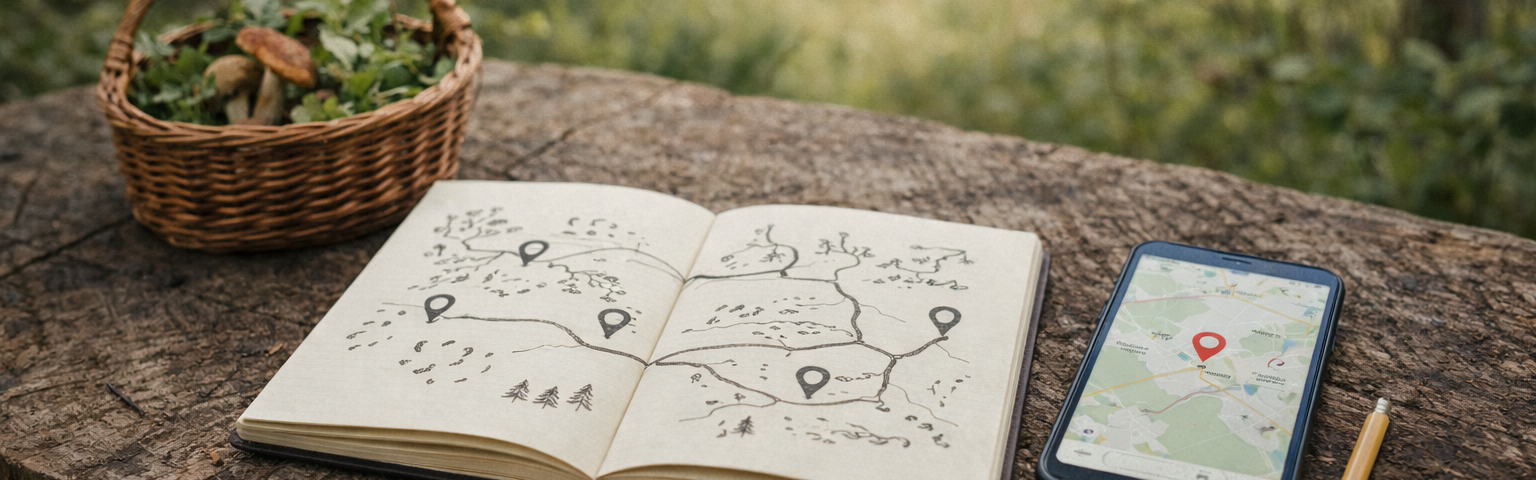
Why Mapping Improves Foraging Success
By now, you have begun building real foraging confidence.
If you missed last week’s discussion, review it here:
Foraging Confidence: How to Trust Your Identification Skills
https://thehgsociety.com/foraging-confidence/
Confidence, however, becomes far more powerful when it connects to place.
Instead of wandering randomly, experienced foragers return to productive areas intentionally. They remember where a patch thrived. They track when mushrooms appeared. Over time, they notice patterns that guide future trips.
In other words, they map.
A personal foraging map transforms scattered discoveries into a repeatable system.
The Beginner Forager Framework
New articles every Thursday at 6:00 PM
This article continues our 12-week progression. Each week strengthens your structure as well as your skill.
Today, you will learn how to create a personal foraging map that improves timing, efficiency, and long-term success.
What Is a Personal Foraging Map?
A personal foraging map is not a public list of secret locations.
Rather, it is a private tracking system that helps you document:
Where a species was found
When it appeared
How productive the patch was
What environmental conditions were present
Instead of relying on memory alone, mapping creates a written record. Consequently, patterns become visible much faster.
Records build predictability.
Why Memory Alone Fails
At first, beginners assume strong spots will be easy to remember. However, seasons shift, weather varies, and landscapes change subtly.
Without documentation, details blur together.
For example, you might recall finding chanterelles in a certain forest. Yet you may forget whether they appeared after two days of rain or after a full week of steady moisture.
Because timing depends on small variables, those forgotten details matter.
Mapping preserves them.
Start With Simple Tools
Fortunately, you do not need advanced technology.
A notebook works. A printed map works. Even a basic phone map app works.
Mark the location clearly. Then add notes about surrounding trees, slope direction, soil moisture, and growth stage.
As seasons pass, those small details accumulate. Eventually, you begin recognizing repeatable timing.
Observation becomes forecasting.
Track More Than Just Coordinates
Location alone does not guarantee success.
Therefore, record additional information such as:
Date of discovery
Recent rainfall
Temperature trends
Sun exposure
Nearby tree species
Specimen quality
When you combine these details, your understanding deepens. As a result, prediction becomes more accurate.
Prediction builds confidence.
Combine Mapping With Seasonal Awareness
Mapping becomes powerful when paired with seasonal awareness.
As discussed in Week 7, growth responds to environmental cues. When you connect those cues to specific locations, you build a forecasting system.
For instance, you may notice that one patch produces mushrooms roughly ten days after consistent autumn rain. Meanwhile, another site may require slightly warmer soil before fruiting.
Over time, your map becomes a seasonal calendar tied to place.
Strategy replaces guesswork.
Protect Your Locations Carefully
A personal foraging map should remain private.
Publicly sharing detailed coordinates can quickly damage productive areas. Increased pressure often reduces sustainability.
Therefore, treat your location data responsibly.
Stewardship applies not only to harvesting but also to information.
Deepen Knowledge With Focused Study
Continue studying one plant and one mushroom each month.
As you encounter each species in different places, record every location. Compare habitat differences. Note how productivity shifts between sites.
Depth reveals nuance.
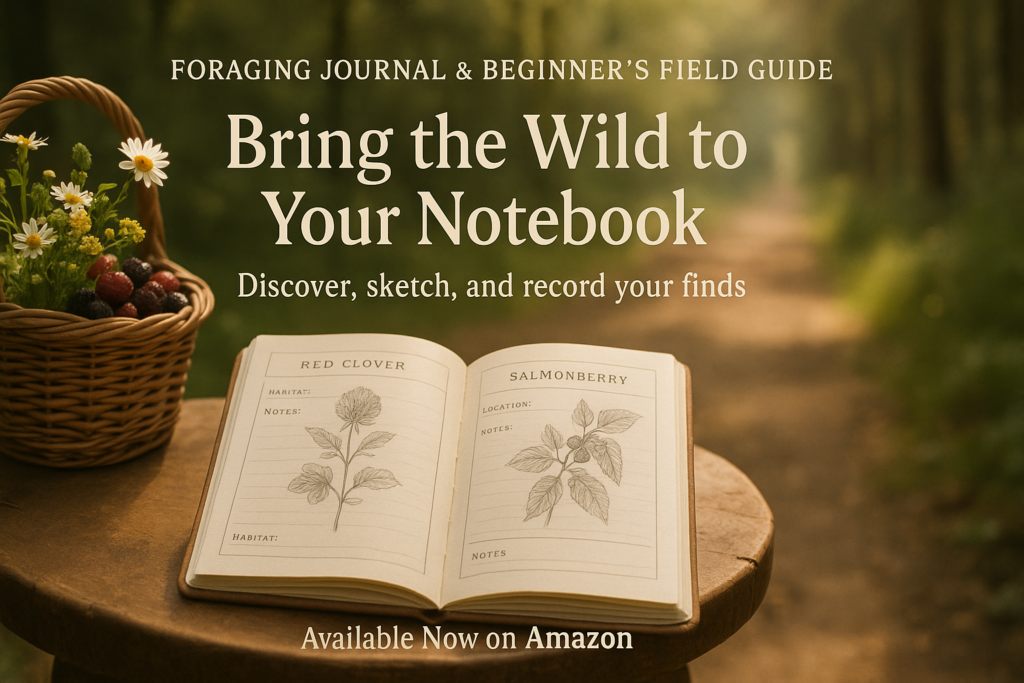
If you prefer a structured way to track this information, the Beginner Field Guide & Foraging Journal was designed specifically to organize location notes, timing observations, and seasonal patterns in one system:
https://www.amazon.com/dp/B0FSF3RM3W
Organization accelerates learning.
Review Before Each Season Begins
Before entering a new season, revisit your map.
Which locations produced last year?
What weather preceded peak growth?
Did timing vary between sites?
Preparation reduces wasted trips. Instead of guessing, you enter the field with informed expectations.
Prepared foragers move efficiently.
Balance Exploration and Repetition
Exploration introduces new opportunities. However, abandoning proven spots too quickly limits depth.
Return to productive areas across multiple seasons. Observe how they change over time. Notice subtle shifts in growth patterns.
Familiarity builds understanding.
At the same time, occasional exploration expands range.
Both approaches matter.
Turn Discovery Into a System
Without mapping, foraging remains opportunistic.
With mapping, it becomes intentional.
You begin anticipating patterns rather than reacting randomly. Gradually, wandering transforms into informed movement.
Systems reduce frustration. Consistency increases results.
Frequently Asked Questions About Personal Foraging Maps
Should I share my foraging map publicly?
No. Protect productive areas by keeping detailed locations private.
Do I need advanced GPS equipment?
No. A simple notebook or phone-based map app works effectively.
How long does it take to see useful patterns?
Patterns often begin emerging after one or two seasons of consistent documentation.
Continue the Beginner Forager Framework
This week, you learned how to create a personal foraging map and track productive locations.
Next week, we will explore:
How to Prepare for a Full Foraging Season With a Simple Action Plan
A new article goes live every Thursday at 6:00 PM.
Until then, document carefully. Revisit intentionally. Build your system.
I will see you next Thursday at 6:00 PM.
Foraging Safety Disclaimer
The information provided on this website and in this article is for educational and informational purposes only. Wild plant and mushroom identification carries inherent risks, including the possibility of serious illness, injury, or death if misidentification occurs.
Always verify identification using multiple reliable sources before harvesting or consuming any wild species. Never rely on a single source, photograph, or description. If you are uncertain about the identity of any plant or mushroom, do not harvest or consume it.
Foraging laws and regulations vary by location. You are responsible for understanding and complying with all local, state, and federal regulations before harvesting wild species.
The Hunter Gatherer Society and its authors assume no responsibility or liability for any injury, illness, loss, or damage resulting from the use or misuse of the information provided.
By using this content, you acknowledge that all decisions related to harvesting and consumption of wild foods are made at your own risk.


