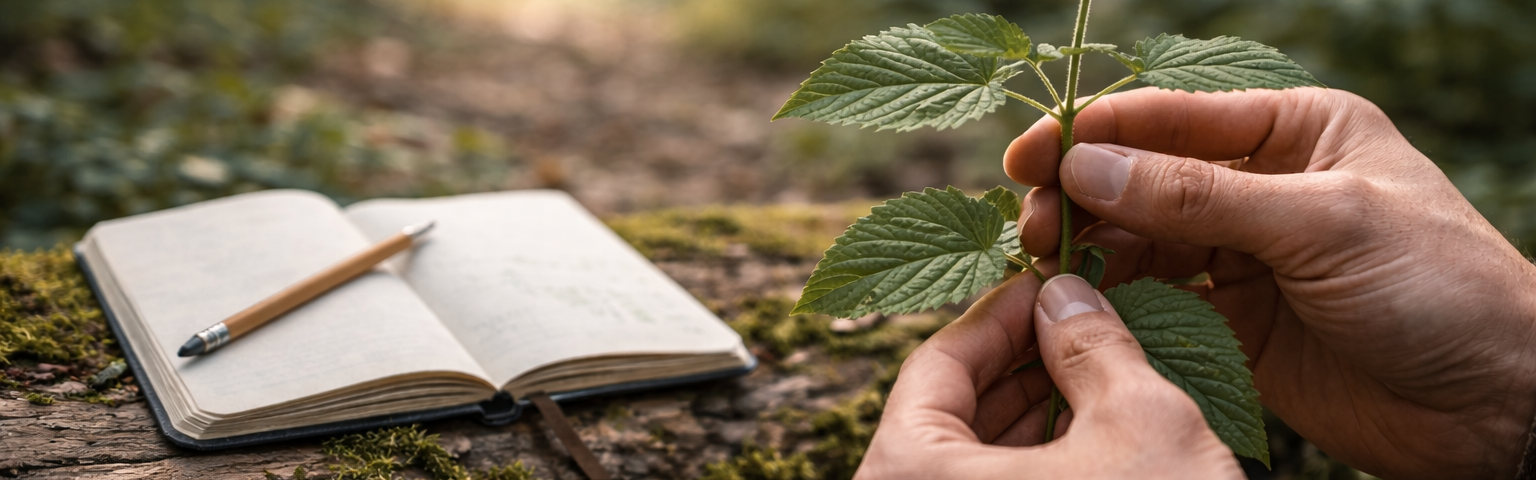
A Structured Identification System for Beginners
If you’ve followed the first two weeks of this series, you already understand something important.
You don’t need to know every plant to begin.
What you do need is a safe system.
Last week we established the 100 percent identification rule. This week, we build the method that makes that rule possible.
Because confident foraging is not about instinct.
It is about verification.
The Beginner Forager Framework
New articles every Thursday at 6:00 PM
This article is part of our 12-week Beginner Forager Framework. Each week adds one practical layer so your confidence grows steadily rather than suddenly.
Last week we focused on safety. Today we focus on identification.
Specifically, how to identify wild edible plants without guessing.
Why Visual Similarity Is Not Enough
Many beginners try to match a plant to a single photograph. While that feels logical, it is rarely reliable.
In botanical field practice, identification requires multiple confirming features. One detail is never enough.
Two plants may share a similar leaf shape. However, their stems can differ dramatically. Likewise, young plants may resemble other species early in the season but change as they mature.
So instead of asking, “Does this look like the picture?”
Ask, “Do all defining characteristics match what I studied?”
That question alone reduces risk.
Step 1: Observe the Entire Growth Habit
Start by looking at the whole plant.
Growth habit refers to how a plant grows in its environment. This includes height, structure, and overall form.
Ask yourself:
Is it upright or creeping?
Does it grow individually or in clusters?
Is it branching heavily or rising on a single stalk?
Is it herbaceous or woody?
Often, growth habit eliminates incorrect possibilities immediately.
For example, chickweed typically forms a low mat across moist soil. In contrast, lamb’s quarters grows upright and can reach several feet tall in disturbed ground.
When you zoom out first, you narrow the field safely.
Step 2: Examine Leaf Arrangement
Next, study how leaves attach to the stem.
Leaf shape matters. However, arrangement is often more reliable.
Look closely.
Are the leaves opposite each other on the stem?
Are they alternating one at a time?
Do they cluster at the base?
Leaf arrangement remains consistent within species. Because of that, it serves as a dependable identification feature.
Take your time here. Rotate the stem gently and examine several nodes, not just one.
Step 3: Evaluate Stem Characteristics
Now move to the stem.
Notice the surface texture. Is it smooth or hairy?
Observe the shape. Is it round or square?
Check for color variations or striping.
Gently feel whether it is hollow or solid.
Certain plant families share stem traits. For instance, square stems are common within the mint family. While this detail alone does not confirm identity, it strengthens your conclusion when paired with other features.
Layer by layer, confidence builds.
Step 4: Confirm the Habitat
Plant identification is not purely visual.
It is ecological.
Most species prefer specific environments. University extension guides consistently emphasize habitat as a confirming factor.
Ask:
Is the plant growing in disturbed soil?
Is it in woodland shade?
Does it appear in open meadow or lawn?
Is the soil dry or moist?
Lamb’s quarters commonly appears in gardens and field edges. Chickweed prefers cooler conditions and moist areas. Dandelion tolerates compacted lawns and open sun.
If habitat contradicts what you studied, pause and reassess.
Context matters.
Step 5: Verify the Season
Season adds another layer of confirmation.
Many edible plants change appearance throughout the year. Some look delicate in early spring but grow fibrous later. Others alter leaf shape as they mature.
Therefore, consider:
Does the growth stage match the time of year?
Is this how the plant should look in this season?
Season should support your identification, not conflict with it.
Step 6: Use Multi-Point Confirmation
Safe identification requires agreement across features.
Growth habit aligns.
Leaf arrangement matches.
Stem characteristics confirm.
Habitat supports it.
Season makes sense.
When several characteristics agree, confidence increases.
If one critical feature does not match, slow down.
Uncertainty is a signal to pause, not push forward.
The One-Plant-Per-Month Advantage
This system becomes much easier when your focus is narrow.
Instead of trying to identify every plant on a hike, concentrate on one species for the month.
Study it in different stages.
Observe it in varying light.
Notice how it interacts with nearby plants.
Over time, recognition becomes faster. Familiarity replaces hesitation.
That is how skill develops.
The Mystery Photo Method
While keeping your monthly focus clear, allow room for curiosity.
If you encounter a plant you do not recognize, take photographs instead of harvesting.
Capture the full plant.
Take a close-up of leaf arrangement.
Include stem details.
Photograph the surrounding habitat.
Later, compare your images calmly against your Field Guide and other reputable references.
Even if identification remains uncertain, you strengthen your observation skills without adding risk.
That is responsible learning.
Understanding Look-Alikes
Concern about toxic look-alikes is common. Fortunately, structured identification reduces that risk significantly.
Rather than memorizing every poisonous plant immediately, focus on distinguishing features of your chosen edible species.
Ask:
What feature clearly defines this plant?
What detail would rule it out?
Learning what makes a species unique improves accuracy.
When to Walk Away
Sometimes identification remains uncertain even after careful review.
In those moments, walking away is not failure.
It is discipline.
Experienced foragers routinely decline harvests when doubt persists. Confidence should feel supported by evidence, not urgency.
If certainty is missing, observation replaces consumption.
That principle protects you.
Skill Develops Through Repetition
Identification improves with practice.
Repeated observation sharpens pattern recognition. Documentation strengthens memory. Comparison builds clarity.
Progress happens gradually.
Over time, what once required effort becomes intuitive.
That intuition, however, is built on structure.
Continue the Beginner Forager Framework
Learning how to identify wild edible plants without guessing is foundational.
Next week, we move into a related but distinct skillset:
How to Identify Beginner-Friendly Wild Mushrooms With Confidence
A new article goes live every Thursday at 6:00 PM.
Until then, slow down. Confirm multiple characteristics. Let structure guide your learning.
I’ll see you next Thursday at 6:00 PM.
Foraging Safety Disclaimer
The information provided on this website and in this article is for educational and informational purposes only. Wild plant and mushroom identification carries inherent risks, including the possibility of serious illness, injury, or death if misidentification occurs.
Always verify identification using multiple reliable sources before harvesting or consuming any wild species. Never rely on a single source, photograph, or description. If you are uncertain about the identity of any plant or mushroom, do not harvest or consume it.
Foraging laws and regulations vary by location. You are responsible for understanding and complying with all local, state, and federal regulations before harvesting wild species.
The Hunter Gatherer Society and its authors assume no responsibility or liability for any injury, illness, loss, or damage resulting from the use or misuse of the information provided.
By using this content, you acknowledge that all decisions related to harvesting and consumption of wild foods are made at your own risk.


