A Practical Safety Framework You Can Trust
If you’re excited about foraging but slightly nervous, that’s a good sign.
Caution is healthy. In fact, responsible concern is what separates safe beginners from careless ones.
Last week, we introduced a simple beginner foraging plan: one plant and one mushroom per month. Now it’s time to build the safety foundation that supports that plan.
Because confidence without safety is not confidence at all.
The Beginner Forager Framework
New articles every Thursday at 6:00 PM
This article is part of the 12-week Beginner Forager Framework series. Each week builds on the last so you can grow steadily and responsibly.
By the end of this series, you won’t just feel informed. You’ll feel grounded.
Why Safety Feels Intimidating at First
Many people hesitate to begin foraging because they’ve heard warnings about poisonous mushrooms or toxic plants. While those warnings are important, they can also feel overwhelming.
The truth is this:
Foraging is safe when approached methodically.
Problems arise when people rush, guess, or assume.
Therefore, your goal is not to eliminate risk entirely. Instead, your goal is to eliminate guessing.
The 100 Percent Identification Rule
Here is the most important principle you will ever follow:
Never eat anything you cannot identify with complete confidence.
Not 90 percent.
Not “pretty sure.”
Not “it looks close.”
Complete confidence.
If doubt exists, observation replaces harvesting.
This rule alone prevents nearly every beginner mistake.
Study Before You Harvest
Remember the structure from Week 1.
Each month you choose one plant and one mushroom to focus on. That focus gives you time to study before you ever put something on your plate.
Study includes:
Reading identification features in your Field Guide.
Learning distinguishing characteristics.
Understanding common look-alikes.
Watching careful identification demonstrations.
Reviewing habitat patterns.
When you do encounter the species in the wild, you are not reacting. You are confirming.
That difference matters.
Learn the Habitat, Not Just the Shape
Many beginners focus only on appearance. While visual identification is critical, habitat is equally important.
Ask yourself:
Is this plant growing where it is supposed to grow?
Is this mushroom attached to the correct type of substrate?
Does the surrounding environment match what I studied?
For example, oyster mushrooms typically grow on hardwood. If you see a similar mushroom on soil with no wood nearby, pause.
Context protects you.
Over time, habitat becomes one of your strongest safety tools.
When You Don’t Know It, Photograph It
If you encounter something unfamiliar, do not harvest it.
Instead, take a clear photo.
Capture:
The full plant or mushroom.
The surrounding environment.
Close-up details.
Size comparison.
Then leave it alone.
At home, compare your photos carefully with your Field Guide. Research calmly. Look for confirming characteristics and eliminate look-alikes.
This simple habit builds skill while keeping risk low.
Avoid High-Risk Locations
Safety is not only about identification. It is also about environment.
Avoid harvesting near:
Busy roads.
Industrial areas.
Recently sprayed lawns.
Contaminated soil.
Even perfectly edible plants can absorb pollutants.
Therefore, choose clean environments. Public forests, well-managed lands, and known safe areas are better starting points.
When in doubt, do not harvest.
Start With Low-Risk Species
Not all species carry the same level of risk.
Some plants and mushrooms included in The Hunter Gatherer Society Beginner Field Guide are considered beginner-friendly because they have fewer dangerous look-alikes.
Starting with these builds confidence without unnecessary exposure to complex identification challenges.
Over time, as your skill improves, your range can expand naturally.
Harvest Conservatively
Even when you are confident, harvest lightly.
Take only what you will use.
Leave healthy specimens behind.
Avoid damaging root systems unnecessarily.
Cut mushrooms cleanly rather than ripping them out.
Responsible harvesting protects ecosystems and builds good habits from day one.
Safety includes environmental responsibility.
Keep Portions Small at First
When you try a wild food for the first time, even if it is confidently identified, eat a small amount.
Although allergic reactions are rare with well-known edible species, starting small is wise.
Cook thoroughly when appropriate.
Avoid mixing new wild foods with many other ingredients.
Pay attention to how you feel.
This approach builds trust gradually.
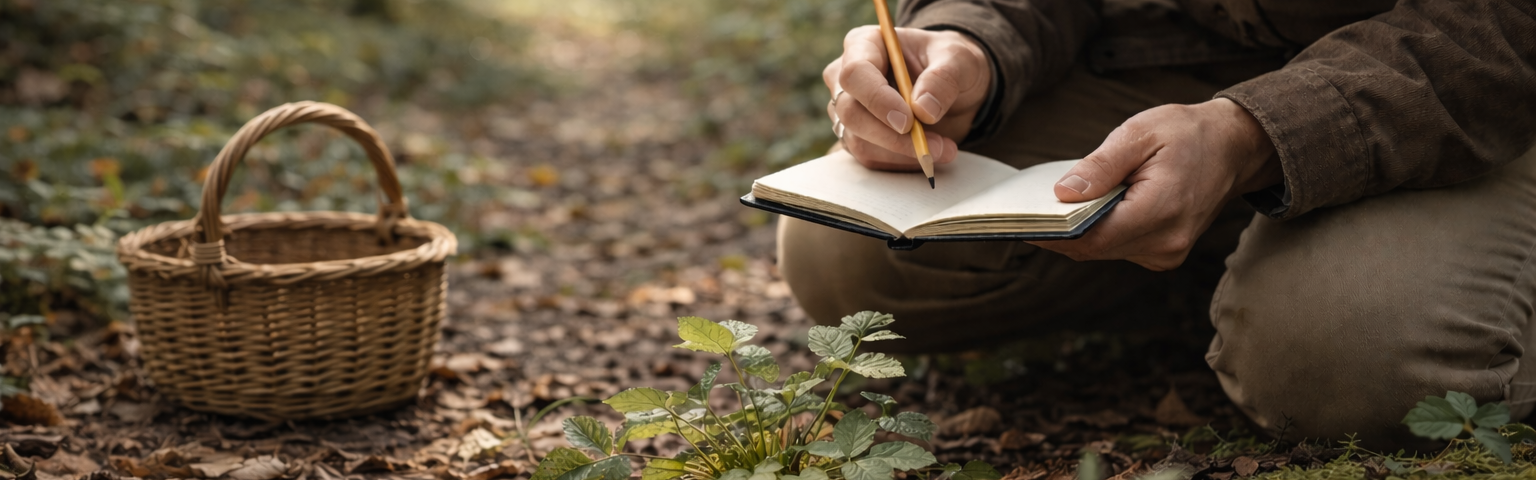
Document What You Learn
Safety improves with documentation.
Each time you study or observe a species, record:
Identification notes.
Habitat conditions.
Confidence level.
Questions that remain.
Writing forces clarity. Clarity strengthens confidence.
Over time, your journal becomes your personal safety reference.
Confidence Comes From Repetition
You do not become safe by memorizing lists.
You become safe by repeating careful observation.
One plant per month.
One mushroom per month.
Photograph unknowns.
Study at home.
Harvest only when fully confident.
The rhythm itself builds protection.
Eventually, what once felt intimidating begins to feel familiar.
Continue the Beginner Forager Framework
Safety is not about fear. It is about discipline and patience.
When you follow a structured beginner foraging plan and respect the process, confidence grows naturally.
A new article in this series goes live every Thursday at 6:00 PM.
Next week, we will explore:
How to Identify Wild Edible Plants Without Guessing
Until then, focus on observation. Focus on caution. Focus on building skill slowly.
I’ll see you next Thursday at 6:00 PM.

Foraging Safety Disclaimer
The information provided on this website and in this article is for educational and informational purposes only. Wild plant and mushroom identification carries inherent risks, including the possibility of serious illness, injury, or death if misidentification occurs.
Always verify identification using multiple reliable sources before harvesting or consuming any wild species. Never rely on a single source, photograph, or description. If you are uncertain about the identity of any plant or mushroom, do not harvest or consume it.
Foraging laws and regulations vary by location. You are responsible for understanding and complying with all local, state, and federal regulations before harvesting wild species.
The Hunter Gatherer Society and its authors assume no responsibility or liability for any injury, illness, loss, or damage resulting from the use or misuse of the information provided.
By using this content, you acknowledge that all decisions related to harvesting and consumption of wild foods are made at your own risk.


