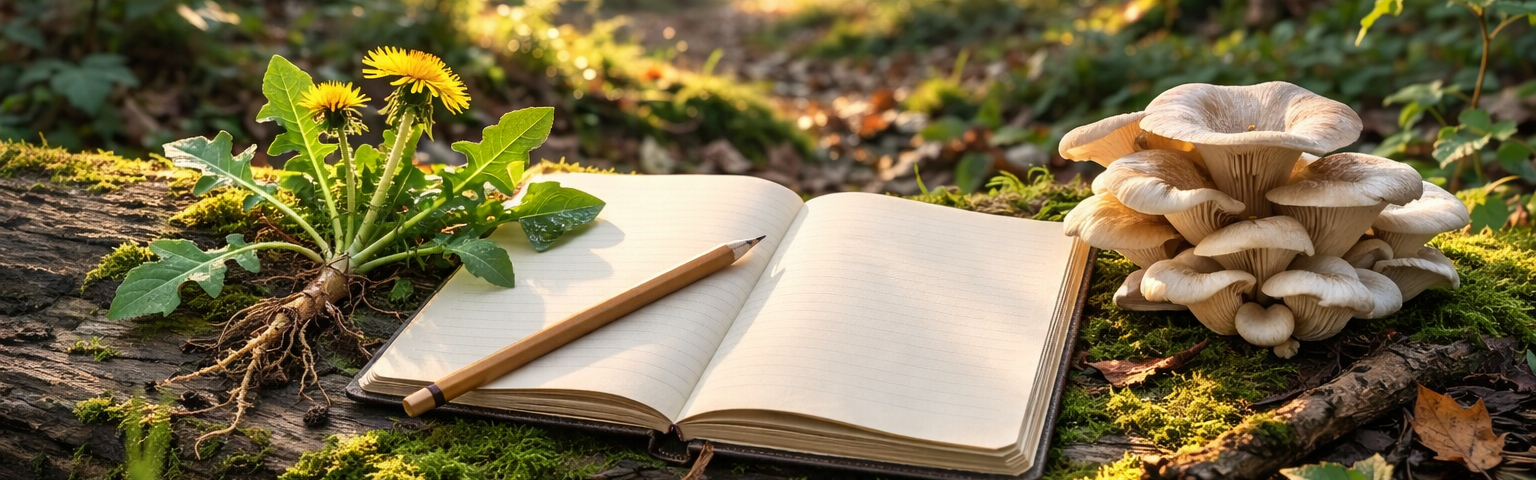
You Don’t Need to Know Every Plant to Start Foraging
If you’ve ever felt overwhelmed trying to learn wild edible plants and mushrooms, you’re not alone.
In fact, most beginners assume they must recognize dozens of species before they can safely enjoy foraging. Many believe they need to memorize scientific names, understand plant families, and identify everything they see before they even begin.
However, that belief stops more people than anything else.
Here’s the truth.
You don’t need to know everything.
Instead, you need a simple beginner foraging plan you can realistically follow.
The Beginner Forager Framework
New articles every Thursday at 6:00 PM
This article is part of a 12-week series designed to help you build real skill through a steady structure: one plant and one mushroom per month, guided by The Hunter Gatherer Society Beginner Field Guide & Foraging Journal.
Each Thursday at 6:00 PM, a new article goes live and builds on the last one. As the weeks progress, your confidence will grow alongside your knowledge. By the end of the series, you’ll have a clear, responsible, and repeatable approach to foraging.
Why Most Beginners Quit
Let’s look honestly at what usually happens.
Someone gets excited about foraging. Soon after, they buy a large field guide. Next, they begin watching hours of videos. Before long, they are scrolling through endless photos of mushrooms with names they cannot pronounce.
At first, the enthusiasm feels strong. Eventually, though, the information becomes overwhelming.
As a result, thoughts like these start creeping in:
I should recognize everything I see.
I should already know the scientific names.
I shouldn’t make mistakes.
Because of that pressure, progress slows. Confidence drops. Gradually, the excitement fades.
The problem is not ability. Rather, it is structure. Without a clear beginner foraging plan, information quickly turns into noise.
Remember Why Foraging Is So Enjoyable
Before we focus on structure, it helps to step back.
At its core, foraging is enjoyable.
It slows you down and sharpens your awareness. Additionally, it gives your walks a sense of purpose.
Once you recognize something simple like dandelion or oyster mushrooms, the woods begin to change. Instead of feeling random, the landscape starts to feel readable.
Over time, you notice patterns in soil, light, moisture, and tree cover. Consequently, you begin asking better questions. Rather than rushing past, you pause and observe.
Foraging trains attention. As attention deepens, connection grows. In turn, connection builds appreciation.
Ultimately, this practice is about more than food.
It is about learning to see.
A Beginner Foraging Plan That Actually Works
So what does a realistic plan look like?
Start by choosing one plant and one mushroom to focus on each month.
Importantly, this does not mean you must find them immediately. Instead, you simply target them intentionally.
For example, you might:
Study them carefully in your Field Guide.
Read about their identifying features.
Watch a responsible identification video.
Learn where they tend to grow.
Keep your eyes open while you hike.
If you find them, that is a bonus. If you do not, you still build knowledge.
Over twelve months, you gradually become familiar with twelve plants and twelve mushrooms already listed in The Hunter Gatherer Society Beginner Field Guide. As a result, your understanding becomes layered and practical rather than rushed and shallow.
That steady familiarity is more than enough to feel confident in the field.
What This Might Look Like
Month One
Plant: Dandelion
Mushroom: Oyster mushroom
Month Two
Plant: Chickweed
Mushroom: Morel
Month Three
Plant: Lamb’s quarters
Mushroom: Chanterelle
Throughout each month, you revisit those species in your mind and in your studies. Meanwhile, you may notice them in videos or photos. During hikes, you casually scan for them without pressure.
Because the focus is narrow, the experience stays manageable.
Instead of urgency, you build steady familiarity.
Add One Simple Habit: The Mystery Photo
To keep the process enjoyable, add one more habit.
While hiking or foraging, take a photo of one plant or mushroom you do not recognize.
Just one.
Rather than trying to identify everything, you allow a small amount of curiosity.
This approach works for several reasons.
First, it keeps learning playful.
Second, it strengthens your observation skills.
Finally, it prevents overwhelm.
Later, when you are home and relaxed, you can review the photo and compare it with your Field Guide. Even if you cannot identify it immediately, you still trained your eye.
Over time, those small moments of attention compound into sharper awareness.
Why One Species at a Time Builds Real Skill
The human brain remembers depth more effectively than volume.
When you spend an entire month thinking about one plant and one mushroom, subtle details begin to stand out. Gradually, leaf shapes become easier to recognize. Likewise, habitat clues start making sense. Eventually, growth stages become familiar rather than confusing.
Instead of feeling lost in the forest, you begin to feel oriented.
For that reason, learning slowly often builds confidence faster than attempting to memorize everything at once.
What About Scientific Names?
Scientific names absolutely matter. In particular, they reduce confusion and create precision, especially with mushrooms.
Nevertheless, they do not need to be mastered on day one.
Begin with physical identification features. As your familiarity grows, layer in the scientific name naturally. Because it connects to something you have already studied, it will stick more easily.
Confidence grows in layers, not leaps.
How This Fills Your Journal Naturally
The Beginner Field Guide & Foraging Journal was built around this steady rhythm.
Each month, you can record:
What you studied
Identification notes
Habitat details
Questions you still have
Whether you observed it in person
Mystery species photos and follow-up research
In other words, you are building experience rather than chasing perfection.
By the end of the year, you will not feel like a beginner.
Instead, you will feel capable and grounded.
The Mindset Shift
Instead of asking:
How many species should I know?
Ask:
What am I focusing on this month?
That small shift removes pressure and creates direction.
Consequently, foraging becomes steady rather than frantic.
Ultimately, it becomes a practice rather than a performance.
Continue the Beginner Forager Framework
Foraging is not about knowing everything. Rather, it is about learning steadily and building confidence one species at a time.
A new article in this series goes live every Thursday at 6:00 PM.
Next week, we will explore:
How to Start Foraging Safely as a Beginner
Until then, remember this: you don’t need to know everything. You simply need a clear system you can follow with confidence. The Beginner Field Guide & Foraging Journal was created to support that journey.
I’ll see you next Thursday at 6:00 PM.
Foraging Safety Disclaimer
The information provided on this website and in this article is for educational and informational purposes only. Wild plant and mushroom identification carries inherent risks, including the possibility of serious illness, injury, or death if misidentification occurs.
Always verify identification using multiple reliable sources before harvesting or consuming any wild species. Never rely on a single source, photograph, or description. If you are uncertain about the identity of any plant or mushroom, do not harvest or consume it.
Foraging laws and regulations vary by location. You are responsible for understanding and complying with all local, state, and federal regulations before harvesting wild species.
The Hunter Gatherer Society and its authors assume no responsibility or liability for any injury, illness, loss, or damage resulting from the use or misuse of the information provided.
By using this content, you acknowledge that all decisions related to harvesting and consumption of wild foods are made at your own risk.


