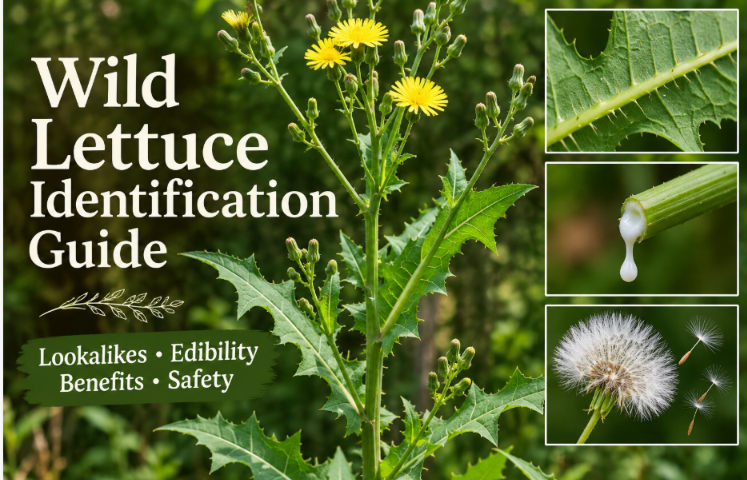
Wild lettuce is one of those plants you might walk past a hundred times without noticing. It grows along trails, in open fields, around gardens, and in disturbed areas. To most people, it looks like another tall, unwanted weed.
However, wild lettuce has a fascinating history. Some species have been gathered as wild greens, while others became popular in traditional herbal medicine.
You may have heard it called opium lettuce or seen claims that it works as a natural painkiller. Those stories make the plant interesting, but they also raise important questions about identification and safety.
After all, not every plant called wild lettuce is suitable for eating. Its medicinal reputation is also much stronger than the scientific evidence behind it.
This wild lettuce identification guide covers the features that matter most in the field. We’ll explore common species, edible uses, lookalikes, traditional benefits, and responsible harvesting.
Whether you’re a beginner or an experienced forager, there’s plenty to discover about this overlooked plant.
Wild Lettuce Quick Answers
Is wild lettuce edible?
Certain species, especially prickly lettuce (Lactuca serriola), have a history of being eaten as young greens. However, not every wild lettuce species is considered suitable for food.
How do you identify wild lettuce?
Look for alternate leaves, milky white sap, upright stems, and small flower heads. Prickly lettuce also has stiff prickles beneath the central leaf vein.
What does wild lettuce look like?
Young plants often resemble dandelion rosettes. Mature plants develop tall stems, branching flower clusters, and leaves that become progressively smaller toward the top.
Where does wild lettuce grow?
Common habitats include fields, gardens, roadsides, forest edges, vacant lots, and disturbed soil.
When is wild lettuce in season?
Young growth appears in spring or fall, depending on the climate. Flowering generally occurs during summer.
Does wild lettuce relieve pain?
Wild lettuce has a history of traditional medicinal use. However, reliable clinical evidence supporting its effectiveness as a pain reliever remains insufficient.
Is wild lettuce poisonous?
Some species and preparations can cause adverse effects. Published medical reports have documented poisoning associated with Lactuca virosa.
Wild Lettuce at a Glance
| Feature | Description |
|---|---|
| Common name | Wild lettuce |
| Scientific genus | Lactuca |
| Plant family | Asteraceae |
| Common species | Lactuca serriola, Lactuca virosa, Lactuca canadensis |
| Growth habit | Upright annual or biennial |
| Typical height | 1 to 6 feet, depending on species |
| Leaves | Alternate, sometimes deeply lobed |
| Stems | Upright, often hollow |
| Sap | Milky white latex |
| Flowers | Small, usually yellow heads in common species |
| Roots | Taproot |
| Habitat | Fields, roadsides, gardens, disturbed ground |
| Best identification season | Summer, when flowers are present |
| Culinary use | Young leaves of confirmed edible species |
| Main lookalikes | Sow thistle, dandelion, chicory |
| Main safety concern | Species confusion and concentrated latex preparations |
Quick Wild Lettuce Identification Tips
Out in the field, you don’t always want to scroll through an entire article. These five checks can help you decide whether a plant deserves closer examination.
- Check the leaf arrangement. Wild lettuce generally has alternate leaves growing at different points along the stem.
- Look beneath the leaves. Prickly lettuce has a distinctive row of small, stiff prickles along the underside of the central vein.
- Examine the stem. Mature plants usually develop a tall, upright stem that becomes branched near the flowering portion.
- Look for milky sap. A damaged leaf or stem releases white latex. Several lookalikes do too, so this feature isn’t enough by itself.
- Study the flowers. Many common wild lettuce species produce clusters of small yellow flower heads that resemble miniature dandelions.
Quick safety tip: Never identify wild lettuce from milky sap alone. Confirm the actual species before considering any culinary use.
What Is Wild Lettuce?
Wild lettuce is a common name for several plants belonging to the genus Lactuca.
Interestingly, this is the same genus that includes cultivated garden lettuce.
Prickly lettuce, or Lactuca serriola, is especially notable because it is a wild ancestor of the lettuce commonly grown for salads.
Despite that connection, wild lettuce often looks very different from the varieties found in grocery stores.
Most species grow taller, produce smaller flower heads, and develop more bitter leaves as they mature.
Some also contain bitter compounds that have attracted attention in traditional herbal medicine.
The name wild lettuce can be confusing because people often use it when discussing several distinct species.
For this guide, we’ll focus primarily on prickly lettuce while explaining how other common species differ.
How to Identify Wild Lettuce
Successful wild lettuce identification involves examining the whole plant.
Leaf shape provides a good starting point. However, the arrangement of leaves, stem structure, flowers, and underside of the midrib are equally important.
Let’s examine each feature.
Leaves: Lobed, Alternate, and Sometimes Prickly
Wild lettuce leaves vary considerably between species.
Prickly lettuce often develops long, narrow leaves with irregular lobes. Some look remarkably similar to dandelion leaves.
Other plants have leaves with wavy edges and very little lobing.
The color is usually green to bluish-green, sometimes with a slightly waxy appearance.
One particularly useful characteristic is the arrangement of leaves along the stem.
Unlike plants with opposite leaves, wild lettuce produces leaves alternately.
The Prickly Midrib
For prickly lettuce, turn a leaf over and examine its central vein.
Small, stiff prickles typically run along the underside of the midrib.
They may be visible without magnification, although a small hand lens makes them easier to examine.
Leaf edges can also have prickles.
This characteristic is one of the easiest ways to separate prickly lettuce from several similar plants.
However, other Lactuca species may have prickly midribs too. Always confirm additional features.
Stems: Tall, Upright, and Often Hollow
Mature wild lettuce plants develop an upright central stem.
Depending on the species, growing conditions, and maturity, stems can reach several feet tall.
Prickly lettuce generally begins as a low rosette before producing its flowering stalk.
The stem is often pale green and may develop reddish or purple coloring.
Branching usually becomes more noticeable near the upper portion of the plant.
Inside, the stem is commonly hollow.
Freshly damaged stems release a milky white sap.
Flowers: Small Yellow Heads
Wild lettuce belongs to the daisy family, so its flowers have a familiar appearance.
Rather than producing a single large flower, most common yellow-flowered species develop numerous small flower heads.
Each head contains multiple strap-shaped florets.
Prickly lettuce flowers are typically pale yellow and roughly one-third of an inch wide.
The flowering stems often form a loose, branching cluster.
As the flowers mature, they produce seeds attached to fluffy white bristles.
Wind carries these seeds into nearby fields, gardens, and disturbed areas.
Roots: A Strong Taproot
Wild lettuce generally grows from a taproot.
Young plants establish themselves by sending this primary root downward into the soil.
As the plant develops, its root system helps support the tall flowering stem.
Although roots are useful for understanding the plant’s growth, they aren’t necessary to examine when identifying an established flowering specimen.
Milky White Sap
Breaking a wild lettuce leaf or stem releases a milky substance known as latex.
This sap is one reason the plant attracts attention.
In some species, it contains bitter compounds historically associated with traditional medicinal preparations.
The dried latex is called lactucarium.
However, latex production is not unique to wild lettuce.
Dandelions, sow thistles, and several other related plants produce similar white sap.
For accurate identification, consider it one piece of evidence rather than a deciding feature.
Common Wild Lettuce Species
Several species share the common name wild lettuce. Understanding their differences helps prevent identification mistakes.
Prickly Lettuce (Lactuca serriola)
Prickly lettuce is widespread across North America.
Its most recognizable features include lobed or wavy leaves, stiff prickles beneath the midrib, clasping leaf bases, milky sap, and small yellow flowers.
Some plants grow quite tall in fertile soil.
Others remain relatively short when growing in dry or exposed conditions.
Young prickly lettuce leaves have a history of culinary use, although their bitterness increases with maturity.
For a detailed botanical description, visit Cornell University’s prickly lettuce identification resource.
Great Wild Lettuce (Lactuca virosa)
Great wild lettuce is sometimes called opium lettuce.
It is native to Europe and has become established in scattered parts of North America.
The plant generally has broad, somewhat bluish-green leaves, a tall stem, and yellow flower heads.
Its bitter latex has been used in traditional herbal preparations.
However, great wild lettuce should not be treated as an ordinary edible green.
Published poisoning cases have involved this species, making accurate identification especially important.
Canadian Wild Lettuce (Lactuca canadensis)
Canadian wild lettuce is native to North America.
It produces tall, leafy stems and numerous small flower heads.
Leaf shape can vary considerably, even on the same plant.
Some leaves are deeply divided, while others appear relatively narrow and less lobed.
Depending on the plant and growing conditions, flowers are generally yellowish.
Tall Blue Lettuce (Lactuca biennis)
Tall blue lettuce is another North American species.
Its bluish to purplish flower heads help distinguish it from the yellow-flowered wild lettuces.
The plant often grows in moist woodland openings and other relatively damp habitats.
Because species overlap in several characteristics, flower color, leaf shape, and habitat should all be considered together.
Where Does Wild Lettuce Grow?
Wild lettuce is often one of the first plants to appear after soil has been disturbed.
It takes advantage of open ground, sunlight, and reduced competition.
Common places to look include:
- Open fields and pastures
- Garden edges and agricultural land
- Roadsides and drainage ditches
- Vacant lots and abandoned properties
- Sunny woodland openings
- Disturbed trailsides
- Recently cleared ground
Although prickly lettuce often tolerates relatively dry conditions, other wild lettuce species prefer moister habitats.
Wild Lettuce in the Pacific Northwest
Here in western Washington, prickly lettuce is a familiar sight in many disturbed areas.
You may encounter it near gardens, open fields, and woodland edges.
It also grows east of the Cascades, where sunny, disturbed ground provides suitable habitat.
Great wild lettuce has been recorded in lowland areas west of the Cascades.
Meanwhile, other Lactuca species occur in different parts of the state.
The University of Washington Burke Herbarium provides regional photographs, botanical information, and distribution records.
For Pacific Northwest foragers, it’s an excellent resource for confirming which species occur locally.
When Is the Best Time to Find Wild Lettuce?
The appearance of wild lettuce changes throughout the growing season.
Learning those changes makes identification much easier.
Spring: Young Rosettes
Young wild lettuce plants often begin as a cluster of leaves close to the ground.
Prickly lettuce rosettes can resemble young dandelions.
At this stage, the leaves are generally more tender and less bitter.
However, early growth can be difficult to identify confidently.
Beginners should consider observing the plant through later stages before attempting a culinary harvest.
Summer: Flowering Plants
Summer is usually the easiest season for identification.
Mature stems, leaves, and flowers provide several useful characteristics at once.
The yellow flower clusters make prickly lettuce particularly noticeable.
Unfortunately, older leaves often become tough and strongly bitter.
This is an excellent time to study the plant, even when it isn’t ideal for gathering greens.
Fall: Seeds and New Growth
As flowering ends, wild lettuce produces fluffy seed heads.
Wind disperses the seeds across nearby open ground.
In suitable conditions, prickly lettuce seedlings may appear again during fall.
Some plants overwinter as rosettes and resume growth the following spring.
Wild Lettuce Lookalikes
Several plants resemble wild lettuce, particularly before flowering.
Fortunately, comparing a few key features can help separate them.
Dandelion (Taraxacum officinale)
Dandelions and young wild lettuce plants can have similar lobed leaves.
Both also produce milky sap.
However, mature dandelions keep their leaves in a basal rosette and produce flower heads on separate, leafless stalks.
Wild lettuce develops a leafy central stem with multiple flower heads.
Dandelions also lack the distinctive midrib prickles found on prickly lettuce.
Sow Thistle (Sonchus Species)
Sow thistles are among the most convincing wild lettuce lookalikes.
Their leaves can be lobed, and their stems produce milky sap.
Both groups also develop yellow flower heads.
However, sow thistles generally lack the distinct row of stiff prickles beneath the leaf midrib found on prickly lettuce.
Some sow thistle species have prickly leaf margins, so inspect the central vein rather than relying on the edges.
Chicory (Cichorium intybus)
Young chicory plants can resemble wild lettuce rosettes.
Later in the season, chicory becomes easier to recognize.
Its mature plants usually develop branching stems with striking blue flowers.
Chicory also lacks the characteristic midrib prickles of prickly lettuce.
Other Wild Lettuce Species
One of the most overlooked identification challenges is distinguishing wild lettuce species from one another.
Many share milky sap, alternate leaves, and similar growth patterns.
For that reason, identifying a plant only as Lactuca may not provide enough information to determine whether it is suitable for eating.
Foraging tip: When several features don’t agree, leave the plant growing. There is no benefit to rushing an uncertain identification.
Is Wild Lettuce Edible?
Yes, certain wild lettuce species have been eaten as wild greens.
Prickly lettuce is particularly relevant because of its close relationship to cultivated lettuce.
Its young leaves are the portions most commonly associated with culinary use.
However, the plant’s bitterness increases as it matures.
Not every wild lettuce species has the same culinary history or safety profile.
Great wild lettuce, in particular, has been associated with poisoning and should not be considered an ordinary food plant.
What Does Wild Lettuce Taste Like?
Young prickly lettuce leaves may taste mildly bitter.
The flavor becomes noticeably stronger as the plant ages.
Mature foliage can be extremely bitter and unpleasant.
For culinary purposes, tender young growth is generally preferred.
Can You Eat Wild Lettuce Raw?
Young prickly lettuce leaves have been eaten raw.
However, beginners should positively identify the species before considering this use.
Wild plants may also carry soil, insects, microorganisms, or environmental contaminants.
Wash edible greens thoroughly and harvest only from clean locations.
Can Wild Lettuce Be Cooked?
Young prickly lettuce leaves have traditionally been cooked as bitter greens.
Blanching may reduce some bitterness.
However, cooking should never be considered a way to make an unidentified or potentially toxic species safe.
Foragers should confirm the species and its established culinary use before preparing it.
Nutritional Value of Wild Lettuce
Wild lettuce belongs to the same genus as familiar garden lettuce.
However, that doesn’t mean their nutritional profiles are identical.
Detailed food composition data for individual wild lettuce species remain limited.
Vitamins and Minerals
Green leaves naturally contain plant pigments, fiber, and mineral nutrients.
Wild lettuce foliage may contribute some of these nutrients to the diet.
However, specific vitamin and mineral levels vary by species, plant maturity, and growing conditions.
For that reason, claims about unusually high amounts of vitamins A, C, or K should be approached cautiously without species-specific laboratory evidence.
Bitter Plant Compounds
Wild lettuce contains naturally occurring compounds known as sesquiterpene lactones.
Some contribute to the bitterness of the plant.
Among the best-known compounds associated with certain wild lettuces are lactucin and lactucopicrin.
Researchers have studied their biological activity, but laboratory findings don’t automatically translate into health benefits from eating the plant.
Is Wild Lettuce a Good Survival Food?
Wild lettuce sometimes appears in discussions about wilderness survival foods.
Although certain species can provide edible greens, the plant offers relatively little energy compared with calorie-rich wild foods.
Its bitterness and species-specific safety concerns also limit its practicality.
Knowing how to recognize edible wild lettuce is useful. However, it shouldn’t become a primary source of wilderness nutrition.
Traditional Medicinal Uses of Wild Lettuce
Wild lettuce has an interesting place in herbal history.
For generations, certain species were used in traditional preparations associated with discomfort, restlessness, and sleep.
Much of this reputation centers on the dried milky latex called lactucarium.
Historically, some herbalists considered it a calming substance.
This eventually contributed to the nickname opium lettuce.
However, the name can create a misleading impression.
Is Wild Lettuce Really Natural Opium?
No. Wild lettuce is not opium.
The plant does not contain the principal opioid alkaloids found in the opium poppy.
Its chemical composition is different, and its effects should not be compared directly with morphine or prescription pain medication.
The nickname reflects historical herbal use rather than chemical equivalence.
Does Wild Lettuce Relieve Pain?
Wild lettuce has traditionally been used for pain relief.
Some of its compounds have demonstrated biological activity in laboratory or animal research.
However, reliable human clinical studies are insufficient to establish wild lettuce as an effective pain treatment.
Traditional use does not prove that a preparation works or that it is safe.
Does Wild Lettuce Help With Sleep?
Some herbal traditions describe wild lettuce as calming or sleep-promoting.
Researchers have investigated compounds associated with these effects.
Nevertheless, strong clinical evidence supporting wild lettuce as a safe, effective sleep aid is lacking.
Concentrated preparations can also produce unpredictable effects.
What About Wild Lettuce Resin?
Online videos sometimes demonstrate collecting milky latex and concentrating it into a dark resin.
These preparations are frequently promoted as natural pain relievers.
However, their chemical strength can vary considerably.
Concentrating plant latex does not guarantee safety, effectiveness, or consistent dosing.
Published medical literature documents poisoning associated with Lactuca virosa.
In one case series, eight patients developed toxic symptoms after ingesting the plant. One required intensive care.
You can read the published research here: Wild Lettuce (Lactuca virosa) Toxicity.
For those reasons, homemade concentrated wild lettuce extracts and resins are not recommended.
Wild Lettuce Safety and Precautions
Wild lettuce deserves careful attention because its common name covers several species with different properties.
A few precautions can help prevent serious mistakes.
Identify the exact species. Similar appearance does not establish equal safety or edibility.
Avoid concentrated latex. Homemade extracts and resins may contain unpredictable concentrations of biologically active compounds.
Be aware of allergies. Wild lettuce belongs to the Asteraceae family. People sensitive to related plants may experience allergic reactions.
Consider medication interactions. Potentially sedating preparations may increase risks when combined with alcohol, sleep aids, or other medications.
Avoid medicinal use during pregnancy and breastfeeding. Reliable safety information is insufficient.
Choose clean harvesting locations. Plants growing near roads, industrial sites, or sprayed fields may be contaminated.
Watch for adverse reactions. Dizziness, nausea, vomiting, unusual agitation, or confusion following ingestion require medical attention.
In the United States, Poison Control can be reached at 1-800-222-1222.
Severe symptoms, including breathing difficulties or loss of consciousness, require emergency medical care.
How to Forage Wild Lettuce Responsibly
Learning to identify wild lettuce can be a rewarding experience even when you don’t plan to eat it.
In fact, observing a plant throughout its growing season is one of the best ways to improve your identification skills.
Start With the Whole Plant
Examine the overall growth pattern before focusing on smaller features.
Notice whether the leaves form a rosette or grow along a flowering stem.
Next, inspect the underside of a mature leaf.
For prickly lettuce, look for the stiff prickles along the central vein.
Photographs of the leaves, stem, flowers, and entire plant can help with later identification.
Confirm the Species
Use more than one reliable field guide or botanical reference.
Regional resources are particularly valuable because they help narrow the possibilities.
For Pacific Northwest plants, the Burke Herbarium is a useful starting point.
Compare your observations with verified botanical photographs and descriptions.
Harvest Only What You Need
For culinary harvesting, collect only from species with established edible uses.
Choose clean locations where gathering is permitted.
Avoid stripping entire patches or damaging surrounding vegetation.
Young leaves are generally preferred when harvesting confirmed edible prickly lettuce.
Learn the Plant’s Full Life Cycle
Try revisiting the same patch over several weeks.
Observe how the leaves change as the stem grows.
Watch for flower development, seed formation, and seasonal changes.
These observations create a much more complete understanding than a single photograph.
Wild Lettuce and Wildlife
Wild lettuce also plays a role in the surrounding ecosystem.
Its flowers can attract pollinating insects, including bees.
The seeds spread by wind and may establish new plants in nearby open areas.
Wild lettuce plants can also provide food or habitat for insects and other wildlife.
However, ecological importance varies by species.
Prickly lettuce is introduced in North America and can spread readily through disturbed landscapes.
Other wild lettuce species are native and contribute to local plant communities.
Identifying the exact species helps us better understand its place in the environment.
Frequently Asked Questions About Wild Lettuce
Is Wild Lettuce the Same as Garden Lettuce?
No. Wild lettuce and cultivated lettuce belong to the same genus, but they are not necessarily the same species.
Prickly lettuce is a wild ancestor of cultivated lettuce.
What Is the Easiest Way to Identify Prickly Lettuce?
Look for alternate leaves, clasping leaf bases, stiff prickles beneath the midrib, milky sap, and small yellow flower heads.
Several features should agree before confirming identification.
Can Wild Lettuce Grow in Washington?
Yes. Prickly lettuce is widespread throughout Washington.
Several other wild lettuce species have also been documented in the state.
Is Wild Lettuce Poisonous to Humans?
Some wild lettuce species and preparations can cause harmful effects.
Great wild lettuce has been associated with documented poisoning cases.
Avoid consuming unidentified species or concentrated latex preparations.
Does Wild Lettuce Contain Opioids?
Wild lettuce does not contain the principal opioid alkaloids found in opium.
Its nickname, opium lettuce, comes from traditional herbal use.
Can You Make Tea From Wild Lettuce?
Traditional herbal preparations sometimes include wild lettuce tea.
However, reliable evidence establishing medicinal safety and effectiveness is limited.
For this reason, medicinal use is not recommended without qualified professional guidance.
When Is the Best Time to Harvest Wild Lettuce?
Young spring growth is generally preferred for culinary use of confirmed edible species.
Summer is often better for identification because mature flowers and stems are visible.
Can Wild Lettuce Be Mistaken for Dandelion?
Yes. Young wild lettuce rosettes can resemble dandelions.
However, wild lettuce eventually develops a tall, leafy flowering stem, while dandelions produce separate, leafless flower stalks.
Final Thoughts on Wild Lettuce Foraging
Wild lettuce is a great reminder that even the most ordinary-looking plants can have interesting stories.
It connects familiar garden vegetables with wild plant identification, traditional herbal practices, and the ecology of disturbed landscapes.
Yet it also teaches an important lesson about responsible foraging.
Just because a plant has a history of medicinal use doesn’t mean every preparation is safe. Similarly, sharing a common name doesn’t mean two species can be used interchangeably.
For me, that’s part of what makes learning wild plants so rewarding.
Each new species adds something to our understanding of the natural world. Sometimes that knowledge leads to another wild food for the kitchen. Other times, the reward is simply recognizing a plant and understanding its place in the environment.
The next time you’re walking along a field or woodland edge, look for those tall stems and small yellow flowers.
Take a closer look at the leaves, especially the prickles beneath the central vein.
You might discover that wild lettuce has been growing around you all along.
And remember our most important foraging rule:
If you can’t name it, don’t eat it.
Continue Exploring Wild Edible Plants
If you enjoyed this wild lettuce identification guide, there are plenty of other useful plants waiting to be discovered.
Our Chickweed Identification and Edibility Guide explores another common wild green, including its lookalikes and culinary uses.
You can also learn about Stinging Nettle Identification, Harvesting, and Uses, one of the Pacific Northwest’s most recognizable wild foods.
For another beginner-friendly plant, explore our Wild Violet Identification Guide.
Keep exploring, stay curious, and enjoy discovering the wild foods and fascinating plants growing all around us.
Disclaimer: This article is for educational purposes only and is not medical advice. Never consume a wild plant unless its species and suitability for consumption have been positively established. Wild lettuce medicinal preparations may cause adverse effects and should not replace appropriate medical care.


