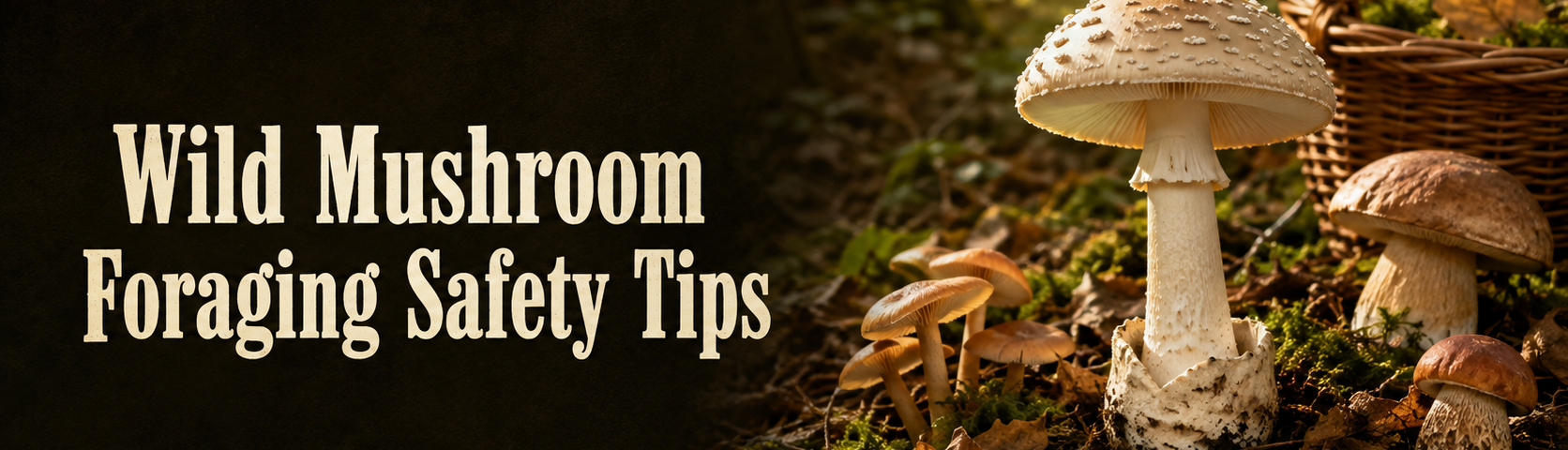
There is one phrase I never want to hear when someone is about to put a wild mushroom in the frying pan:
“I’m pretty sure.”
Perhaps you are pretty sure it is a chanterelle.
Maybe the identification app seems confident.
The gills might look right.
You may even remember picking the same mushroom last year.
Still, when it comes to wild mushroom foraging safety, “pretty sure” is exactly where we stop.
At The Hunter Gatherer Society, we have a simple rule:
When it comes to wild food, never say “I think,” “I believe,” or “I’m pretty sure.”
That does not mean we should be afraid of mushroom foraging. Quite the opposite.
Learning wild mushrooms is one of the best excuses I know to slow down in the woods, look more closely, and notice things we might otherwise walk right past.
However, there is an important difference between trying to identify a mushroom and deciding to eat one.
You are allowed to guess while you are learning.
You should never guess at dinner.
Quick Answer: How Can You Forage Wild Mushrooms Safely?
The safest approach to wild mushroom foraging is to identify mushrooms using multiple characteristics, rather than relying on a photograph or one feature.
Before eating a wild mushroom:
- Identify the entire mushroom, including the stem base.
- Examine the cap, gills or pores, stem, habitat, and growth pattern.
- Learn the poisonous lookalikes for the species you intend to eat.
- Use more than one reliable identification source.
- Never rely entirely on an identification app.
- Keep unidentified mushrooms separate from edible mushrooms.
- Make sure you can explain why the mushroom matches the edible species and why it does not match a dangerous lookalike.
Most importantly, if you are still saying, “I think this is…”, it is not ready for the kitchen.
Recent Mushroom Poisonings Offer an Important Lesson
Wild mushroom safety returned to the news after an unusually large outbreak of mushroom poisonings in California.
According to the California Department of Public Health, 50 poisoning cases were reported between November 18, 2025 and May 19, 2026. Four people died, and at least four required liver transplants.
Death Caps and Western Destroying Angels were associated with the outbreak.
Those are serious numbers. Even so, I do not think the lesson for foragers should be:
“Wild mushrooms are too dangerous to gather.”
Instead, the more useful lesson is:
Learn how mushroom identification actually works.
The Death Cap, Amanita phalloides, and Western Destroying Angel, Amanita ocreata, contain amatoxins that can cause severe liver injury.
More importantly for foragers, they can sometimes be confused with edible mushrooms, especially during certain stages of growth.
A poisonous mushroom does not necessarily look poisonous.
In fact, it may look fresh, clean, healthy, and perfectly ordinary.
That is why identifying a mushroom involves much more than finding a photograph that looks similar.
The Most Important Mushroom Identification Skill Is Knowing When to Stop
Beginning foragers naturally want to know what everything is.
I still do.
You spot something interesting beside the trail and immediately begin trying to put a name on it.
Yet one of the most valuable skills you can develop is recognizing when you do not have enough information yet.
Suppose you find a mushroom that looks exactly like something in your field guide.
Great.
Next, turn it over.
Look underneath the cap.
Then inspect the stem.
Check the entire base.
After that, look at what it is growing from and which trees are nearby.
If possible, compare young and mature specimens.
You may also need to check the season, spore color, bruising, smell, or other characteristics.
Finally, ask the question that beginning mushroom hunters sometimes forget:
What dangerous mushroom could I confuse this with?
That whole process is identification.
Matching a cap to a photograph is only the beginning.
Learn the Dangerous Lookalikes First
This is one of my favorite mushroom identification tricks because it turns the normal learning process around.
Rather than studying only the edible mushroom you want to find, study its dangerous lookalikes as well.
For example, if you want to learn puffballs, learn what an immature Amanita can look like when sliced open.
Likewise, if you plan to gather white gilled mushrooms, learn which poisonous white gilled species grow in your region first.
If boletes interest you, find out which local species should be avoided and what separates them from the mushrooms you hope to collect.
Instead of asking:
“Does this look like the edible mushroom?”
Ask:
“What else could this possibly be?”
That second question will make you a much better mushroom hunter.
Take the Whole Mushroom When You Are Identifying It
One simple habit can make mushroom identification considerably easier.
When you collect an unknown mushroom for identification, carefully remove the entire mushroom, including the base.
In other words, do not automatically cut the stem off at ground level.
Some mushrooms have important identification characteristics right at, or even below, the soil line.
This becomes particularly important with Amanita species.
For example, some Amanitas have a swollen base or a cup like structure called a volva. Depending on the species and growing conditions, that feature may be hidden beneath soil, needles, leaves, or forest debris.
Therefore, if you cut the mushroom off halfway up the stem, you may leave one of your best identification clues in the ground.
When the purpose is identification, slow down.
First, move the leaves and duff aside.
Next, carefully loosen the mushroom.
Then remove the whole specimen.
Finally, replace the disturbed soil and forest litter when you are finished.
Get to Know the Amanita Warning Signs
You do not need to become an Amanita expert before you begin mushroom hunting.
Nevertheless, anyone interested in eating wild mushrooms should become familiar with this important group.
Death Caps and Western Destroying Angels can have combinations of characteristics that include:
- White or pale gills
- A ring or skirt around the stem
- A swollen or bulbous stem base
- A cup or saclike volva around the base
- White spores
However, this is where mushroom identification becomes interesting.
Those features are clues, not a checklist that guarantees an identification.
A ring can deteriorate over time.
Similarly, a volva can remain underground.
Rain may wash away surface characteristics, while animals can damage other identifying features.
In addition, young mushrooms may look considerably different from mature specimens.
Color can vary as well.
For all of those reasons, good mushroom identification relies on several characteristics working together.
Use the HGS Seven Point Mushroom Identification Check
Before an unfamiliar mushroom becomes food, slow the process down and build your identification from several pieces of evidence.
1. Examine the Cap
Start by looking closely at the cap.
Pay attention to its:
- Color
- Shape
- Texture
- Surface
- Size
- Margin
Whenever possible, compare younger and older specimens because mushrooms can change dramatically as they mature.
2. Turn It Over
Next, look underneath the cap.
Does the mushroom have:
- True gills?
- Ridges?
- Pores?
- Teeth?
- Another type of spore bearing surface?
If it has gills, examine their color, spacing, thickness, and how they connect to the stem.
3. Inspect the Stem
After checking the underside, move on to the entire stem.
Look for:
- A ring or skirt
- Webbing
- Texture
- Color
- Hollow or solid structure
- Bruising or staining
- A swollen base
Most importantly, do not forget the portion beneath the soil.
4. Check the Base
Carefully remove the entire mushroom when identification requires it.
Then look for:
- A bulb
- A cup
- A saclike volva
- Rooting structures
- Changes in color or texture
In some cases, the base can provide one of the most important clues for separating an edible mushroom from a dangerous lookalike.
5. Look at the Habitat
Where a mushroom grows can tell you almost as much as the mushroom itself.
For instance, is it growing:
- Directly from soil?
- From buried wood?
- On a dead hardwood log?
- On a conifer?
- In grass?
- In wood chips?
- Near a particular tree species?
Many fungi form relationships with certain trees. Others, meanwhile, grow primarily on specific types of dead or decaying wood.
As a result, the mushroom and its surroundings should make sense together.
6. Use More Than One Reliable Source
One picture should never make the decision for you.
Instead, compare your mushroom with a good regional field guide, reputable mushroom resource, experienced identifier, or local mycological organization.
Also, look at several specimens and several photographs whenever possible.
Your goal is not simply to find one photograph that matches.
Rather, you want to determine whether all of the important characteristics match.
7. Eliminate the Dangerous Lookalikes
Finally, do not stop after deciding:
“This matches a chanterelle.”
Go one step further and ask:
“What mushrooms could be confused with a chanterelle here?”
Then eliminate those possibilities by comparing identifiable characteristics.
Ultimately, you should be able to explain both sides:
Why this is the mushroom I want.
And:
Why this is not the dangerous mushroom that resembles it.
That is real identification confidence.
Your Mushroom Identification App Gets a Vote, Not the Final Vote
I like technology.
Identification apps can be incredibly useful for learning plants and mushrooms.
For example, you can take a photograph and an app may quickly point you toward a genus, family, or possible species. Without that help, you might spend considerably longer flipping through a field guide.
That is useful information.
Still, there is a big difference between asking:
“What might this mushroom be?”
and asking:
“Can I eat it?”
A photograph might not show:
- The underground portion of the stem
- Spore color
- Gill attachment
- Interior structure
- Nearby trees
- Substrate
- Bruising reactions
- Changes between young and mature mushrooms
Furthermore, an app can only evaluate the information you give it.
If you photographed only the cap, the app only saw the cap.
Therefore, use identification apps to generate possibilities.
Then identify the mushroom yourself.
Never Let One Feature Make the Decision
This is an easy trap to fall into.
You may notice that the gills are white.
Perhaps the mushroom bruises blue.
Another specimen might have pores instead of gills.
You could also notice that it grows on wood, has a hollow stem, or gives off a distinctive smell.
Every one of those observations can be useful.
However, none should determine edibility by itself.
Think of mushroom identification like assembling a case.
First, one characteristic gives you a clue.
Then several independent characteristics pointing toward the same species create much stronger evidence.
After that, compare the mushroom against its dangerous lookalikes.
The question is not:
“Does one feature match?”
Instead, ask:
“Does the entire mushroom match?”
Spore Prints Are Still Useful
Smartphones have not made old fashioned mushroom identification techniques obsolete.
A spore print is a good example.
To make one, place a mature mushroom cap with the spore producing surface facing downward on an appropriate surface. Then allow enough time for the spores to drop.
Depending on the species, a mushroom might produce spores that appear:
- White
- Cream
- Pink
- Brown
- Rusty brown
- Purple brown
- Black
In some cases, spore color can eliminate potential identifications surprisingly quickly.
Still, a spore print will not magically tell you what mushroom you found.
Instead, it provides another piece of evidence.
And good mushroom identification is built from evidence.
Familiarity Is Helpful, but It Is Not Proof
Familiar places can occasionally make us less careful.
For example, chanterelles may have appeared on the same hillside for ten years.
Elsewhere, oyster mushrooms might keep fruiting from an old fallen log.
Meanwhile, morels may return near the same abandoned apple trees every spring.
That history is useful.
However, it is not identification.
The mushroom in your hand still gets checked.
Every time.
After all, the forest does not promise that only one species will ever grow in one location.
Treat familiarity as supporting information, never proof.
Cooking Cannot Fix an Identification Mistake
Some edible wild mushrooms need to be thoroughly cooked before eating.
Because of that, people sometimes get the mistaken impression that heat can make poisonous mushrooms safe.
It cannot.
For example, the amatoxins associated with Death Caps and destroying angels are not made harmless through normal cooking, boiling, or drying.
Therefore, if you are unsure of the identification before the mushroom enters the kitchen, the frying pan cannot solve the problem.
Dinner starts with identification in the woods.
It Is Perfectly Fine to Leave a Mushroom Behind
This may be the easiest wild mushroom safety rule of all.
You do not have to eat it.
Sometimes I cannot get an identification where I want it.
Perhaps the mushroom is too old.
In another case, an important characteristic may be damaged.
Occasionally, I may be stuck between two possible species.
Other times, something simply does not feel right about the identification.
That is fine.
Take pictures.
Study it.
Bring a specimen home for identification if appropriate.
You might also make a spore print or ask someone with more experience.
Most importantly, do not eat it until you know what it is.
That is not a failed foraging trip.
Instead, that is responsible foraging.
The woods will make another mushroom.
Keep Unknown Mushrooms Separate From Your Dinner Basket
Another simple habit can make mushroom foraging safer.
If you collect unfamiliar mushrooms for identification, keep them separate from mushrooms you intend to eat.
For example, use a separate paper bag, wax paper, container, or section of your basket.
This helps prevent broken pieces of an unidentified mushroom from becoming mixed with edible species.
In addition, separating specimens makes them easier to examine later.
A basket containing forty mushrooms from several species, all piled together, is much harder to sort through carefully when you get home.
Start With a Few Mushrooms and Learn Them Well
Beginning mushroom foragers sometimes feel like they should identify everything in the forest.
You do not need to.
In fact, learning three mushrooms extremely well is more useful than vaguely recognizing thirty.
Start with distinctive edible species found in your region.
Then learn:
- What they look like when young
- What they look like when mature
- Where they grow
- When they fruit
- Which trees they associate with
- Their important identification characteristics
- Their poisonous or inedible lookalikes
Handle them.
Photograph them.
Look underneath them.
Make spore prints when useful.
Better yet, go mushroom hunting with experienced foragers or join a local mycological club.
Over time, you begin building a mental library.
That is where real confidence comes from.
If you are also learning how to gather mushrooms without unnecessarily damaging their habitat, read our guide to Responsible Mushroom Foraging: How to Harvest Wild Mushrooms Sustainably.
Identification and responsible harvesting really belong together.
The Hunter Gatherer Society Wild Food Rule
Ultimately, wild mushroom foraging safety comes down to a surprisingly simple question:
What words are going through your head when you are holding that mushroom?
If your thoughts sound like this:
“I think…”
“It probably is…”
“The app says…”
“It looks close enough…”
“I’m pretty sure…”
Then you already have your answer.
Do not eat it.
Instead, keep learning until those words change.
You want to be able to say:
“I know what this mushroom is.”
“I know its identifying characteristics.”
“I know its dangerous lookalikes.”
“I know why this specimen is not one of them.”
That represents a very different level of confidence.
More importantly, getting there is part of the fun.
Mushroom foraging is not a race to fill a basket.
It is learning to notice details most people walk right past.
You begin seeing the shape of a gill.
Then you notice the tree growing twenty feet away.
Soon, you are looking for a cup hidden beneath the soil, tiny pores beneath a cap, or the color of spores left on a piece of paper overnight.
Little by little, those details turn an unfamiliar forest into a place you understand.
So get outside.
Turn over some mushrooms.
Take pictures.
Carry a field guide.
Make some spore prints.
Ask questions.
Most importantly, learn from people who know more than you do.
And remember the rule whenever something is headed toward the dinner table:
When it comes to wild food, never say “I think,” “I believe,” or “I’m pretty sure.”
Know before you eat.
Then get outside and do something wild.
Wild Mushroom Foraging Safety FAQ
Can I trust a mushroom identification app?
Identification apps are useful learning tools. However, they should not be the sole basis for deciding whether a wild mushroom is edible.
Instead, use an app to suggest possible identifications. Then verify the mushroom using multiple characteristics and reliable identification resources.
What parts of a mushroom should I examine?
Start with the cap and underside. Then examine the gills or pores, complete stem, stem base, growth pattern, substrate, surrounding habitat, and nearby trees.
Depending on the species, spore color, bruising, smell, and internal structure may also be important.
Should I cut or pull a mushroom when identifying it?
When you need a mushroom for identification, carefully collecting the entire specimen can reveal important features around the stem base that might otherwise remain underground.
Afterward, replace any disturbed soil or forest litter.
Is a wild mushroom safe if I cook it thoroughly?
Not necessarily.
Some edible mushrooms should be cooked before eating. However, cooking does not make every poisonous mushroom safe.
For example, amatoxins found in Death Caps and destroying angels remain dangerous after normal cooking and food preparation.
What should I do if I am not completely sure a mushroom is edible?
Do not eat it.
Instead, photograph it, study it, make a spore print when appropriate, or ask an experienced mushroom identifier.
There will always be another mushroom.
What should I do if someone may have eaten a poisonous wild mushroom?
Do not wait for symptoms to develop.
In the United States, contact Poison Control at 1-800-222-1222 for guidance. Seek emergency medical care when advised or if serious symptoms develop.
If possible, save any remaining mushroom specimens and photographs because they may help with identification.
Sources and Further Reading
California Department of Public Health: Poisonous Wild Mushrooms
The Hunter Gatherer Society: Responsible Mushroom Foraging


