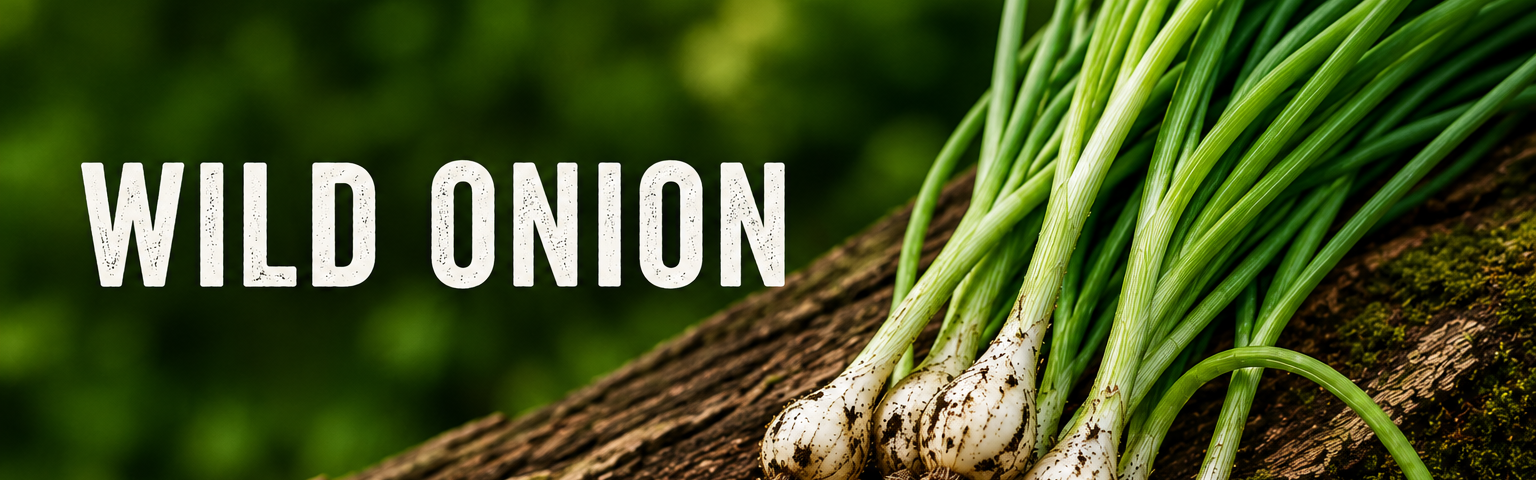
Wild onions are one of the easiest wild foods to overlook. Their narrow green leaves often blend into grass, lawns, field edges, and open woods. However, crush a leaf and the smell usually gives the plant away. A true wild onion should release a clear onion, garlic, or chive-like scent.
Several species in the genus Allium are commonly called wild onion or wild garlic. Depending on where you live, you may find common wild onion (Allium canadense), field garlic (Allium vineale), nodding onion (Allium cernuum), or another regional Allium species.
Many of these plants are edible. In fact, the leaves, flowers, and bulbs can often be used much like cultivated onions, garlic, or chives.
There is an important safety concern, though. Death camas can be deadly if mistaken for an edible onion. For that reason, never identify wild onion by leaf shape alone.
If you are new to wild plants, start with the Hunter Gatherer Society guide on how to identify wild edible plants without guessing. That same multi-point identification approach works well with wild onions.
Quick Answers
Are wild onions edible?
Yes. Many true wild onions in the genus Allium are edible.
What parts can you eat?
Depending on the species, the leaves, flowers, bulbs, and sometimes aerial bulblets can be eaten.
What does wild onion taste like?
Flavor ranges from mild chive or green onion to stronger garlic.
What is the easiest way to identify wild onion?
Look for narrow leaves, an underground bulb, Allium-type flowers, and a clear onion or garlic smell when the plant is crushed.
What is the most dangerous lookalike?
Death camas (Toxicoscordion spp.) is one of the most important toxic lookalikes.
Does death camas smell like onion?
No. Death camas does not have the strong onion or garlic smell found in true Allium species.
Can you eat wild onion raw?
Yes. Correctly identified wild onions can be eaten raw or cooked.
Quick Identification
Look for several of these traits together:
- Narrow, grass-like leaves
- Leaves growing from the base
- An underground bulb
- Smooth leaves without obvious hairs
- A mostly leafless flower stalk
- Rounded or umbrella-like flower clusters
- Small white, pink, lavender, or purple flowers
- Six tepals on each flower
- Possible aerial bulblets
- A strong onion or garlic smell when crushed
The smell is one of the most useful clues. Even so, it should be used with the rest of the plant’s characteristics.
No Onion Smell? Do Not Eat It
If a plant looks like wild onion but does not smell like onion or garlic, do not eat it.
Odor should not be your only test. Still, the lack of an onion or garlic smell is a strong warning sign.
What Is Wild Onion?
“Wild onion” is a common name used for several species.
True wild onions belong to the genus Allium. This is the same genus that includes cultivated onions, garlic, chives, leeks, and ramps.
One common North American species is Allium canadense. It may also be called common wild onion, meadow garlic, or wild garlic.
Another common species is Allium vineale, often called field garlic, wild garlic, crow garlic, or onion grass.
Because common names overlap, it is better to learn the actual species growing in your area. That makes identification more precise and also helps when comparing regional lookalikes.
How to Identify Wild Onion
Leaves
Wild onion leaves are usually narrow, smooth, and green.
At first glance, they often look like grass. However, they rise from the base of the plant rather than from branching stems.
Leaf shape also varies by species. Some wild onions have flat leaves, while others have rounded or hollow leaves.
For example, common wild onion usually has fairly flat leaves. Field garlic, on the other hand, often has hollow leaves that resemble chives.
Because of this variation, leaf shape alone is not enough for a positive identification.
Smell
The smell is one of the strongest field clues.
Crush a small piece of leaf between your fingers. A true wild Allium should smell clearly like onion, garlic, or chives.
The scent may be mild or strong. Nevertheless, it should be recognizable.
North Carolina Extension recommends using the distinctive onion odor as part of identifying common wild onion.
Important Safety Rule
Do not use smell as the only test.
Instead, treat it as one part of the full identification. If the plant looks right but has no onion or garlic smell, stop there.
Most importantly, do not eat it.
Bulbs
Wild onions grow from bulbs underground.
Depending on the species, the bulb may be round, oval, or elongated. In addition, it may have a papery or fibrous outer layer.
Some plants grow as single bulbs. Others form clusters with smaller offset bulbs.
If you need to inspect the bulb for identification, dig carefully. Usually, examining only a small number of plants is enough to learn the structure of the patch.
Flowers
Flowers make wild onions much easier to identify.
Most Allium species produce flowers in a rounded or umbrella-like cluster called an umbel.
Flower color varies by species. For example, you may see:
- White
- Pink
- Lavender
- Purple
Each small flower usually has six petal-like parts called tepals.
Common wild onion (Allium canadense) often produces pale flowers. In addition, it may produce small aerial bulblets in the flower cluster.
Because flowers provide several extra traits at once, they are especially useful for beginners.
Aerial Bulblets
Some wild onions produce tiny bulb-like structures above ground.
These are called bulblets or bulbils. They form in the flower cluster and help the plant reproduce.
Common wild onion and field garlic can both produce them. However, not every plant will have bulblets at every stage.
Therefore, their absence does not automatically rule out wild onion.
Flowering Stalk
Wild onions often send up an upright flowering stalk called a scape.
The upper part is usually leafless and ends in the flower cluster. As a result, a flowering plant is much easier to identify than a handful of young green leaves.
Whenever possible, learn a patch after the plants have flowered. Later, you will have a better chance of recognizing the same species earlier in the season.
Where Wild Onion Grows
Habitat varies by species.
You may find wild onions in:
- Meadows
- Fields
- Lawns
- Woodland edges
- Prairies
- Open woods
- Roadsides
- Pastures
- Disturbed ground
- Sunny slopes
Common wild onion is native across much of eastern and central North America. It grows in fields, lawns, meadows, and open woods.
Field garlic is introduced from Eurasia and North Africa. Even so, it is now widespread in many parts of North America.
Because several species tolerate disturbance well, wild onions can sometimes appear very close to home.
When to Find Wild Onion
Season depends on species and location.
Many wild onions are easiest to find from spring into early summer. Meanwhile, some species appear during cooler weather and fade as summer heat increases.
For beginners, flowering season is often the best time to learn a patch. Flowers give you several extra identification features.
Once you know the plant well, you can recognize its earlier growth with more confidence.
The Most Important Lookalike: Death Camas
Death camas is the lookalike every wild onion forager should know.
Several species once placed in Zigadenus are now classified in genera such as Toxicoscordion.
Meadow death camas (Toxicoscordion venenosum) is especially important in western North America.
Death camas may have:
- Narrow leaves
- Underground bulbs
- Upright flower stalks
- Pale flowers
Unfortunately, that combination can fool someone who is only looking for a grass-like plant with a bulb.
Oregon State University Extension warns that human poisonings have occurred when death camas was mistaken for onion or edible camas. Their Meadow Deathcamas in the Pacific Northwest guide is an excellent reference for western foragers.
Because the consequences can be severe, death camas should be learned alongside wild onion, not after the fact.
Wild Onion vs. Death Camas
Wild onion usually has:
- A clear onion or garlic smell
- Narrow basal leaves
- An underground bulb
- A rounded Allium-type flower cluster
Death Camas
Death camas has:
- No onion or garlic smell
- Narrow leaves
- An underground bulb
- Pale flower clusters
- Potent toxic alkaloids
The Most Important Difference
If a plant does not smell like onion or garlic, do not eat it as wild onion.
At the same time, a familiar smell should not be used to ignore other conflicting traits.
Never taste a questionable plant to identify it.
Quick Comparison
| Feature | Wild Onion | Death Camas |
|---|---|---|
| Underground bulb | Yes | Yes |
| Narrow leaves | Yes | Yes |
| Onion or garlic smell | Yes | No |
| Flower type | Rounded Allium cluster | Different flower cluster |
| Edible | Many species | No |
| Risk | Normal food use | Potentially deadly |
Why Flowers Matter
Young wild onion leaves can be difficult to identify because only a few traits are visible before flowering.
Once flowers appear, however, you can check:
- Flower shape
- Flower color
- Flower arrangement
- Flowering stalk
- Bulblets
- Mature leaves
- Overall growth habit
If you are unsure of a young patch, mark the location and come back later.
There is no need to rush. In fact, waiting for more identification features is often the safer choice.
Other Possible Lookalikes
Wild onion can also resemble other narrow-leaved or bulb-forming plants.
Depending on your area, these may include:
- Edible camas
- Ornamental bulbs
- Star-of-Bethlehem
- Young lilies
- Other grass-like plants
Some of these plants are toxic.
For that reason, never settle for “it looks like an onion.” Instead, confirm that the plant actually fits the characteristics of Allium.
Is Wild Onion Edible?
Many wild Allium species are edible.
For common wild onion (Allium canadense), edible parts include:
- Leaves
- Bulbs
- Flowers
- Flower stalks
- Bulblets
North Carolina Extension notes that the bulbs can be eaten raw, boiled, pickled, or used as seasoning. Its Allium canadense plant profile is a useful reference for identification and edibility.
Even with edible species, however, positive identification comes first.
What Does Wild Onion Taste Like?
Flavor depends on the species.
Some taste mild and grassy, much like chives. Others are stronger and closer to garlic.
Depending on the plant, you may notice flavors similar to:
- Green onion
- Chives
- Garlic
- Shallot
- Mild onion
Young leaves are often the easiest part to use. They are also convenient because harvesting a few leaves does not require digging up the whole plant.
What Parts Can You Eat?
Leaves
Young leaves work well in:
- Eggs
- Soups
- Salads
- Potatoes
- Sauces
- Compound butter
- Wild herb mixes
In most cases, you can use them much like chives or green onions.
Flowers
Flowers from correctly identified edible Allium species can also be eaten.
Besides adding mild onion flavor, they can make an attractive garnish.
Bulbs
Bulbs can be:
- Chopped
- Sautéed
- Roasted
- Pickled
- Added to soup
- Used as seasoning
However, digging the bulb kills that individual plant.
Therefore, if you only want a little onion flavor, taking a few leaves is usually the more sustainable choice.
Bulblets
Some species produce edible aerial bulblets.
These can have a stronger flavor than the leaves. As a result, a small amount may be enough.
How to Harvest Wild Onion
For everyday use, leaves are often the best choice.
Snip a few healthy leaves with scissors or a knife. Then leave plenty of green growth behind so the plant can continue growing.
If you decide to harvest bulbs, be more conservative.
Dig only from a large, healthy patch. Afterward, replace the soil and avoid disturbing nearby plants.
Wild onions may reproduce by seed, offsets, bulbs, or bulblets. Because removing the bulb removes the whole plant, bulb harvesting has a greater impact than clipping a few leaves.
Responsible Harvesting
Bulb-forming plants deserve extra care.
When you take a few leaves, the plant can often keep growing. In contrast, digging the bulb removes the entire individual.
For that reason:
- Harvest only from abundant patches
- Take only what you need
- Prefer leaves when possible
- Leave flowering plants behind
- Avoid damaging nearby plants
- Replace disturbed soil
- Follow local rules
- Ask permission on private property
The Hunter Gatherer Society Foraging Identification Guides cover similar identification and harvesting principles for other wild foods.
Where Not to Harvest Wild Onion
Wild onion often grows in lawns and disturbed places.
However, that does not mean every patch is safe to eat.
Avoid areas that may be contaminated, including:
- Treated lawns
- Roadsides
- Highway shoulders
- Railroad corridors
- Industrial sites
- Areas sprayed with herbicides
- Dog-heavy areas
- Contaminated drainage ditches
North Carolina Extension also warns against harvesting wild onion from areas where herbicides have been used.
In short, correct plant identification does not guarantee a clean harvesting site.
Cleaning Wild Onion
Wild onion leaves are simple to clean.
Rinse them well and remove damaged or dead tissue. Bulbs, however, usually need a little more work.
Wash away soil and trim dirty roots. If necessary, remove damaged outer layers before cooking.
Because soil can collect around the base, pay extra attention to that area.
How to Use Wild Onion
Wild onion works well anywhere you would normally use chives, green onions, garlic, or mild onions.
Wild Onion and Eggs
Finely chop the leaves.
Then add them near the end of cooking scrambled eggs or an omelet. This helps keep more of the fresh onion flavor.
Wild Onion Butter
Mix finely chopped leaves into softened butter.
Add a small amount of salt if you like. Afterward, use it on:
- Bread
- Potatoes
- Fish
- Vegetables
- Grilled foods
Soups and Stews
Chopped wild onion leaves or bulbs work well in soups and stews.
However, start with a small amount. Wild plants can taste stronger than their cultivated relatives.
Can You Eat Wild Onion Raw?
Yes.
Correctly identified wild onion leaves and bulbs can be eaten raw.
Young leaves work especially well in:
- Salads
- Sandwiches
- Dips
- Garnishes
- Herb mixtures
Still, large amounts of raw onion-family plants can upset some stomachs.
If it is your first time eating the plant, start small.
Nutritional Value
Wild onions belong to the same genus as cultivated onions, garlic, leeks, and chives.
Nutritional content varies by species, soil, maturity, and plant part.
Rather than treating wild onion as a “superfood,” it is better to think of it as a flavorful wild vegetable.
In addition to adding variety, it can bring a strong savory flavor to otherwise simple foods.
Traditional Food Use
Wild Allium species have a long history as food.
Different cultures have used the leaves, bulbs, and flowers as vegetables, seasonings, soup ingredients, cooked greens, and preserved foods.
However, many species are called wild onion. Because of that, historical use should be tied to a specific species and region whenever possible.
That distinction keeps traditional-use information more accurate.
Wild Onion vs. Wild Garlic
The names “wild onion” and “wild garlic” are often used for the same or similar plants.
For example, Allium canadense may be called either wild onion or wild garlic. Field garlic (Allium vineale) creates similar naming confusion.
For a forager, the common name matters less than the actual identification.
Instead, focus on:
- Genus
- Species
- Leaf structure
- Flowers
- Bulb
- Habitat
- Smell
Scientific names are especially helpful when common names overlap.
What About Ramps?
Ramps (Allium tricoccum) are also in the genus Allium.
However, they look quite different from most grass-like wild onions. Ramps have broad, flat leaves and usually grow in rich woodland habitat.
They also need special harvesting care because digging the bulbs can quickly reduce a patch.
For that reason, ramps are better treated in their own identification guide.
Beginner Identification Checklist
Before eating a suspected wild onion, confirm:
- The leaves match the expected Allium species
- The leaves grow from the base
- An underground bulb is present
- Flower structure matches Allium
- The plant smells clearly like onion or garlic
- Death camas has been ruled out
- Other local toxic lookalikes have been ruled out
- The harvest location is clean
- Harvesting is legal
If the onion smell is absent, do not eat the plant.
Likewise, if the other traits do not match, leave it alone.
The Beginner Rule to Remember
Wild onion is a good example of the difference between guessing and positive identification.
Do not think:
“It is not death camas, so it must be wild onion.”
Instead, ask whether every important feature confirms an edible Allium.
That change in approach matters. Rather than trying to eliminate one dangerous plant, you are positively identifying the plant you intend to eat.
Wild Onion Field Summary
Common name: Wild onion
Genus: Allium
Family: Amaryllidaceae
Growth type: Bulb-forming herbaceous perennial
Leaves: Narrow, linear, often grass-like
Leaf margins: Smooth
Bulb: Underground
Flowers: Small, often star-shaped
Flower cluster: Rounded or umbrella-like
Flower colors: White, pink, lavender, or purple
Odor: Strong onion or garlic smell when crushed
Habitat: Meadows, fields, lawns, woodland edges, and disturbed ground
Edible parts: Leaves, flowers, bulbs, and sometimes bulblets
Flavor: Onion, garlic, or chive-like
Main toxic lookalike: Death camas
Key safety feature: Onion or garlic smell combined with full botanical identification
Final Identification Summary
Wild onions are members of the genus Allium. This group also includes cultivated onions, garlic, chives, leeks, and ramps.
Most wild onions have narrow leaves that rise from underground bulbs. Later, they produce a flower stalk with a rounded cluster of small flowers.
Many species are edible. However, positive identification is essential because dangerous bulb-forming plants can grow nearby.
One of the easiest field clues is the smell. When you crush a leaf, a true wild onion should smell clearly like onion or garlic.
Still, smell is only one part of the identification.
Death camas can look similar, especially before flowering. It also grows from a bulb, but it does not smell like onion or garlic and is dangerously toxic.
The safest field rule is simple:
Narrow leaves + bulb + correct Allium flower structure + clear onion or garlic smell = strong wild onion characteristics.
If the smell is missing, stop.
Likewise, if the plant does not match the full pattern, leave it alone.
Learn the species growing in your area, compare it with toxic lookalikes, and harvest only from clean locations. Once you know the whole plant, wild onion can become one of the easiest and most useful wild seasonings to recognize.


