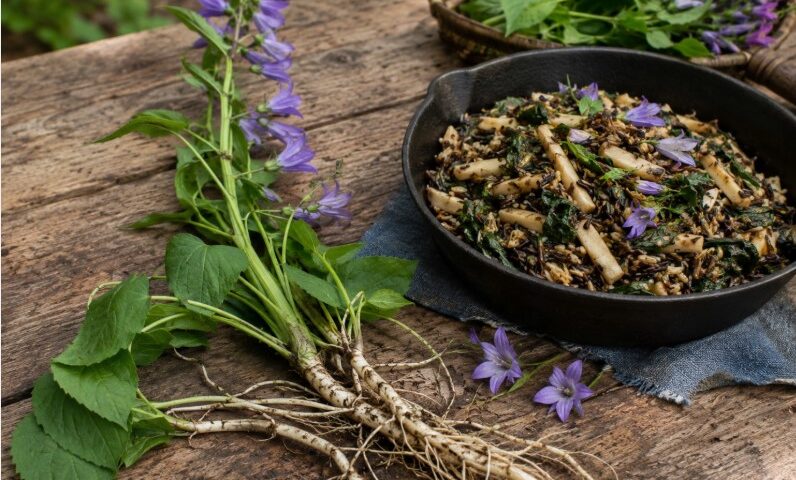
Creeping bellflower identification is important for Minnesota foragers, gardeners, and anyone interested in turning invasive plants into useful wild food. This aggressive purple-flowered plant can take over yards, gardens, lawns, and disturbed areas, but it also has an overlooked benefit: creeping bellflower is edible when correctly identified and harvested from a clean, unsprayed location.
The young leaves, tender shoots, flowers, and roots can all be used in the kitchen. However, this is not a plant to spread, plant, or encourage. Creeping bellflower is considered invasive in Minnesota, and University of Minnesota Extension describes it as an invasive perennial that spreads by both seed and roots.
That makes this plant a good fit for the “eat the weeds” approach. The goal is not to celebrate the invasion. The goal is to identify the plant correctly, remove it carefully, cook what you can use, and dispose of the rest in a way that does not help it spread.
Quick Identification Summary
Common name: Creeping bellflower
Other names: European bellflower, rampion
Scientific name: Campanula rapunculoides
Plant family: Campanulaceae
Status in Minnesota: Invasive perennial
Growth habit: Upright perennial that spreads by seed and underground roots
Height: Usually 2 to 3 feet tall
Flowers: Blue to purple, bell-shaped, five-lobed, mostly arranged along one side of the flowering stalk
Leaves: Basal leaves are heart-shaped; upper leaves become narrower and lance-shaped
Leaf arrangement: Alternate
Stem: Upright, green to purplish, with milky sap when broken
Roots: White, fleshy, tuber-like storage roots with rhizomes and fine roots
Edible parts: Young leaves, tender shoots, flowers, and roots
Best uses: Cooked greens, soups, wild rice skillets, stir-fries, edible flower garnish, quick pickles, and root vegetable dishes
What Is Creeping Bellflower?
Creeping bellflower, Campanula rapunculoides, is a perennial plant in the bellflower family. It was introduced to North America from Europe and western Siberia as an ornamental garden plant before escaping cultivation.
At first glance, it can look like a harmless purple garden flower. The problem is underground. Creeping bellflower forms a persistent root system with tuber-like storage roots and rhizomes. It also spreads by seed. According to University of Minnesota Extension, one plant can produce up to 15,000 seeds.
Once established, creeping bellflower can outcompete other plants and become difficult to remove. Foragers and gardeners can use that persistence as motivation. If the plant is already present in a clean, unsprayed area, careful harvesting can remove edible food while helping reduce the infestation.
Is Creeping Bellflower Edible?
Yes, creeping bellflower is edible when properly identified. Go Botany notes that the leaves and young shoots are high in vitamin C and mild in flavor, while the roots are edible raw or cooked.
The edible parts include:
Young leaves
Tender shoots
Flowers
Roots
The roots are often the most interesting edible part because they are mild, crisp, and slightly sweet. The greens can be cooked like spinach or other pot greens, while the flowers can be used as a mild edible garnish.
However, edibility does not make creeping bellflower a plant to grow. Do not plant it, move it, sell it, share root pieces, or toss seed heads where they can spread. Eat it only where it already grows and where removal is appropriate.
Creeping Bellflower Identification
Correct identification matters before eating any wild plant. Creeping bellflower is easiest to confirm when it is flowering, but the best edible greens often appear before the plant fully blooms. Learn the full plant pattern before harvesting.
Flowers
Creeping bellflower has blue to purple bell-shaped flowers with five pointed lobes. The flowers usually grow along one side of the flowering stalk, creating a one-sided spike.
This one-sided flower arrangement is one of the most useful identification clues when the plant is in bloom. In Minnesota, creeping bellflower typically flowers in summer and may continue into early fall.
Leaves
Creeping bellflower leaves change shape as the plant matures.
The lower basal leaves are usually heart-shaped and have longer leaf stalks. As the leaves move up the stem, they become narrower and more lance-shaped.
The leaves are alternate, meaning one leaf grows from each node instead of forming opposite pairs. They also have coarse-toothed edges and may feel slightly rough or hairy, especially underneath.
Stems
The stems are upright and can be green or purplish. When broken, they release a milky sap.
Milky sap can help support the identification, but it should not be used alone. Always confirm several traits, including leaf arrangement, flower shape, growth habit, and roots.
Roots
The roots are one of the most important identification features. Creeping bellflower forms white, fleshy, tuber-like storage roots along with rhizomes and smaller fine roots.
These roots are edible, but they are also why the plant is so persistent. Small root fragments left in the soil can allow the plant to regrow. When digging roots for food, work carefully and contain every piece.
Creeping Bellflower Look-Alikes
Creeping bellflower can be confused with other bellflowers, including native and ornamental species. That matters because not every bellflower-like plant should be removed.
Some native bellflowers have blue to purple flowers but do not share the same aggressive creeping root system. Creeping bellflower is usually identified by its combination of alternate leaves, one-sided spikes of bell-shaped flowers, milky sap, and persistent underground roots.
Do not rely on flower color alone. Purple flowers are common in many plant families, and young leafy plants can be harder to identify before bloom.
Before harvesting, confirm:
The plant has alternate leaves
The lower leaves are heart-shaped
The upper leaves are narrower and lance-shaped
The flowers are blue-purple and bell-shaped
The flowers grow mostly along one side of the stalk
The broken stem has milky sap
The plant has white, fleshy storage roots and rhizomes
The plant is growing in an area where removal is allowed and welcome
If you are still building your plant identification skills, start with our full library of Wild Edible Plant Identification Guides before harvesting new plants.
Where Creeping Bellflower Grows
Creeping bellflower often grows in yards, gardens, lawns, roadsides, disturbed soil, field edges, and waste areas. In Minnesota, it is especially common around homes and landscaped spaces where it may have escaped from older plantings.
For food use, the best harvest location is a known, unsprayed yard or garden where the landowner wants the plant removed.
Avoid harvesting from:
Roadsides
Sprayed lawns
Public parks with unknown herbicide use
Industrial areas
Drainage ditches
Contaminated soils
Dog-heavy areas
Any plant that looks wilted, twisted, yellowed, burned, or chemically damaged
Because creeping bellflower is often treated as a weed, assume herbicide exposure is possible unless you know the site history.
When to Harvest Creeping Bellflower
Creeping bellflower can be harvested through much of the growing season, but different parts are best at different times.
Young leaves and shoots are best in spring and early summer, before the plant becomes tough.
Flowers are useful in summer, while they are fresh and before seed formation.
Roots can be harvested whenever the ground can be dug, but they are often easiest to find when the flowering stalks make the patch obvious.
For invasive control, harvesting before seed set is especially useful. Removing flowers before they produce seed can reduce future spread, while digging roots removes some of the plant’s stored energy.
How Eating Creeping Bellflower Helps Fight an Invasive Plant
Eating creeping bellflower will not eliminate a large infestation by itself, but it can support a larger control strategy.
Harvesting flowers before seed formation can reduce seed production. Digging and cooking the roots removes part of the underground storage system. Repeated harvesting also keeps pressure on a plant that often survives casual pulling.
The key is containment.
Do not compost creeping bellflower in a home compost pile. Do not toss roots into a brush pile. Do not shake soil from the roots across the yard. Do not move live roots, seed heads, or contaminated soil to another property.
Treat every root fragment and seed head as a potential new plant.
Edible Parts of Creeping Bellflower
Creeping bellflower has four main edible parts: young leaves, tender shoots, flowers, and roots.
Young Leaves
Young leaves can be cooked like spinach, nettles, kale, or other pot greens. They are mild in flavor, but the texture can be slightly rough when raw. Cooking improves them.
Use creeping bellflower leaves in:
Soups
Sautéed greens
Egg dishes
Wild rice bowls
Pasta fillings
Creamed greens
Mixed wild-green skillets
Tender Shoots
Tender shoots are best before flowering. Steam, blanch, or sauté them. They pair well with butter, garlic, lemon, chili flakes, mushrooms, cream, and eggs.
Flowers
The flowers are mild and decorative. Use them as an edible garnish on salads, wild rice dishes, soups, berry bowls, or savory plates.
Harvest flowers before seed formation. Once seed capsules begin to form, focus on removal and containment rather than garnish.
Roots
The roots are the best culinary part of creeping bellflower. They are white, crisp, mild, and slightly sweet.
Use the roots in:
Skillets
Soups
Stir-fries
Quick pickles
Roasted root dishes
Wild rice dishes
Butter-sautéed sides
Creamy vegetable preparations
Younger roots are usually more tender. Older roots may need a little extra cooking.
Creeping Bellflower Nutrition
Reliable nutrition data for creeping bellflower is limited. Because of that, it is best not to claim exact calories, protein, minerals, or vitamin percentages unless a species-specific nutrient analysis is available.
What we can say is that Go Botany reports the leaves and young shoots are high in vitamin C.
For a stronger wild-food meal, pair creeping bellflower with nutrient-dense regional foods such as wild rice, mushrooms, fish, serviceberries, eggs, or other verified edible greens.
How to Prepare Creeping Bellflower
Start by separating the plant into greens, flowers, and roots.
Wash the greens in several changes of cold water. Because the leaves can be slightly rough, blanching helps improve texture. Drop the greens into boiling salted water for 30 to 90 seconds, then drain and squeeze out excess moisture.
For roots, scrub thoroughly. Trim away tough crowns, damaged spots, and tiny fibrous roots. Boil the cleaned roots briefly in salted water until tender, then finish them in butter, oil, soup, or stir-fry.
Keep all scraps contained. Any root pieces you do not cook should be bagged or disposed of according to local invasive plant guidance.
Creeping Bellflower Recipes
These recipes are designed around the “eat the weeds” concept. They use creeping bellflower as a real food plant while keeping the larger goal in mind: reduce the spread of an invasive species.
Recipe 1: Creeping Bellflower Root and Minnesota Wild Rice Skillet
This is the best starting recipe for Minnesota foragers because it pairs an invasive plant with one of the region’s most iconic native foods.
Ingredients
2 cups cooked wild rice
1 cup cleaned creeping bellflower roots, cut into bite-size pieces
2 cups young creeping bellflower leaves or tender shoots
2 tablespoons butter or oil
1 small onion, diced
2 cloves garlic, minced
1/2 cup mushrooms, sliced
Salt and black pepper
Lemon juice or apple cider vinegar
Optional: cooked trout, smoked fish, venison, or a fried egg
Instructions
Scrub the creeping bellflower roots well. Boil them in salted water for 2 to 5 minutes, or until just tender. Drain and set aside.
Blanch the creeping bellflower greens for 30 to 90 seconds. Drain, squeeze out excess water, and chop.
Heat butter or oil in a skillet. Add the onion and cook until softened. Add garlic and mushrooms, then cook until fragrant.
Add the boiled bellflower roots and cook until lightly browned. Stir in the cooked wild rice and chopped greens.
Season with salt, black pepper, and a splash of lemon juice or apple cider vinegar.
Serve as a side dish or make it a full meal with fish, venison, eggs, or roasted mushrooms.
Recipe 2: Invasive Greens Horta With Creeping Bellflower and Garlic Mustard
This recipe combines two edible invasive plants: creeping bellflower and garlic mustard. University of Minnesota Extension notes that planting or propagating garlic mustard in Minnesota landscapes is illegal, although existing plants are edible.
Only use garlic mustard before seed pods form, and dispose of any unused plant material responsibly.
Ingredients
4 cups young creeping bellflower leaves and tender shoots
1 cup young garlic mustard leaves
2 tablespoons olive oil or butter
1 clove garlic, minced
Lemon juice
Salt
Red pepper flakes, optional
Instructions
Wash the greens thoroughly. Blanch them in salted boiling water until tender, then drain well.
Heat olive oil or butter in a skillet. Add the garlic and cook briefly.
Add the drained greens and toss until hot and glossy.
Finish with lemon juice, salt, and red pepper flakes.
Serve with fish, eggs, wild rice, roasted potatoes, or grilled meat.
Recipe 3: Creamy Creeping Bellflower and Wild Rice Soup
This soup is ideal when you have more greens than roots. It uses creeping bellflower like spinach and lets wild rice turn the dish into a filling meal.
Ingredients
3 cups cooked wild rice
4 cups creeping bellflower greens, blanched and chopped
1 cup creeping bellflower roots, cleaned, boiled, and sliced
1 onion, diced
2 celery stalks, diced
2 carrots, diced
3 tablespoons butter
3 tablespoons flour
6 cups chicken, vegetable, or mushroom broth
1 cup cream, half-and-half, or oat milk
1 teaspoon thyme
Salt and black pepper
Lemon juice
Instructions
Melt butter in a soup pot. Add onion, celery, and carrots. Cook until softened.
Stir in flour and cook for 1 minute.
Slowly add broth while stirring to prevent lumps. Add wild rice, bellflower roots, and thyme. Simmer for 10 to 15 minutes.
Stir in the chopped bellflower greens and cream. Warm gently without boiling hard.
Season with salt, black pepper, and a small squeeze of lemon juice.
Recipe 4: Bellflower Root Stir-Fry
This simple stir-fry lets the mild, crisp roots shine. The carrots add sweetness, while soy sauce and vinegar give the dish a savory finish.
Ingredients
1 cup cleaned creeping bellflower roots, cut into thin matchsticks
1 cup carrot, cut into thin matchsticks
1 tablespoon neutral oil
1 tablespoon soy sauce
1 teaspoon sesame oil
1 teaspoon honey or maple syrup
1 teaspoon rice vinegar or apple cider vinegar
Optional: sesame seeds, chili flakes, or green onion
Instructions
Boil the cleaned bellflower roots for 1 to 2 minutes, then drain.
Heat neutral oil in a skillet. Add the roots and carrots.
Stir-fry for 3 to 5 minutes, until the vegetables are tender but still slightly crisp.
Add soy sauce, sesame oil, honey, and vinegar. Toss until glazed.
Finish with sesame seeds, chili flakes, or green onion.
Serve warm, room temperature, or chilled as a side dish.
Recipe 5: Serviceberry, Bellflower Blossom, and Wild Rice Salad
This recipe pairs creeping bellflower flowers with serviceberries, also called Juneberries. Serviceberries are native to Minnesota and produce edible purple fruit that can be used much like blueberries.
Ingredients
2 cups cooked and cooled wild rice
1 cup serviceberries or blueberries
1/2 cup fresh creeping bellflower flowers, picked before seed set
1/4 cup toasted sunflower seeds, hazelnuts, or walnuts
2 tablespoons maple syrup
2 tablespoons apple cider vinegar
3 tablespoons neutral oil or light olive oil
Pinch of salt
Optional: chopped mint, bee balm, or young plantain leaves
Instructions
Whisk maple syrup, apple cider vinegar, oil, and salt into a simple dressing.
Toss the wild rice, berries, and toasted seeds or nuts.
Add the creeping bellflower flowers at the end so they stay bright and intact.
Serve chilled or at room temperature.
This makes a good picnic salad, side dish, or light summer lunch.
Recipe 6: Creeping Bellflower Root Quick Pickles
Quick pickles are useful when you dig more roots than you can cook right away. This is a refrigerator pickle, not a canning recipe.
Ingredients
1 cup cleaned creeping bellflower roots
1/2 cup apple cider vinegar
1/2 cup water
1 tablespoon maple syrup or honey
1 teaspoon salt
1 garlic clove
Optional: mustard seed, dill, black pepper, or chili flakes
Instructions
Scrub the roots thoroughly. Slice larger roots into coins or thin strips.
Bring vinegar, water, maple syrup, and salt to a simmer.
Place the roots, garlic, and any spices in a clean jar.
Pour the hot brine over the roots. Cool, cover, and refrigerate.
Let sit overnight before eating. Use within two weeks.
Best Flavor Pairings for Creeping Bellflower
Creeping bellflower has a mild flavor, so it works best with stronger ingredients. Try it with:
Butter
Garlic
Lemon
Vinegar
Chili flakes
Mushrooms
Wild rice
Smoked fish
Trout
Eggs
Cream
Maple syrup
Serviceberries
Garlic mustard
Roasted roots
Venison
The greens behave like a mild cooked green. The flowers are mostly decorative. The roots are the most interesting part, especially when boiled and finished with butter, soy sauce, or vinegar.
Harvest Safety and Invasive Handling Rules
Only harvest creeping bellflower from clean, unsprayed areas.
Confirm identification before eating any part of the plant.
Do not plant creeping bellflower.
Do not transport live roots, seed heads, or contaminated soil to new locations.
Do not compost creeping bellflower in a home compost pile.
Harvest flowers before seed formation.
Contain all root scraps and plant waste.
Try a small amount the first time you eat it.
Check local disposal rules before throwing away invasive plant material.
Foraging Safety Disclaimer
This article is for educational purposes only. Always confirm plant identification with multiple reliable sources before eating any wild plant. Never eat plants from sprayed, polluted, or contaminated areas. When managing invasive plants, follow local and state disposal rules.
Final Thoughts: Identify It, Remove It, Eat It Responsibly
Creeping bellflower is a frustrating plant. It spreads aggressively, hides energy underground, and can take over gardens, lawns, and disturbed spaces. However, it also offers an opportunity.
The leaves can become cooked greens. The flowers can brighten a summer salad. The roots can be turned into skillets, soups, stir-fries, and pickles. When handled responsibly, every meal made from creeping bellflower removes at least part of a plant that should not be spreading through Minnesota landscapes.
That is the real value of learning creeping bellflower identification. It is not just about naming another weed. It is about recognizing a problem plant clearly enough to remove it, use it, and keep it from spreading farther.
Dig it. Cook it. Eat it. Contain the rest.
Then keep going.
Continue Learning
If you are building your wild food identification skills, start with our full library of Wild Edible Plant Identification Guides.
For creeping bellflower identification and invasive plant management, review the University of Minnesota Extension creeping bellflower guide. For additional botanical details and edibility notes, see the Go Botany profile for Campanula rapunculoides.
Sources and Further Reading
University of Minnesota Extension: Creeping Bellflower
Go Botany: Campanula rapunculoides
University of Minnesota Extension: Garlic Mustard
The Hunter Gatherer Society: Wild Edible Plant Identification Guides


