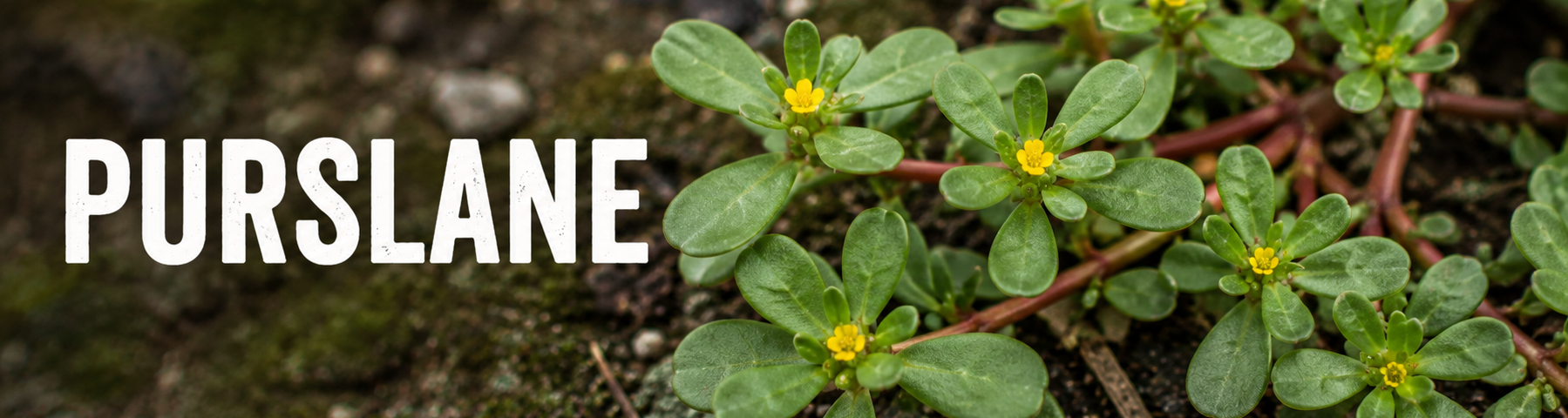
Common purslane (Portulaca oleracea) is one of those wild edible plants that can be hiding in plain sight. It grows low to the ground in gardens, disturbed soil, sidewalk cracks, farm fields, and other sunny places, where its thick leaves and reddish succulent stems are often dismissed as weeds.
For foragers, purslane is much more interesting.
The tender leaves and stems are edible raw or cooked, with a pleasantly tart, slightly salty flavor and a crisp, succulent texture. Purslane also has a long history as a food plant and is still eaten in many parts of the world.
It can be an excellent beginner wild edible, but there is one particularly important identification lesson: learn to distinguish purslane from prostrate or spotted spurges before harvesting it.
If you are new to gathering wild plants, start with the Hunter Gatherer Society guide to identifying wild edible plants without guessing. Purslane is a good plant for practicing that multi-point identification approach.
Quick Answers
Is purslane edible?
Yes. Common purslane (Portulaca oleracea) is edible. The leaves, tender stems, flowers, and seeds can be eaten.
What does purslane taste like?
Fresh purslane is crisp and succulent with a mild tart or lemony quality and sometimes a slightly salty flavor.
Can you eat purslane raw?
Yes. Young leaves and tender stems can be eaten raw or cooked.
What is the easiest way to identify purslane?
Look for a low-growing plant with smooth, fleshy leaves, thick succulent stems that are often reddish, and no milky white sap when broken.
What is the most important purslane lookalike?
Spotted and prostrate spurges (Euphorbia spp.) are important lookalikes. Spurges generally have thinner leaves and stems and produce conspicuous white, milky latex when broken. Purslane does not.
Where does purslane grow?
It favors sunny, warm, disturbed ground and commonly appears in gardens, cultivated soil, thin lawns, paths, agricultural areas, and cracks in pavement.
When is purslane in season?
It is primarily a warm-season annual. Depending on climate, plants generally appear from late spring through summer and persist until cold weather.
Quick Identification
Before harvesting, look for this combination of characteristics:
- Low, spreading growth, often forming a mat
- Thick, fleshy, succulent leaves
- Leaves generally oval, spoon-shaped, or wedge-shaped
- Smooth leaf edges with no teeth
- Thick, smooth, succulent stems
- Stems commonly reddish or reddish-green
- No hairs on the stems or leaves
- Small yellow flowers, usually with five petals
- No white milky sap when a stem is broken
Do not identify purslane from only one feature. Confirm several characteristics before considering a plant edible.
How to Identify Purslane
Growth Habit
Common purslane is a low-growing summer annual.
Young plants may initially grow somewhat upright, but established plants usually spread outward across the soil. Multiple fleshy stems radiate from central growing points, often creating a low, spreading mat.
According to Penn State Extension’s common purslane identification guide, purslane emerges from seed from late spring into midsummer and spreads laterally in a roughly radial pattern. The plant is particularly noticeable during warm summer weather.
Because purslane tolerates heat, poor soil, and moderate drought, it may remain healthy during summer conditions when some surrounding vegetation begins to struggle.
Leaves
The leaves are one of purslane’s strongest identification features.
Look for leaves that are:
- Thick and fleshy
- Smooth
- Hairless
- Usually oval, oblong, spoon-shaped, or somewhat wedge-shaped
- Rounded toward the tip
- Narrower where they join the stem
- Entire, meaning they have no teeth or serrations
They have the unmistakable texture of a small succulent rather than the thin, papery texture of many common lawn weeds.
Leaves frequently appear clustered around stem joints.
Stems
Purslane stems are:
- Smooth
- Hairless
- Fleshy
- Succulent
- Often red, pinkish-red, or reddish-green
Older stems can become fairly thick.
Break a stem and examine it.
Purslane should not release the conspicuous white milky latex characteristic of spurges.
That distinction is particularly useful when learning the plant.
Flowers
Purslane produces tiny yellow flowers.
Typical flowers:
- Are roughly 1/4 to 1/3 inch across
- Usually have five yellow petals
- Occur near leaf axils or stem tips
- Often open in bright sunlight
Because the flowers are small and may not always be open, you should be able to identify purslane without relying on flowers.
Seeds and Seed Capsules
After flowering, purslane forms small seed capsules.
When mature, the capsules open and release numerous tiny dark seeds.
Purslane is a prolific seed producer, which helps explain why it can repeatedly appear in gardens and disturbed ground.
Purslane vs. Spurge: The Lookalike Every Beginner Should Learn
The most important practical comparison for a beginning purslane forager is with low-growing spurges.
Both can:
- Grow flat against the ground
- Occupy lawns, gardens, pathways, and disturbed soil
- Have reddish stems
- Produce opposite-looking leaves
- Form spreading mats
But when examined closely, they are quite different.
Purslane
Purslane has:
- Thick succulent leaves
- Thick fleshy stems
- Smooth leaves
- Smooth leaf margins
- Often spoon-shaped or rounded leaves
- Small yellow flowers
- No milky white latex
Spurge
Common prostrate and spotted spurges generally have:
- Much thinner leaves
- Thin, wiry stems rather than plump succulent stems
- Leaves that may have a reddish or purple spot
- Tiny inconspicuous flowers
- White milky latex when stems or leaves are broken
The Sap Test
Breaking a stem can provide an excellent supporting characteristic.
White milky sap strongly points away from purslane and toward a spurge.
Do not use the sap test as your only identification method. Learn the overall structure of both plants and confirm multiple characteristics.
When you become familiar with purslane’s thick, juicy leaves and stems, the difference becomes much easier to recognize.
Another Possible Lookalike: Prostrate Knotweed
Prostrate knotweed can also form low mats in disturbed areas.
Unlike purslane, knotweed:
- Is not succulent
- Has thinner leaves and stems
- Has a papery sheath, called an ocrea, around the stem at the leaf nodes
Purslane has fleshy leaves and stems and lacks this papery sheath.
Where Does Purslane Grow?
Common purslane is extremely widespread and occurs across much of the world.
Foragers most often encounter it in places disturbed by people.
Look for it in:
- Vegetable gardens
- Flower beds
- Farm fields
- Orchards
- Bare soil
- Gravel
- Thin lawns
- Paths
- Along buildings
- Sidewalk and driveway cracks
- Other sunny disturbed areas
It generally prefers full sun and warm conditions.
One of the interesting things about purslane is that some of the places where it grows most abundantly are also places where you shouldn’t necessarily harvest it.
A beautiful purslane plant growing through a parking lot crack may be easy to identify, but that does not make it a good food source.
When to Harvest Purslane
Purslane is primarily a summer wild edible.
The exact season depends on your climate, but plants generally begin appearing as temperatures warm and can continue growing through summer and into early fall.
For eating, younger growth is usually preferable.
Look for:
- Plump leaves
- Tender stem tips
- Fresh green growth
- Healthy plants without discoloration or obvious contamination
Older stems can become tougher, although the leaves may remain useful.
How to Harvest Purslane
For a quick harvest, pinch or cut tender stem tips rather than automatically uprooting the entire plant.
Harvest:
- Young leaves
- Tender stems
- Growing tips
- Flowers if desired
The seeds are also edible, although gathering enough of the tiny seeds requires considerably more effort.
Responsible Harvesting
Purslane can be extremely abundant and is often actively removed as a garden weed. Even so, responsible foraging principles still apply.
Take only what you will use.
When harvesting from wild or semi-wild populations:
- Leave some healthy plants behind
- Avoid stripping small isolated patches
- Minimize unnecessary disturbance
- Follow local harvesting regulations
- Obtain permission before harvesting on private property
For more detail, see the Hunter Gatherer Society’s Foraging Identification Guides, which include identification, harvesting, edibility, lookalike, and field-safety resources for beginning foragers.
In a garden where purslane is being weeded out anyway, harvesting it for food can turn an unwanted volunteer plant into a useful crop.
Where NOT to Harvest Purslane
This deserves special attention because purslane thrives in disturbed places.
Avoid harvesting from areas that may be contaminated, including:
- Heavily traveled roadsides
- Parking lots
- Industrial properties
- Areas treated with herbicides
- Lawns treated with pesticides or other chemicals
- Sites contaminated by runoff
- Areas regularly used by dogs
- Soil of uncertain contamination history
- Railroad rights-of-way
Purslane growing from a sidewalk crack may look perfect while still being a poor choice for the dinner table.
Positive identification tells you what the plant is. It does not tell you whether the location is safe to harvest from.
What Parts of Purslane Are Edible?
Much of the above-ground plant is edible.
Leaves
The leaves are the most commonly eaten portion.
They are crisp, juicy, and mildly tart.
Use them:
- Raw in salads
- In sandwiches
- In wraps
- As a garnish
- Cooked like greens
- In soups and stews
- In egg dishes
Tender Stems
Young stems are also edible.
Their succulent texture makes them particularly useful when the plant is young and tender.
Older, thicker stems may become less pleasant.
Flowers
The small yellow flowers can be eaten along with the tender shoots.
Seeds
Purslane’s tiny seeds are also edible.
Historically, purslane has been valued primarily for its succulent greens, but the seeds can also be gathered and used as food.
What Does Purslane Taste Like?
Purslane has a flavor and texture that make it different from many wild greens.
Flavor: Mildly tart, slightly sour, fresh, and sometimes subtly salty.
Texture: Crisp, juicy, and succulent when raw.
Its texture can be almost cucumber-like in its juiciness, although the flavor is distinctly its own.
Cooking softens the plant and brings out its mucilaginous quality.
That natural mucilage can help thicken soups and stews.
How to Eat Purslane
One of purslane’s advantages for beginning foragers is that it requires very little preparation.
Wash it thoroughly and remove any tough or damaged portions.
Eat It Raw
Try tender leaves and stem tips in:
- Green salads
- Tomato salads
- Cucumber salads
- Sandwiches
- Wraps
Its tartness works particularly well with fresh summer vegetables.
Cook It Like a Green
Purslane can be lightly sautéed much like spinach.
A simple preparation is to cook clean purslane briefly with a little oil and garlic until just tender.
Avoid overcooking if you want to preserve some texture.
Add It to Eggs
Chopped purslane works well in:
- Scrambled eggs
- Omelets
- Frittatas
Add It to Soup
Purslane’s mucilaginous character makes it useful in soups and stews.
The same quality that gives raw purslane its juicy texture can provide a subtle thickening effect when cooked.
Pickle It
The succulent stems and leaves also lend themselves well to pickling.
This can be particularly useful when a garden suddenly produces far more purslane than you can eat fresh.
Simple Purslane and Tomato Salad
One of the easiest ways to appreciate fresh purslane is alongside ripe summer tomatoes.
Ingredients
- 1 cup cleaned tender purslane leaves and tips
- 1 large ripe tomato, chopped
- 1/4 cucumber, sliced
- A small amount of chopped onion
- Olive oil
- Lemon juice or vinegar
- Salt and pepper to taste
Directions
Combine the purslane, tomato, cucumber, and onion.
Dress lightly with olive oil and lemon juice or vinegar.
Season to taste.
The result is crisp, juicy, tart, and refreshing, exactly the qualities that make purslane such a useful summer wild green.
Nutritional Value of Purslane
Purslane has attracted considerable attention because its nutritional profile differs from many other leafy vegetables.
It provides nutrients and compounds including:
- Beta-carotene
- Vitamin C
- Vitamin E compounds
- Minerals
- Antioxidant compounds
Purslane is particularly notable among leafy plants for containing alpha-linolenic acid, or ALA, an omega-3 fatty acid.
Research from the USDA Agricultural Research Service on Portulaca oleracea discusses purslane’s use as a vegetable in several regions of the world and its omega-3 fatty acids, alpha-tocopherols, ascorbic acid, beta-carotene, and other constituents.
That doesn’t make purslane a miracle food, nor should it be treated as medicine. It does, however, make it a nutritionally interesting edible green.
Purslane and Oxalates
Purslane contains oxalates, naturally occurring compounds also found in foods such as spinach, beet greens, rhubarb, and sorrel.
For most people, normal culinary portions of appropriately identified purslane can simply be treated as another food containing oxalates.
However, consuming very large quantities isn’t advisable.
People who have been medically instructed to restrict dietary oxalate should follow the advice of their healthcare professional.
Is Purslane Native?
The ancient origin and dispersal history of Portulaca oleracea is complicated.
Purslane has been associated with humans as food for a very long time and today has an essentially worldwide distribution.
It has been used as a vegetable in numerous regions, including parts of:
- Europe
- Africa
- The Middle East
- Asia
- Mexico and Central America
Its relationship with humans is old enough that separating ancient natural distribution from human-assisted movement can be difficult.
For the modern forager, the practical point is simpler:
Purslane is now an extremely widespread edible plant.
Traditional and Historical Use
Purslane isn’t simply a modern “edible weed.”
It has a long history as a food plant.
Across different cultures, the succulent stems and leaves have been:
- Gathered wild
- Cultivated
- Eaten fresh
- Cooked as vegetables
- Added to soups and stews
- Preserved or pickled
Its continued use in traditional cuisines demonstrates something important about foraging: the distinction between a “weed” and a “vegetable” is often cultural rather than botanical.
A plant pulled from one garden as a nuisance may be deliberately grown for food somewhere else.
Can You Grow Purslane?
Absolutely.
In fact, if you enjoy eating purslane, deliberately growing it may be preferable to repeatedly harvesting from questionable urban locations.
Purslane thrives in:
- Full sun
- Warm weather
- Well-drained soil
- Garden beds
- Containers
Once established, it can produce large quantities of seed, so gardeners should be aware that allowing every plant to mature can result in plenty of purslane the following year.
For a forager who also gardens, that may be a feature rather than a problem.
Beginner Identification Checklist
Before eating a suspected purslane plant, confirm:
- Thick, succulent leaves
- Smooth leaf margins
- Smooth, hairless surfaces
- Thick, succulent stems
- Stems often reddish
- Low, spreading growth
- Small yellow flowers when present
- No papery sheath around the leaf nodes
- No white milky latex when broken
- Plant came from a clean harvesting location
If those characteristics don’t line up, don’t eat it.
Purslane vs. Spotted Spurge Quick Comparison
| Feature | Purslane | Spotted/Prostrate Spurge |
|---|---|---|
| Leaves | Thick and succulent | Thin |
| Stems | Thick, juicy, often reddish | Thin, wiry, often reddish |
| Leaf surface | Smooth and fleshy | Thin, sometimes hairy depending on species |
| Leaf markings | Usually plain green | Often reddish or purple spotted |
| Flowers | Small, yellow | Tiny and inconspicuous |
| White milky sap | No | Yes |
| Edible wild green | Yes | No, do not substitute for purslane |
The easiest field lesson is:
Purslane looks and feels succulent. Spurge does not.
And if the plant releases obvious white milky latex, stop. It isn’t purslane.
Foraging Safety
Never eat a wild plant based only on a photograph, app, or single characteristic.
Before eating purslane:
- Positively identify the plant as Portulaca oleracea.
- Learn the local spurges that can grow alongside it.
- Confirm several identification characteristics.
- Harvest only from clean, legally accessible locations.
- Wash the plant thoroughly.
- Try a small amount the first time you eat it.
Individual food sensitivities are always possible, even with correctly identified edible plants.
Another excellent beginner species for practicing multi-point identification is Plantain (Plantago): Identification, Edibility, Uses, Harvesting, and Complete Field Guide.
Why Purslane Is a Great Beginner Foraging Plant
Purslane checks many of the boxes that make a wild edible useful for beginners.
It can be:
- Abundant
- Widespread
- Easy to harvest
- Easy to prepare
- Eaten raw or cooked
- Found close to home
- Recognized by several strong physical characteristics
More importantly, learning purslane teaches an excellent foraging habit.
Don’t simply memorize what an edible plant looks like.
Learn the dangerous or undesirable lookalikes at the same time.
Once you can confidently distinguish succulent purslane from low-growing spurges, a plant that once looked like an ordinary garden weed becomes a useful summer vegetable.
Final Identification Summary
Common purslane (Portulaca oleracea) is a low-growing annual with fleshy, smooth leaves and thick succulent stems that frequently have a reddish color. It produces tiny yellow flowers during warm weather and commonly grows in sunny disturbed soil.
The leaves, tender stems, flowers, and seeds are edible. Fresh purslane has a crisp texture and pleasantly tart flavor and can be eaten raw, sautéed, added to soups, cooked with eggs, or pickled.
For beginners, the most important safety lesson is distinguishing purslane from prostrate and spotted spurges.
Remember the key combination:
Fleshy leaves + succulent reddish stems + yellow flowers + no milky white sap = strong purslane characteristics.
Confirm the entire plant before harvesting, choose a clean location, and this common “weed” can become one of the easiest wild vegetables to add to your foraging repertoire.


