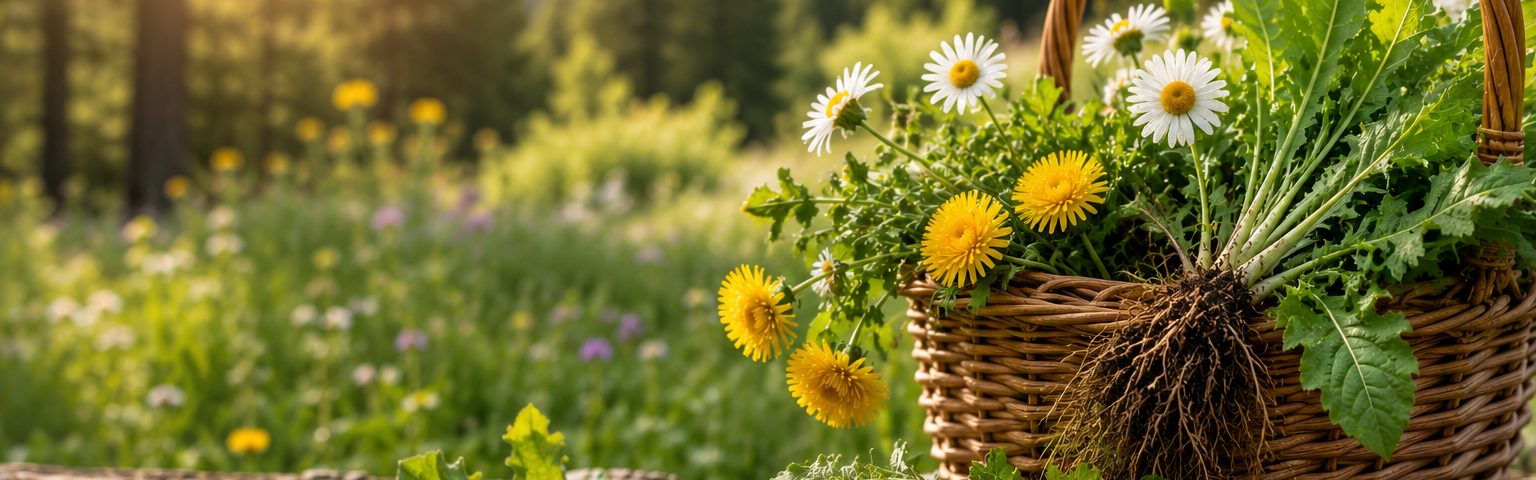
A good foraging trip should end with two things: something useful in your basket and enough left behind that the patch barely notices you were there.
That is the heart of responsible foraging.
Wild plants may feel free for the taking, especially when a field is overflowing with dandelions or berry canes are bending under ripe fruit. However, every patch is part of a larger living system. Flowers feed pollinators, fruit and seeds feed wildlife, roots hold soil in place, and healthy plants create the next generation.
The goal is not to avoid harvesting. It is to harvest in a way that allows wild food, habitat, and future opportunities to continue.
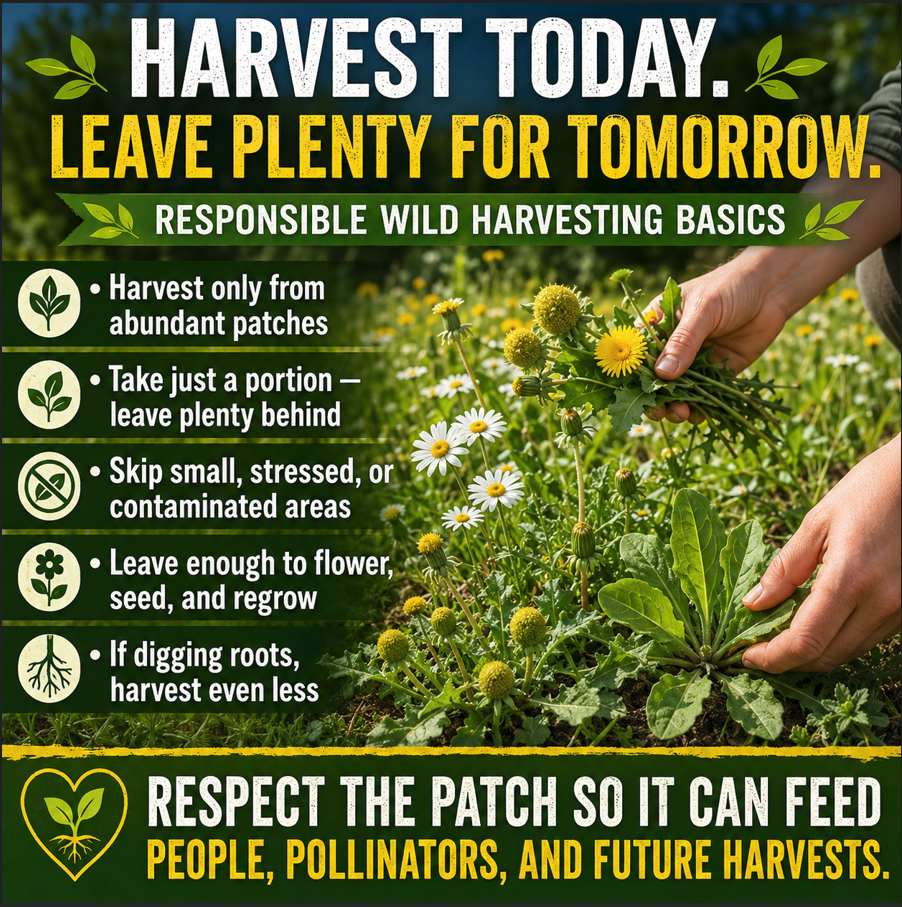
Harvest today. Leave plenty for tomorrow.
Quick Answer: What Is Responsible Foraging?
Responsible foraging means harvesting legal, correctly identified wild foods from healthy and abundant populations while leaving enough for the plants to reproduce, wildlife to feed, and other people to enjoy.
In practical terms:
- Harvest only from abundant patches.
- Take only what you will actually use.
- Leave most of the patch undisturbed.
- Avoid rare, stressed, damaged, or isolated populations.
- Take fewer flowers, seeds, roots, bulbs, and whole plants.
- Minimize trampling and damage to the surrounding habitat.
- Never harvest where collecting is prohibited.
- Skip areas that may have been sprayed or contaminated.
Responsible foraging is not about following one magical percentage. It is about observing the plant, the patch, the season, and the effect your harvest may have.
What Is Responsible Wild Harvesting?
Responsible wild harvesting is the practice of gathering wild plants while protecting the long-term health of the population and the surrounding ecosystem.
The terms responsible foraging, ethical foraging, and sustainable foraging are often used interchangeably. They share the same basic idea: gathering something from the wild creates a responsibility to understand what you are taking, where it came from, and whether the patch can recover.
Recent ecological research describes stewardship—the combination of care, knowledge, restraint, and long-term responsibility—as one of the most important foundations of sustainable foraging. Foraging can support a stronger connection between people and nature, but it can also damage local populations when harvesting becomes careless, repetitive, or commercial in scale.
Organizations such as the FairWild Foundation apply similar principles to larger wild-plant supply chains, emphasizing population health, legal compliance, ecosystem protection, and respect for local communities.
You do not need a clipboard and a population survey every time you pick a handful of berries. You do need to slow down long enough to notice what is happening around you.
Why Responsible Foraging Matters
One careful harvest from a large patch may have almost no noticeable effect. Dozens of people repeatedly harvesting the same small patch can create a very different result.
That cumulative pressure is easy to overlook because we usually see only our own basket.
A plant population must retain enough leaves to produce energy, enough flowers to reproduce, enough fruit or seeds to create future plants, and enough healthy individuals to withstand drought, disease, wildlife browsing, and changing weather. The amount that can be harvested sustainably varies by species, plant part, habitat, population size, and how frequently the location is visited.
Responsible harvesting also protects:
- Food and shelter for insects, birds, and other wildlife
- Genetic diversity within wild plant populations
- Soil and nearby vegetation
- Future crops of fruit, seeds, greens, and roots
- Opportunities for other foragers
- The long-term reputation of the foraging community
The fullest basket does not always belong to the best forager. Sometimes the most responsible decision is leaving a patch completely alone.
Start With Abundance, Not Appetite
Before reaching for your knife or basket, step back and look at the entire patch.
Is the plant growing throughout the area, or are you looking at the only few specimens present? Are there plants of different sizes and ages? Do they look vigorous, or are they wilted, diseased, insect-damaged, or struggling through drought?
A responsible harvest begins with a healthy population.
Signs of an abundant patch include:
- Many plants spread across a broad area
- Plants at several stages of growth
- Active flowering, fruiting, or seed production
- Healthy leaves and stems
- Additional populations nearby
- No obvious evidence of heavy previous harvesting
Leave the patch alone when:
- Only a few plants are present
- The population is isolated
- Plants appear stressed or damaged
- The site has recently been disturbed
- The species is rare, protected, or unfamiliar
- Other people have already harvested heavily
- You cannot confidently judge whether the population is healthy
A large patch can usually spare more than a small one, but “large” does not automatically mean unlimited. What looks like endless abundance from the trail may be a thin strip growing along one favorable edge.
Walk around. Look beyond the first cluster. Let the patch tell you what it can spare.
How Much Should You Take When Foraging?
There is no single harvesting percentage that works for every plant.
You may hear rules such as “take one-third,” “take no more than 10 percent,” or “leave half behind.” These can encourage restraint, but they are not universal ecological laws.
Harvesting ten percent of berries from a massive blackberry thicket is very different from digging ten percent of the roots in a slow-growing woodland plant population. Likewise, collecting leaves from a fast-growing plant may have less impact than removing its flowers, seeds, bulb, or entire root system.
A better general rule is:
Take only what you will use, spread your harvest across an abundant population, and stop well before the patch looks harvested.
Try the visible-impact test before leaving:
Stand back and look at the area. Is your activity obvious? Are there bare spots, broken stems, crushed plants, open holes, or noticeably fewer flowers?
When the answer is yes, you probably took too much or harvested too aggressively.
This is not a scientific measurement. It is simply a useful reminder that a careful forager should leave a light footprint.
The Plant Part You Harvest Makes a Difference
Not every harvest affects a plant in the same way. Taking a few berries is not equivalent to digging up the entire plant.
Leaves and Young Shoots
Take a small amount from several healthy plants instead of stripping one plant bare. Leaves produce the energy plants need to grow, recover, flower, and store nutrients.
For perennial plants, leaving plenty of healthy foliage allows the plant to continue growing after your visit.
Flowers
Flowers provide nectar and pollen for bees, butterflies, flies, beetles, and other pollinators. Successful pollination also allows many plants to produce fruit and seed.
Harvest flowers selectively, particularly when:
- The patch is small
- Few other plants are blooming
- It is early in the season
- Pollinators are actively using the flowers
- You also want the plant to produce fruit or seed
Picking a few flowers from a huge, healthy patch is not the same as clearing every bloom from a small roadside cluster. Context matters.
Fruit and Berries
Pick ripe fruit gently without breaking branches or crushing nearby growth. Leave some ripe fruit and plenty of unripe fruit for wildlife, seed production, and later visitors.
Avoid tearing apart shrubs just to reach one perfect berry. There will always be another berry.
Probably.
Seeds and Nuts
Seeds and nuts are both wild food and the plant’s next generation. They also feed birds, mammals, and insects.
Collect modestly, especially when production is light. Leave healthy seed-bearing plants throughout the patch and avoid taking every seed head from one small location.
Roots, Bulbs, Corms, and Rhizomes
Underground parts require the most caution because digging often kills the plant or removes its stored energy and ability to regrow.
Harvest roots only when:
- The species is positively identified
- Collection is legal
- The population is genuinely abundant
- The species is not rare or vulnerable
- You understand how it reproduces
- You have a clear use for what you take
Even then, harvest far less than you would when collecting leaves or fruit.
Whenever a recipe can use leaves, shoots, fruit, or another renewable part instead of the root, that is usually the gentler option.
Bark
Removing bark around the entire circumference of a living tree or shrub can interrupt the movement of water and nutrients and may kill it. Never girdle a living tree.
When bark is traditionally used, species-specific guidance is essential. Fallen branches, storm damage, authorized pruning material, or cultivated plants are often better sources than cutting into a healthy wild trunk.
How to Harvest Wild Plants Responsibly
Responsible harvesting becomes much easier when you follow the same basic process each time.
Confirm That Harvesting Is Legal
Ownership and land designation matter.
Get permission before collecting on private property. On public land, regulations can vary by agency, individual park or forest, species, quantity, season, and whether the harvest is for personal or commercial use.
Plant collecting is generally restricted across National Park Service lands unless a specific exception has been established. National forests, state lands, municipal parks, wildlife areas, and Bureau of Land Management properties may have completely different rules or permit systems.
Check the current rules for the exact property rather than assuming that “public land” means “free to pick.”
The National Park Service resource-protection guidance provides a useful starting point, but the local land manager remains the final authority.
Positively Identify the Species
Never harvest a plant first and plan to identify it later.
Confirm several characteristics, including leaf arrangement, stem structure, flowers, fruit, habitat, growth pattern, and any dangerous look-alikes. Use more than one reliable resource whenever possible.
The Foraging Identification Guides can help you begin learning individual plants and mushrooms, but local field guides and experienced mentors remain valuable.
Evaluate the Entire Population
Do not make the decision based on the first plant you see. Walk the area and determine whether the patch is truly abundant.
When you are uncertain, leave it.
Harvest Only What You Need
Gather with a meal, recipe, or preservation plan in mind. Taking a large basket simply because something is available often leads to waste.
The woods are not running a buy-one-get-three-free sale.
Spread Out the Harvest
Take a little from many healthy plants rather than repeatedly cutting one section. This helps distribute the impact and leaves intact plants throughout the population.
Use the Right Tools
Clean scissors, a sharp knife, or pruners usually cause less damage than tearing, twisting, or yanking.
Use a container that protects the harvest without crushing it, and keep soil disturbance to a minimum.
Protect the Surrounding Habitat
Watch where you place your feet. A careful harvest loses much of its value when the forager crushes seedlings, compacts wet soil, tears up moss, or creates an unofficial trail through a fragile area.
Leave No Trace guidance for foraging emphasizes planning ahead, knowing local regulations, avoiding unnecessary disturbance, and making decisions based on the resilience of the location.
Leave Flowers for Pollinators and Future Crops
Flowers are often the most visible and tempting part of a wild plant. They may be used for teas, fritters, syrups, garnishes, jelly, infused vinegar, or simply eaten fresh.
They are also working.
Flowers provide pollen and nectar, while pollination supports fruit and seed production. Some insects depend on particular plants, and the value of a flower can be especially important when few other species are blooming nearby.
That does not mean responsible foragers can never collect flowers. It means flower harvesting should reflect the size and condition of the patch.
When collecting dandelions, oxeye daisies, pineapple weed, or other edible flowers:
- Choose large, dense populations.
- Harvest from scattered areas.
- Leave most flowers standing.
- Avoid clearing every bloom from one plant or cluster.
- Be more conservative when other flowers are scarce.
- Leave enough for seed production and future growth.
Responsible flower harvesting is not driven by guilt. It is driven by awareness.
What About Harvesting Invasive Plants?
Harvesting invasive plants can sometimes support removal or control efforts, but “invasive” does not automatically mean “take as much as possible.”
First, verify that the species is officially classified as invasive where you are harvesting. A plant may be invasive in one region, naturalized in another, and native somewhere else.
Next, understand how the plant spreads. Carrying mature seed heads, dropping root fragments, or moving contaminated soil can unintentionally create new populations.
When harvesting an invasive edible plant:
- Confirm the identification and local classification.
- Obtain landowner or land-manager permission.
- Learn whether it spreads through seed, roots, runners, or fragments.
- Contain seed-bearing material during transport.
- Never scatter scraps or unwanted portions elsewhere.
- Dispose of reproductive material according to local recommendations.
- Avoid damaging neighboring native vegetation.
A heavily established invasive patch may tolerate or benefit from more intensive harvesting than a native wildflower population. However, harvesting alone rarely replaces a coordinated management plan.
Eat the weeds when appropriate—just do not accidentally help them move into a new neighborhood.
Avoid Stressed or Contaminated Harvesting Areas
A healthy-looking plant is not necessarily growing in a clean location.
Skip plants growing in or immediately beside:
- Heavily traveled roadways
- Railroad rights-of-way
- Industrial properties
- Drainage ditches receiving road runoff
- Recently sprayed lawns or fields
- Areas treated with herbicides or pesticides
- Old dumping sites
- Contaminated flood zones
- Locations with heavy pet waste
- Land with an uncertain use history
Washing removes ordinary soil and surface debris, but it does not turn an unknown harvesting site into a trustworthy one.
When you cannot determine whether an area is clean, move on. Wild food is abundant enough that no single plant is worth gambling over.
Keep a Record of Productive Patches
A foraging journal is not only useful for remembering where something grows. It can help you observe whether a patch is expanding, declining, flowering normally, or receiving increased harvesting pressure.
Record:
- Date and location
- Approximate patch size
- Plant stage
- Weather and soil conditions
- Amount harvested
- Which plant parts were taken
- Signs of wildlife use
- Signs of previous human harvesting
- Whether you should return next season
Long-term observation turns foraging from simple collecting into stewardship.
The Confident and Ethical Forager Guide explores how identification, seasonal awareness, documentation, and restraint work together as practical field skills.
A Responsible Foraging Checklist
Before harvesting, ask yourself:
- Is collecting legal here?
- Do I have permission?
- Am I completely confident in the identification?
- Is this species common and abundant at this location?
- Does the patch appear healthy?
- Are there enough plants at different growth stages?
- Is the area free from obvious contamination?
- Which plant part am I removing?
- Can I use a less damaging part?
- How much will I realistically use?
- Will plenty remain for wildlife, pollinators, reproduction, and other people?
- Can I harvest without trampling or damaging the habitat?
- Will the patch still look healthy when I leave?
When any important answer is “no” or “I am not sure,” the responsible choice is simple: leave it and keep walking.
There is always value in finding, identifying, photographing, and learning from a plant, even when nothing comes home.
Frequently Asked Questions About Responsible Foraging
Is taking 10 percent of a patch always sustainable?
No. Fixed percentages are only rough guidelines. Sustainable amounts depend on the species, plant part, population size, habitat, reproductive strategy, previous harvest pressure, and how frequently the patch is visited.
Does picking wildflowers harm bees and other pollinators?
A small harvest from a large, flower-rich population is different from stripping a small patch. Removing flowers reduces the pollen and nectar available at that location and may also reduce fruit or seed production. Leave most flowers standing, particularly when other blooms are limited.
Is it better to cut a plant than pull it?
Usually, yes, when harvesting leaves, shoots, or stems. Cutting allows many perennial plants to retain their roots and regrow. Pulling may remove or damage the root system. However, the correct technique depends on the species and the plant part being collected.
Can I collect wild food from any public land?
No. Rules vary widely. Some areas prohibit collecting, while others allow limited personal-use harvesting or require permits. Always check the regulations for the specific park, forest, preserve, or management unit.
Can invasive plants be harvested more heavily?
Sometimes, but only after confirming the species, local classification, ownership, and proper handling method. Careless transportation of seeds or root fragments can spread the plant instead of controlling it.
Should beginners harvest roots?
Roots are generally a poor starting point for beginners because identification can be more difficult and digging often kills the plant. Begin with renewable parts from common, easily identified species whenever possible.
Do these rules also apply to mushroom foraging?
Many principles do: follow local laws, harvest only what you will use, avoid damaging the habitat, and leave part of the flush behind. However, fungi have different biology from plants, so species-specific mushroom guidance is still important.
Final Thoughts: Harvest Today and Leave Plenty for Tomorrow
Responsible foraging is not about turning an enjoyable walk into a complicated environmental audit.
It is about paying attention.
Notice whether the patch is abundant. Understand which part of the plant you are taking. Gather only what you need, leave far more than you collect, and avoid locations that cannot support the pressure.
Over time, this becomes second nature. You stop seeing wild plants as isolated ingredients and begin seeing the relationships around them—soil, weather, insects, wildlife, reproduction, and the changing seasons.
Respect the patch so it can continue feeding people, pollinators, wildlife, and future harvests.
Then get outside and do something wild—while leaving plenty of wild behind.
Foraging Safety and Legal Disclaimer
This article is intended for general educational purposes. It does not establish that a plant is safe to eat or that harvesting is legal in a particular location. Always confirm identification through multiple reliable sources, investigate poisonous look-alikes, obtain permission, review current local regulations, and avoid areas that may have been contaminated or chemically treated.


