Introduction
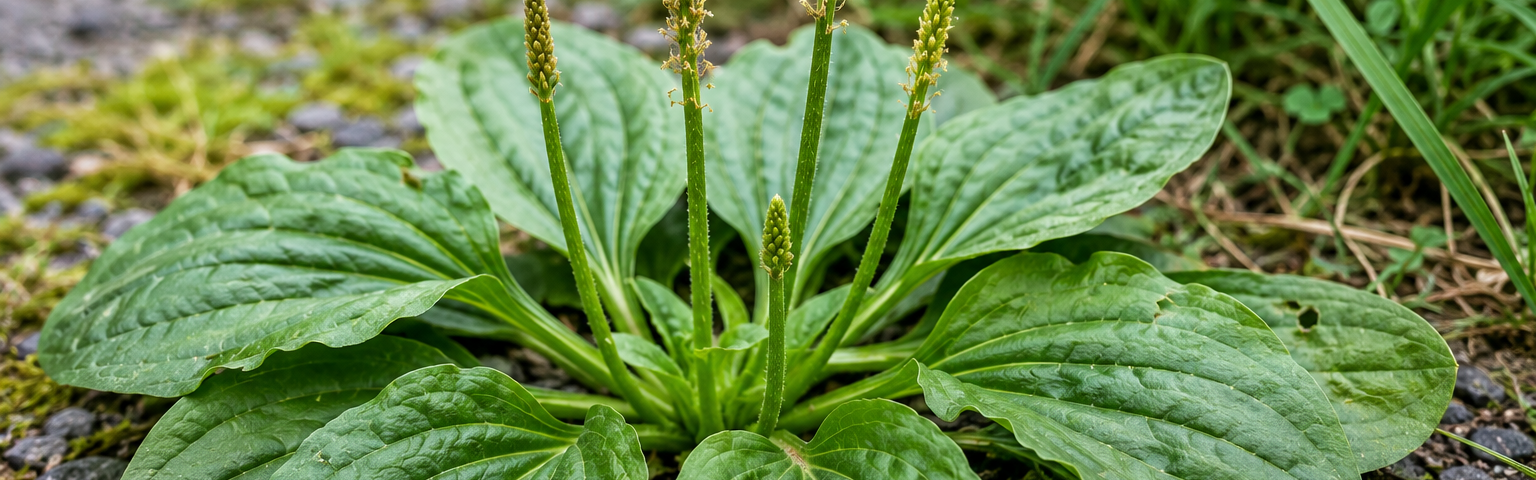
If there is one wild edible plant that almost everyone has seen but few people recognize, it is plantain.
Not the tropical fruit found in grocery stores, but the common lawn and trail plant in the genus Plantago. It grows in yards, parks, campgrounds, gravel roads, logging trails, and disturbed ground across North America. Chances are you have stepped over it hundreds of times without realizing it.
Plantain is one of the first wild edible plants I teach beginners to identify because it is widespread, useful, relatively easy to recognize, and available through much of the year. Here in the Pacific Northwest, I encounter it almost everywhere I hike, camp, fish, forage, and ride my ebike.
Many foragers focus on rare mushrooms or unusual plants. Meanwhile, one of the most useful edible and traditionally valued plants in North America is quietly growing beside the trail.
Once you learn its distinctive veins and growth pattern, you will start seeing plantain everywhere.
Quick Answer Box
Is plantain edible?
Yes. Young leaves, immature flower stalks, and seeds are edible.
What does plantain taste like?
Young leaves have a mild, earthy flavor. Older leaves become tougher and more fibrous.
How do you identify plantain?
Look for a low-growing rosette of leaves with strong parallel veins running from the base to the tip.
Is plantain safe for beginners?
Generally yes. Plantain is considered one of the easiest wild edible plants to identify correctly.
Where does plantain grow?
Lawns, trailsides, gravel roads, parks, fields, campgrounds, disturbed soil, and compacted ground throughout North America.
Key Takeaways
- Plantain is one of the most common wild edible plants in North America.
- Broadleaf plantain and narrowleaf plantain are both edible.
- Young leaves are the preferred edible stage.
- Mature leaves often become fibrous and are better cooked.
- Seeds are edible and contain valuable fiber.
- Plantain has a long history of traditional use around the world.
- Distinctive parallel veins make identification relatively easy.
- The plant thrives in disturbed and compacted soils where many other species struggle.
Featured Snippet Answers
What Is Plantain?
Plantain is a group of herbaceous plants in the genus Plantago. The most common species found in North America are broadleaf plantain (Plantago major) and narrowleaf plantain (Plantago lanceolata).
Can You Eat Plantain?
Yes. Young leaves, immature flower stalks, and seeds are edible and have been used as food for centuries.
How Do You Identify Plantain?
Plantain grows as a basal rosette with leaves that display prominent parallel veins. These veins often remain visible as string-like fibers when the leaf is torn.
Scientific Classification and Quick Facts
Kingdom: Plantae
Order: Lamiales
Family: Plantaginaceae
Genus: Plantago
Common Names
- Plantain
- Broadleaf Plantain
- Common Plantain
- Greater Plantain
- Narrowleaf Plantain
- Ribwort Plantain
- White Man’s Foot
Scientific Names
- Plantago major
- Plantago lanceolata
Native or Introduced?
Most of the commonly encountered plantain species in North America were introduced from Europe and Asia and have become naturalized throughout the continent.
Interesting Facts
Plantain was so successful at following European settlement across North America that some Indigenous tribes reportedly referred to it as “White Man’s Foot” because it seemed to appear wherever settlers traveled.
Identification
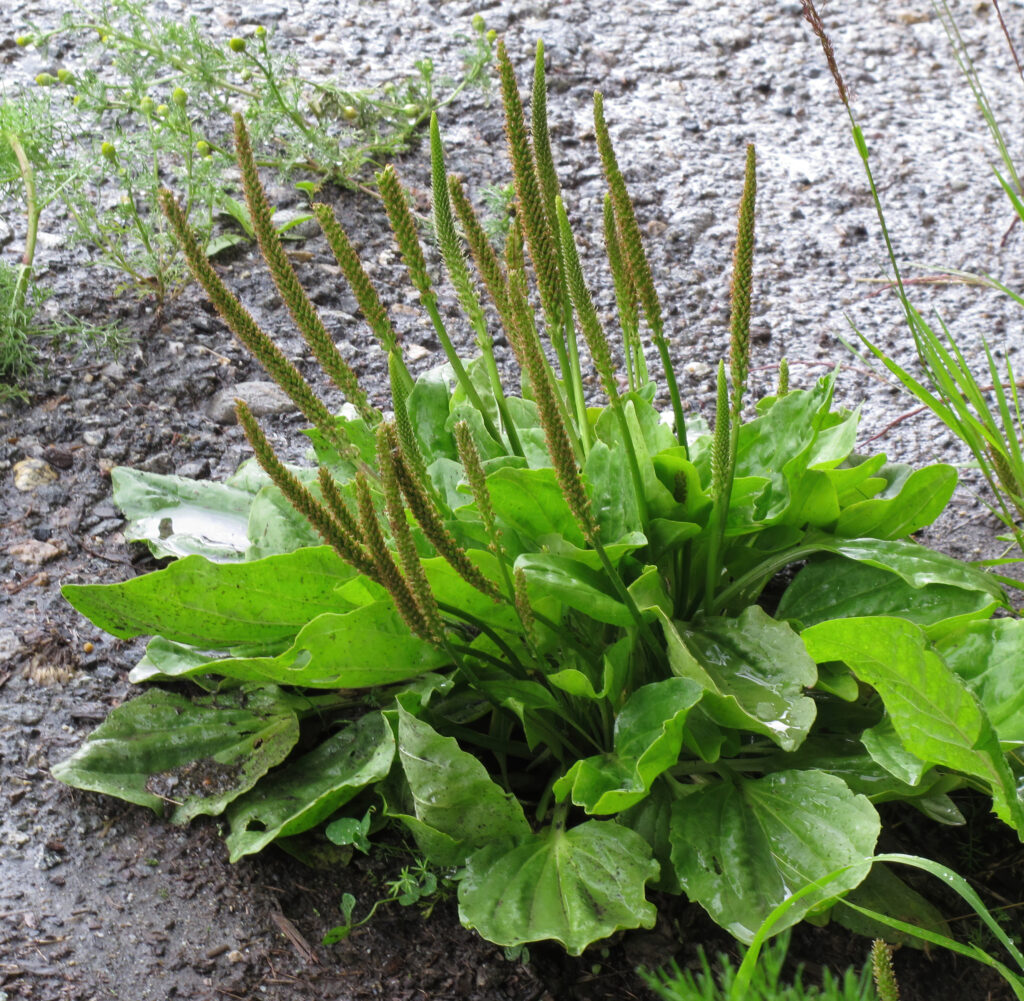
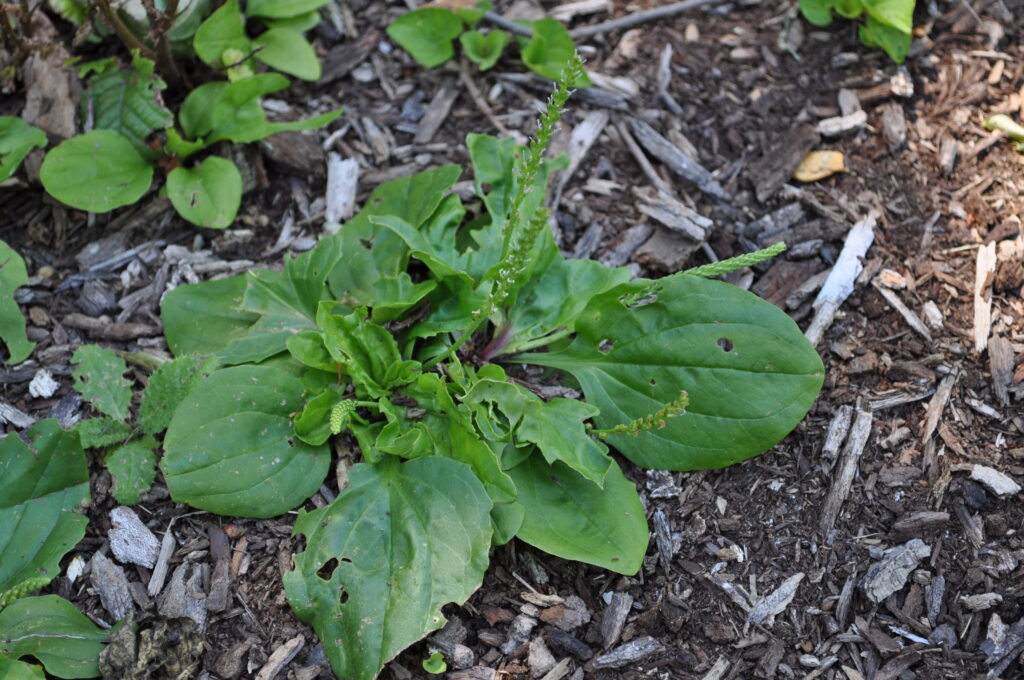
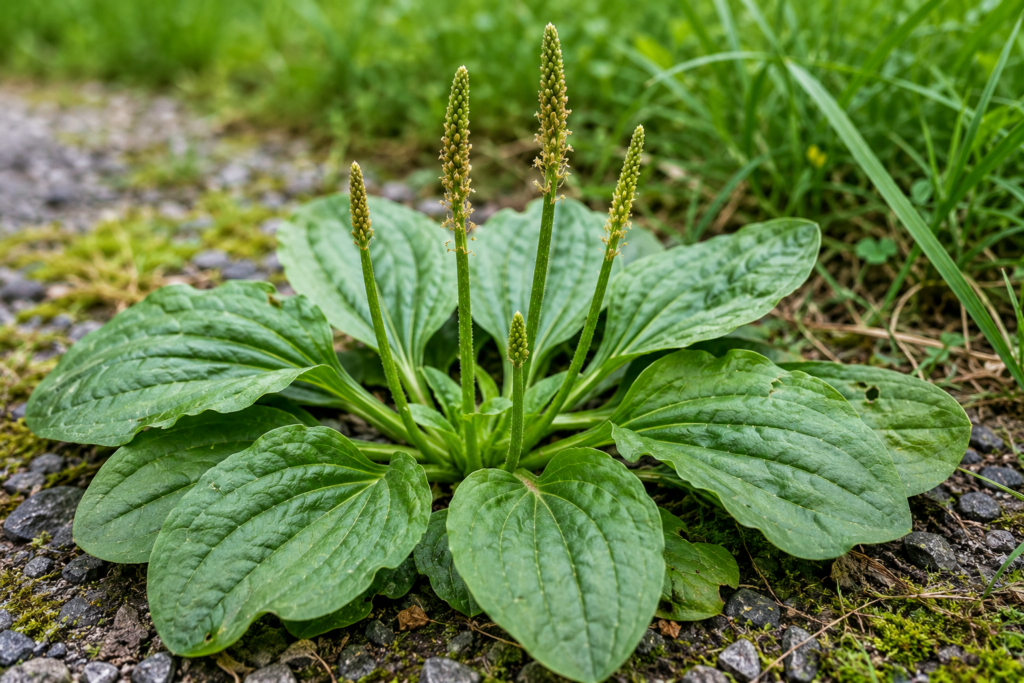
Plantain grows in a basal rosette, meaning all leaves emerge from a central crown near ground level.
Unlike many plants, it does not produce an obvious upright leafy stem.
Instead, flower stalks rise directly from the center of the plant.
Quick Identification Checklist
Low-growing rosette
Leaves emerge from a central crown
Prominent parallel veins
Veins create string-like fibers when torn
Leafless flower stalks
Dense flower and seed spikes
Common in disturbed ground
Key Features Checklist
Leaves
Broadleaf plantain produces wide oval leaves that often range from 2 to 10 inches long.
Narrowleaf plantain produces long lance-shaped leaves that resemble narrow grass blades.
Veins
The veins are the most important identifying feature.
Several prominent ribs run parallel from the leaf base to the tip.
Flowers
Tiny greenish flowers cluster tightly around a cylindrical spike.
Seeds
Each flower spike eventually develops numerous tiny seeds.
Roots
Plantain develops a short taproot with numerous fibrous roots.
Growth Pattern
Plants form low rosettes that hug the ground.
Scent
The leaves have little noticeable fragrance when crushed.
Beginner Identification Tips
The easiest way to identify plantain is to focus on the veins.
Pick a leaf and gently tear it.
Thin string-like fibers usually remain attached between the torn sections.
Those fibers are the leaf veins.
Few common lawn plants display this characteristic as clearly as plantain.
Additionally, plantain almost always grows in a circular rosette pattern. Once you learn the shape, it becomes very recognizable.
Habitat and Distribution
Plantain thrives in places where people walk.
In fact, compacted soil often gives it a competitive advantage.
Common Habitats
- Lawns
- Parks
- Trails
- Campgrounds
- Gravel roads
- Sidewalk edges
- Pastures
- Disturbed soil
- Logging roads
- Farm fields
Soil Preferences
Plantain tolerates:
- Clay soil
- Gravel
- Loam
- Compacted ground
Moisture Preferences
It grows in both moderately dry and moderately moist environments.
Sun Exposure
- Full sun
- Partial shade
North American Distribution
Plantain occurs throughout nearly all of the United States and Canada.
Pacific Northwest Distribution
Plantain is abundant throughout Washington, Oregon, Idaho, and British Columbia.
It is commonly encountered from coastal regions to mountain valleys.
Seasonality and Availability
Plantain can often be found throughout most of the year, especially in milder climates.
Tender growth is most common during spring and early summer.
Monthly Availability Chart
| Month | Availability |
|---|---|
| January | Limited |
| February | Limited |
| March | Good |
| April | Excellent |
| May | Excellent |
| June | Excellent |
| July | Excellent |
| August | Excellent |
| September | Excellent |
| October | Good |
| November | Moderate |
| December | Limited |
Edible Parts
Young Leaves
The most commonly harvested edible portion.
Best harvested before they become tough.
Flower Stalks
Immature flower stalks can be eaten raw or cooked.
Many foragers enjoy them as a trail snack.
Seeds
Seeds are edible and contain significant amounts of fiber.
Inedible Parts
No commonly recognized poisonous plant parts exist in the edible Plantago species most often encountered by foragers.
However, older leaves can become extremely fibrous and unpleasant to eat.
Taste and Texture
Young leaves have:
- Mild flavor
- Slight earthiness
- Subtle grassy notes
Older leaves develop:
- Tough texture
- Stringy fibers
- Increased bitterness
Immature flower stalks are often slightly nutty and pleasantly crunchy.
Nutritional Information
Plantain contains:
- Vitamin A
- Vitamin C
- Vitamin K
- Calcium
- Potassium
- Dietary fiber
The seeds contain soluble fiber similar to psyllium products derived from related Plantago species.
While plantain should not be viewed as a miracle food, it can be a nutritious addition to a varied diet.
Traditional and Historical Uses
Plantain has been used for centuries throughout Europe, Asia, and North America.
Historical records describe its use as both a food plant and a traditionally valued herb.
Many Indigenous communities incorporated introduced plantain into their practices after it became established across the continent.
It is important to distinguish between traditional use and modern scientific evidence. Historical use does not automatically prove effectiveness. However, plantain’s long record of use helps explain why it remains well known today.
Food Uses
Plantain is surprisingly versatile.
Young leaves can be:
- Added to salads
- Chopped into soups
- Added to stews
- Mixed into omelets
- Combined with other wild greens
Many foragers blend young leaves with chickweed, dandelion greens, and stinging nettles.
Tea Uses
Leaves can be dried and steeped into herbal tea.
The resulting tea is generally mild, grassy, and earthy.
Cooking Uses
Cooking significantly improves older leaves.
Some popular methods include:
- Sautéing
- Stir frying
- Soup additions
- Steaming
- Green powders
The leaves can also be dehydrated and powdered for later use.
Harvesting Guide
Choose clean harvesting locations away from contamination sources.
Avoid collecting from:
- Busy roadsides
- Industrial areas
- Chemically treated lawns
- Areas heavily used by pets
Harvesting Steps
- Locate healthy plants.
- Select young leaves.
- Cut rather than pull when possible.
- Leave the root system intact.
- Harvest lightly from each patch.
Ethical Harvesting Practices
Even abundant species deserve respect.
Follow these guidelines:
- Take only what you need.
- Leave healthy plants behind.
- Avoid damaging surrounding habitat.
- Follow local regulations.
- Respect private property.
Plantain is common, but ethical harvesting habits learned here transfer to more sensitive species later.
Preservation Methods
Drying
Leaves dry easily for tea and powdered use.
Freezing
Blanch briefly before freezing.
Powdering
Dried leaves can be ground into a fine powder.
Seed Storage
Seeds can be stored in airtight containers for future use.
Look-Alikes
Fortunately, plantain has few dangerous look-alikes.
Several rosette-forming plants may initially confuse beginners.
These include:
- Dandelion
- Cat’s Ear
- Dock seedlings
- False dandelions
The distinctive parallel veins usually separate plantain from all of them.
Comparison Table
| Feature | Plantain | Dandelion |
|---|---|---|
| Veins | Parallel | Branching |
| Flower | Seed spike | Yellow flower |
| Growth Form | Rosette | Rosette |
| Leaf Texture | Fibrous | Softer |
| Edibility | Yes | Yes |
Safety Considerations
Plantain is generally considered a safe wild edible.
Nevertheless, safety always comes first.
- Confirm identification before consumption.
- Harvest from clean locations.
- Wash thoroughly.
- Introduce any new wild food gradually.
- Be mindful of individual allergies.
Pregnant individuals or those with medical conditions should consult qualified healthcare professionals before consuming large quantities of any wild food.
Common Mistakes and How to Avoid Them
Harvesting Mature Leaves
Older leaves become tough and stringy.
Choose younger growth whenever possible.
Collecting From Treated Areas
Many lawns receive herbicides or pesticides.
Know the history of the site.
Ignoring Leaf Veins
The veins are one of the strongest identification features.
Always verify them.
Pulling Entire Plants
Harvest leaves instead of removing whole plants when possible.
My Field Notes
Plantain is one of those plants that becomes impossible to ignore once you learn it.
Throughout western Washington I regularly encounter it along logging roads, trailheads, fishing access sites, campgrounds, gravel pullouts, and hiking trails.
One observation I have made repeatedly is that younger leaves make a tremendous difference in eating quality. Spring growth can be surprisingly tender. By midsummer, many plants become much more fibrous and are usually better suited for cooking.
Many beginners initially overlook plantain because it appears ordinary. Ironically, that is one of its greatest strengths. It grows where people already spend time outdoors.
Because of that, plantain often becomes one of the first truly useful wild edible plants a new forager learns to recognize with confidence.
Frequently Asked Questions
Is plantain edible raw?
Yes. Young leaves are commonly eaten raw.
Which plantain species are edible?
Broadleaf plantain and narrowleaf plantain are both edible.
Can you eat plantain seeds?
Yes. The seeds are edible and rich in fiber.
What does plantain taste like?
Young leaves are mild, earthy, and slightly grassy.
Is plantain medicinal?
Plantain has a long history of traditional use. Scientific research continues to evaluate many traditional claims.
Can children learn to identify plantain?
Yes. It is often considered one of the easiest wild plants for beginners to learn.
Does plantain grow in cities?
Absolutely. It commonly thrives in urban environments.
Is plantain native to North America?
Most commonly encountered species were introduced from Europe and Asia.
Can plantain be dried?
Yes. Drying is one of the easiest preservation methods.
When should I harvest plantain?
Spring and early summer generally provide the most tender leaves.
Can plantain survive drought?
It tolerates drought surprisingly well once established.
Does wildlife use plantain?
Many insects and birds utilize plantain as part of their habitat.
Related Hunter Gatherer Society Articles
If you are new to foraging, I also recommend reading my guide on responsible harvesting practices. Learning how to identify edible plants is only part of the journey. Understanding how to harvest sustainably is equally important.
- Responsible Foraging Guide – Learn how to harvest wild foods ethically while protecting future plant populations.
Another excellent beginner-friendly edible plant is wood sorrel. Although it looks very different from plantain, it is another species that many people walk past without recognizing.
- Wood Sorrel (Oxalis) Edible Guide – Learn how to identify, harvest, and enjoy one of the most refreshing wild edible plants.
Additional Resources and References
For readers who want to dive deeper into the science, distribution, and botany of plantain, these resources provide reliable information:
University of Minnesota Extension – Evidence-based information on plant identification, ecology, and related horticultural topics.
USDA Plants Database – Distribution maps, taxonomy, and identification information for Plantago species throughout North America.
Lady Bird Johnson Wildflower Center – Detailed plant profiles, habitat information, and botanical references.
Summary
Plantain may never become the most exciting plant in a forager’s basket, but it deserves a place among the most useful.
Its distinctive veins, widespread distribution, edible leaves, nutritious seeds, and long history of traditional use make it one of the best beginner plants available.
Most importantly, it teaches an important lesson about foraging. Sometimes the most valuable wild foods are not hidden deep in the forest. Sometimes they are growing right beside the trail.
Once you learn plantain, you will likely start seeing it everywhere.
Check out our next foraging article: Dandelion Identification Guide: Edibility, Uses, Harvesting, and Complete Field Guide
Foraging Safety Disclaimer
Always positively identify any wild plant before consuming it. Never rely solely on photographs, online content, or a single identifying characteristic. Harvest only from clean locations free of pesticides, herbicides, industrial pollution, and heavy roadside contamination. If you are uncertain about identification, consult multiple field guides and qualified local experts before eating any wild food. Wild plants should be introduced gradually, especially if you have allergies, sensitivities, or underlying health conditions.


