A Clear and Safe System for New Foragers
Mushrooms can feel intimidating at first.
Unlike plants, they seem mysterious. Stories about poisonous species circulate widely. Because of that, many beginners hesitate before ever studying them.
However, fear is not the solution.
Structure is.
Last week, we built a step-by-step system for plant identification. If you missed that article, you can review it here:
How to Identify Wild Edible Plants Without Guessing
https://thehgsociety.com/how-to-identify-wild-edible-plants-without-guessing/
That same multi-point confirmation system applies to mushrooms. In fact, with fungi, structure becomes even more important.
Because guessing is never acceptable.
The Beginner Forager Framework
New articles every Thursday at 6:00 PM
This article is part of the 12-week Beginner Forager Framework. Each week adds one layer of skill so confidence builds steadily.
First, we covered mindset.
Then, we established safety rules.
After that, we built a plant identification system.
Now, we apply those principles to mushrooms.
Why Mushrooms Feel Riskier
Many people believe mushrooms are inherently dangerous.
In reality, most risk comes from misidentification. Reputable mycology education consistently emphasizes careful verification over fear.
Some mushrooms are toxic. A few are dangerously toxic. Therefore, discipline matters.
At the same time, many edible mushrooms have distinctive features that make them appropriate for beginners when studied carefully.
The key is choosing wisely and verifying thoroughly.
Start With Beginner-Friendly Species
Not all mushrooms are suitable for new foragers.
Within The Hunter Gatherer Society Beginner Field Guide, certain species are included because they have clearer structural traits and fewer dangerous look-alikes.
Common beginner-focused examples include:
Oyster mushrooms
Morels
Chanterelles
Even so, every specimen must be confirmed individually.
Beginner-friendly does not mean risk-free.
Step 1: Observe the Whole Mushroom
Before touching anything, step back.
Look at the entire growth pattern.
Ask yourself:
Is it growing in clusters or alone?
Is it attached to wood or emerging from soil?
Does it resemble a shelf, a trumpet, or a traditional cap and stem?
How large is it compared to nearby vegetation?
For example, oyster mushrooms typically grow in layered clusters on hardwood. That habitat provides strong context before you inspect details.
Starting with the whole structure narrows possibilities quickly.
Step 2: Examine the Underside Carefully
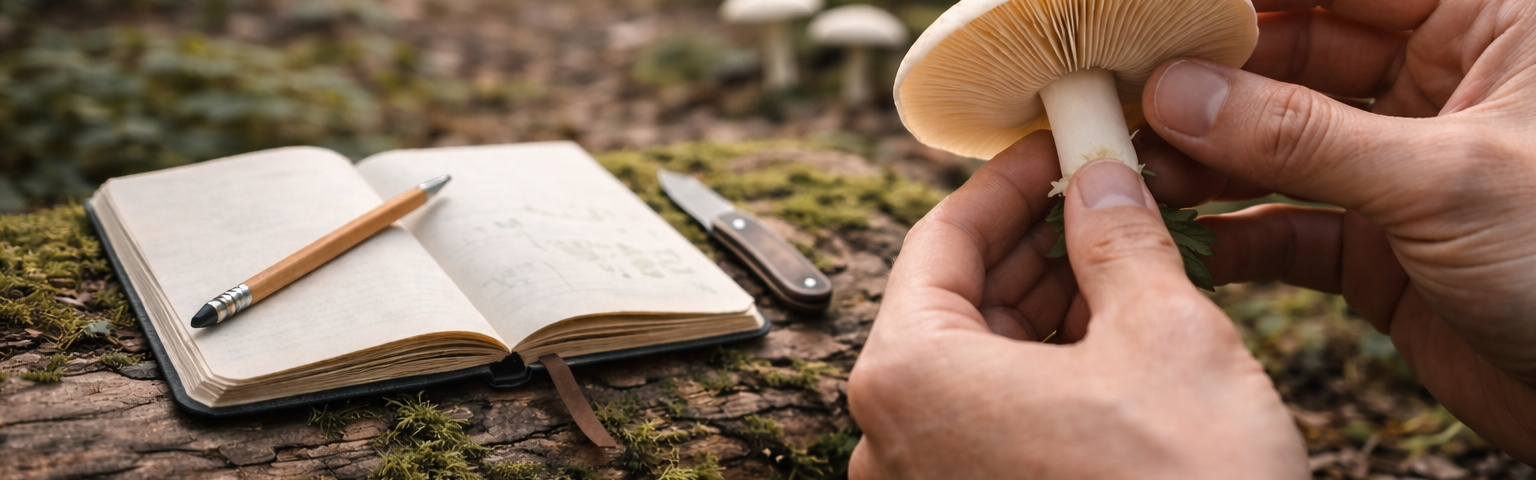
Next, inspect the underside.
This step is critical.
Look closely at the surface beneath the cap.
Does it have true gills?
Are there blunt ridges instead of sharp gills?
Does it have pores rather than gills?
Do the gills attach to the stem or run down it?
Chanterelles have blunt, forked ridges rather than thin gills. Morels have a honeycomb surface with no gills at all. Oyster mushrooms have decurrent gills that extend down the stem.
These structural traits matter more than color.
Cap color alone is never sufficient.
Step 3: Confirm Habitat and Substrate
Mushrooms grow in specific environments.
Therefore, habitat confirmation is essential.
Ask:
Is it growing on hardwood or conifer?
Is it emerging directly from soil?
Could there be buried wood underneath?
What season is it?
Morels often fruit in spring. Chanterelles commonly appear during moist summer or fall conditions depending on region. Oyster mushrooms typically grow on hardwood logs.
If the environment contradicts what you studied, pause.
Habitat is a safety filter.
Step 4: Slice It Open
With many mushrooms, cutting them lengthwise provides valuable confirmation.
Look for:
Hollow or solid interior
Uniform structure
Unexpected color changes
Signs of decay
True morels are hollow from tip to base when sliced. False morels are often chambered or filled.
That simple cut can clarify uncertainty.
Step 5: Learn the Look-Alikes
Every edible mushroom has potential look-alikes.
Responsible identification includes understanding distinguishing differences.
For example:
True morels are hollow.
Chanterelles have blunt ridges rather than thin gills.
Oyster mushrooms grow on wood and lack a thick central stem.
If one defining feature does not match, do not rationalize it.
Uncertainty means no harvest.
Use the One-Mushroom-Per-Month Method
This is where structure protects you.
Instead of trying to identify every mushroom during a hike, focus on one species for the month.
Study it in different lighting.
Observe it in various growth stages.
Notice how aging affects its appearance.
Over time, familiarity increases.
When recognition becomes natural, confidence grows.
When to Walk Away
Sometimes a mushroom looks close but not exact.
In those moments, discipline matters.
Experienced foragers frequently walk away from uncertain specimens. Mushrooms return. Opportunities repeat.
Safety must remain the priority.
Confidence should feel calm, not pressured.
Cook Thoroughly and Start Small
Even correctly identified edible mushrooms should be cooked properly.
Many species are considered inedible raw. Cooking improves digestibility and reduces gastrointestinal discomfort.
When trying a mushroom for the first time, eat a small portion. Pay attention to how you feel.
Gradual introduction builds trust.
Confidence Comes From Confirmation
Mushroom identification is not based on a single trait.
Instead, it relies on multiple confirmations:
Overall structure
Underside features
Habitat
Season
Interior structure
Agreement across reliable references
When these align, confidence feels steady.
That steadiness is your goal.
Continue the Beginner Forager Framework
This week, we applied structured identification to mushrooms.
Next week, we will shift from identification to preparation and explore:
How to Build Your First Simple Wild Meal With Confidence
A new article goes live every Thursday at 6:00 PM.
Until then, slow down. Confirm multiple characteristics. Respect uncertainty.
I’ll see you next Thursday at 6:00 PM.
Foraging Safety Disclaimer
The information provided on this website and in this article is for educational and informational purposes only. Wild plant and mushroom identification carries inherent risks, including the possibility of serious illness, injury, or death if misidentification occurs.
Always verify identification using multiple reliable sources before harvesting or consuming any wild species. Never rely on a single source, photograph, or description. If you are uncertain about the identity of any plant or mushroom, do not harvest or consume it.
Foraging laws and regulations vary by location. You are responsible for understanding and complying with all local, state, and federal regulations before harvesting wild species.
The Hunter Gatherer Society and its authors assume no responsibility or liability for any injury, illness, loss, or damage resulting from the use or misuse of the information provided.
By using this content, you acknowledge that all decisions related to harvesting and consumption of wild foods are made at your own risk.


