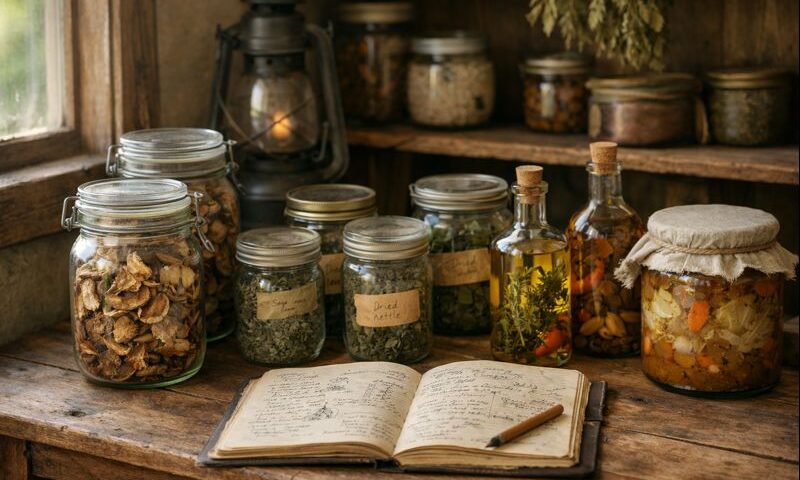
How to Build a Year Round Supply of Wild Foods the Slow Way
The forager’s pantry is not about filling shelves as fast as possible.
Instead, it is about building comfort, confidence, and rhythm with wild food over time. For many people, the idea of a pantry brings up images of hoarding or scarcity. In foraging, however, it represents something very different.
A well tended forager’s pantry reflects attention, restraint, and gratitude. It holds the memory of past seasons and quietly supports the ones still to come.
What the Forager’s Pantry Really Represents
Modern food systems teach convenience. Foraging teaches relationship.
Because of that, a forager’s pantry is not about stockpiling. It is about preparedness. It allows you to harvest less aggressively because you already have what you need. It also creates freedom to walk away when conditions are not right.
Over time, this approach changes how you forage. Instead of chasing abundance, you learn to recognize when enough is already enough.
The Philosophy Behind a Forager’s Pantry
Preparedness and scarcity are not the same thing.
Scarcity drives urgency and overharvesting. Preparedness creates calm and restraint. A forager’s pantry supports sustainable harvesting because it removes pressure from any single season.
In nature, abundance comes in waves. Greens arrive quickly and disappear just as fast. Mushrooms flush hard and then vanish. Berries offer short windows of opportunity. A pantry helps you bridge those gaps without forcing the land to give more than it should.
Preservation Methods That Work for Everyday Foragers
Building a forager’s pantry does not require special equipment or complicated processes.
Drying is one of the simplest methods. Leaves, mushrooms, roots, and berries can all be dried and stored safely with minimal tools. Drying preserves flavor while reducing space and spoilage.
Fermenting is another accessible option. Vegetables, simple beverages, and wild ferments introduce beneficial bacteria while extending shelf life. Fermentation also deepens flavor in ways fresh food cannot.
Infusing oils, vinegars, and honey captures seasonal plants in usable forms that last for months. Pickling, whether quick or long term, provides another layer of preservation that fits easily into home kitchens.
Together, these methods form the backbone of a practical forager’s pantry.
Staples Every Forager’s Pantry Can Include
A forager’s pantry does not need to be large to be effective.
Wild teas and simple herbal blends are easy to store and use regularly. Dried mushrooms and mushroom powders add depth to everyday meals. Seasoning salts and spice blends turn small harvests into long lasting flavor.
Shelf stable broths and stocks create comfort during colder months. Infused oils and vinegars bring wild ingredients into daily cooking. Basic ferments like kraut, shrubs, or kvass round out a pantry that supports both nourishment and enjoyment.
If you are new to this process, learning the basics of
how to forage wild edible plants as a beginner
can help you choose the right materials to preserve safely.
Designing a Forager’s Pantry That Fits Your Life
A pantry only works if you actually use it.
Because of that, design matters. Rotate what you store. Label and date everything. Keep preserved foods visible so they are part of daily meals rather than forgotten jars.
A forager’s pantry should reflect your climate, space, and habits. Someone foraging in the Pacific Northwest will store different foods than someone in the Midwest or Southeast. Both approaches are valid.
Using your pantry regularly bridges seasonal gaps and reinforces the idea that wild food belongs in everyday life, not just special occasions.
For guidance on keeping notes and tracking what you preserve each season,
using a foraging journal and beginner field guide
can make the process more intentional and repeatable.
Stewardship and Safety in the Forager’s Pantry
A responsible forager’s pantry starts with ethical harvesting.
Take only what you can process. Leave healthy populations behind. Pay attention to local regulations and land access rules. Preservation should never justify overharvesting.
Food safety matters as well. Proper drying, clean storage, and careful fermentation reduce risk. Educational resources like the
National Center for Home Food Preservation
offer research based guidance that supports safe, long term storage.
Entering the Seasons With a Stocked Forager’s Pantry
A full pantry changes how you experience the year.
Winter becomes reflective rather than restrictive. Early spring feels patient rather than desperate. You forage because you want to, not because you have to.
Over time, the forager’s pantry becomes a quiet form of resilience. It reduces reliance on convenience food while increasing connection to place, season, and effort.
Bringing the Pantry Practice Forward
A forager’s pantry is built slowly. Jar by jar. Season by season.
It grows alongside your skills and awareness. It rewards restraint more than excess. Most importantly, it supports a way of foraging that feels calm, grounded, and sustainable.
That is why I created
The Hunter Gatherer Society Foraging Journal and Beginner Field Guide.
It helps you track what you gather, how you preserve it, and how each season builds on the last. Over time, those notes become your personal reference and your lived experience on paper.
If your goal is to build a forager’s pantry that supports real life rather than perfection, this is a simple place to start.


