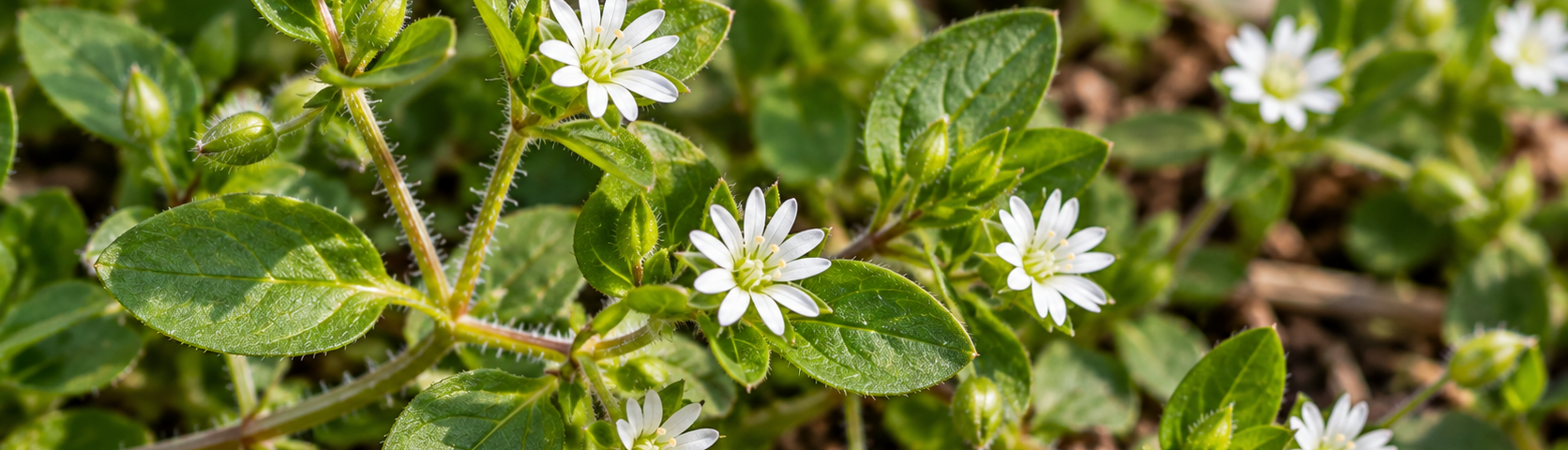
Common chickweed (Stellaria media) is easy to walk past. It creeps through gardens, lawns, paths, field edges, and other disturbed ground, often forming soft green mats during cool weather.
For foragers, that little patch of green is worth a closer look.
Chickweed is a tender edible plant with a mild flavor. The young leaves, stems, and flowers can be eaten raw or lightly cooked. Better yet, the plant gives us several useful identification features that are easy to check in the field.
You still need to identify it carefully.
Scarlet pimpernel can grow in similar places and has somewhat similar leaves. Low-growing spurges can also become tangled in a chickweed patch. Both deserve attention before anything goes into your basket.
Fortunately, common chickweed has a useful combination of clues: opposite leaves, small white flowers with deeply divided petals, a round stem, and a narrow line of fine hairs running along the stem.
Once you know that pattern, chickweed becomes much easier to recognize.
If you are still learning wild greens, our guide to how to identify wild edible plants without guessing is a good companion to this article.
Quick Answers
Is chickweed edible?
Yes. Common chickweed, Stellaria media, is edible. The tender leaves, stems, flowers, and seeds can be eaten. The young above-ground growth is usually the best part for the kitchen. North Carolina Extension lists the leaves, flowers, stems, and seeds as edible.
Can you eat chickweed raw?
Yes. Tender chickweed works especially well raw in salads, sandwiches, and fresh sauces. You can also cook it briefly like spinach.
What does chickweed taste like?
The flavor is mild, fresh, and green. Some people notice a faint corn-like quality. It is much less bitter than many wild greens.
What is the easiest way to identify chickweed?
Look for opposite leaves, a round stem with a narrow line of fine hairs, and tiny white flowers. Each flower has five deeply divided petals that can look like ten.
What is the most important chickweed lookalike?
Scarlet pimpernel is one to learn well. It can have similar opposite leaves, but its stems are square rather than round. Its flowers are usually salmon-orange, and the petals are not deeply split. UC IPM notes that the plant can be toxic if eaten.
Does chickweed have milky sap?
No. If a broken stem releases obvious white latex, you are not dealing with common chickweed.
When is chickweed in season?
Chickweed prefers cool, moist conditions. In many areas, the best growth appears from fall through spring. In mild coastal climates, it may persist much longer. UC IPM provides a good overview of its seasonal growth.
Chickweed at a Glance
| Feature | Common Chickweed |
|---|---|
| Scientific name | Stellaria media |
| Family | Caryophyllaceae |
| Growth habit | Low, sprawling, creeping, sometimes mat-forming |
| Leaves | Opposite, oval to egg-shaped, smooth-edged |
| Stem | Thin, round, usually with a narrow line of fine hairs |
| Flowers | Tiny and white |
| Petals | Five, deeply split so they often appear to be ten |
| Roots | Shallow and fibrous |
| Sap | No milky white latex |
| Habitat | Gardens, lawns, fields, paths, nurseries, disturbed soil |
| Best season | Cool, damp weather |
| Edible parts | Tender leaves, stems, flowers, and seeds |
| Main lookalikes | Scarlet pimpernel, spurges, mouse-ear chickweed |
| Best field clue | Opposite leaves + stem hair line + split white petals |
No single feature should make the identification for you. Chickweed becomes convincing when several traits agree.
What Is Common Chickweed?
Common chickweed is a small annual or short-lived plant in the carnation family.
Its scientific name is Stellaria media.
It is now widespread across much of the world, especially where people regularly disturb the soil. Gardens, farm fields, flower beds, lawns, and paths are classic chickweed habitat.
Most people meet it as a weed.
That is understandable. Chickweed can spread quickly, produce plenty of seed, and form dense mats in cultivated ground. From a forager’s point of view, though, those same traits can make it an abundant seasonal green.
Several plants share the name “chickweed.” This guide focuses specifically on common chickweed, Stellaria media.
That distinction matters.
When you intend to eat a wild plant, identifying the actual species is more useful than deciding it simply “looks like chickweed.”
For current botanical classification and range information, Kew’s Plants of the World Online entry for Stellaria media is a useful reference.
How to Identify Chickweed
Chickweed is a good example of why field identification works best as a pattern rather than a single trick.
Start with the whole plant. Then work your way down to the smaller details.
Growth Habit
Common chickweed usually grows low to the ground.
Its thin stems spread outward, weaving over the soil and through nearby plants. A healthy patch can form a loose green carpet.
Growth changes with conditions.
In a short lawn, chickweed may stay almost flat. In rich garden soil or light shade, the stems can grow longer and rise several inches above the ground.
The plant usually feels soft and flexible rather than stiff.
Stems may also root where the nodes touch moist soil.
UC IPM describes common chickweed as prostrate to upright and sometimes mat-forming in its common chickweed identification profile.
Leaves
The leaves grow in opposite pairs.
That means two leaves meet the stem at the same point, directly across from each other.
Chickweed leaves are usually oval or egg-shaped. Most have a small point at the tip. Their edges are smooth rather than toothed.
The leaves are also relatively soft.
Common chickweed is not covered in thick fuzz. If the entire plant looks distinctly hairy, you may have another species.
Leaf shape alone is not enough for identification. Scarlet pimpernel and several other low-growing plants can also have opposite leaves.
That is why the stem matters so much.
The Stem and Its Line of Hairs
This is one of chickweed’s best field characteristics.
The stem is thin and round. Now turn it slowly in good light.
Look for a narrow line of very fine hairs running along the stem.
The rest of the stem may look almost smooth.
UC IPM also uses this band of hairs as a useful diagnostic feature in its chickweed comparison guide.
A small hand lens makes the hairs much easier to see. Once you know what you are looking for, though, they are often visible with the naked eye.
Think of it as a tiny strip of hair rather than an evenly fuzzy stem.
That distinction helps separate common chickweed from several similar species.
Flowers
Chickweed’s flowers are small enough to miss from a standing position.
Get close and they become much more useful.
The flowers are white and have five petals.
However, each petal is deeply divided down the middle. As a result, the flower often looks as though it has ten narrow petals.
It does not.
That five-petals-that-look-like-ten effect is one of the classic chickweed clues.
Small green sepals sit behind the petals.
Flowering plants are especially useful when you are learning chickweed for the first time.
The Inner “Thread”
There is another field trick that experienced foragers often use.
Take a fresh stem and gently pull it apart.
Sometimes the soft outer tissue separates while a thin, elastic strand remains inside.
That inner strand is part of the plant’s vascular tissue.
It can be a useful supporting clue. However, I would not identify a plant from the thread alone.
Use it after the leaves, stem hairs, flowers, and growth habit already point toward chickweed.
Roots, Fruit, and Seeds
Common chickweed has a shallow, fibrous root system.
That is one reason whole plants pull easily from loose garden soil.
After flowering, the plant forms small capsules filled with tiny seeds. Mature seeds are generally pale tan to reddish-brown.
You do not need fruit or seeds to identify a flowering plant. Still, learning the full life cycle makes chickweed easier to recognize throughout the season.
Where and When Chickweed Grows
If the weather is cool, the soil is damp, and someone has disturbed the ground, chickweed is worth looking for.
Common habitat includes vegetable gardens, flower beds, lawns, orchards, nurseries, farm fields, paths, woodland edges, and other disturbed sites.
It often thrives in moist, fertile soil.
Rain can transform a thin patch into a lush green mat surprisingly quickly.
Chickweed is primarily a cool-season plant. In many climates, seedlings appear in fall and continue growing through mild winter weather. Growth often becomes vigorous again in early spring.
Hot, dry weather usually slows it down.
In cooler or maritime climates, however, chickweed may grow for a much longer season. Irrigated gardens and shady sites can also keep it going.
UC IPM notes that common chickweed can survive year-round in some mild coastal areas.
For eating, the nicest plants are usually young, lush, and actively growing.
Is Chickweed Edible?
Yes.
Correctly identified common chickweed is a traditional edible green.
The tender leaves, stems, and flowers are the parts most foragers gather. The seeds are edible too, although they are tiny and not especially practical to collect.
North Carolina Extension’s Stellaria media profile lists the stems, leaves, flowers, and seeds as edible and suitable for raw or lightly cooked use.
Young plants have the best texture.
As chickweed ages, the stems become longer and tougher. Older plants can also collect more grit and dead material near the ground.
That does not necessarily make them inedible. They simply become less appealing.
What Does Chickweed Taste Like?
Chickweed is mild compared with many wild greens.
There is usually very little bitterness.
The flavor falls somewhere between young spinach, lettuce, and fresh garden greens. Some people also notice a faint sweet-corn quality.
That gentle flavor is one reason chickweed works so well raw.
You do not have to disguise it.
How to Harvest Chickweed
Harvest the tender upper growth rather than pulling up the whole plant.
Scissors work well.
Snip healthy growing tips with soft stems and fresh leaves. Flowers can come along with them.
Leave the tougher lower growth and roots behind.
This keeps a surprising amount of soil out of your basket.
More importantly, look through every handful before you cut.
Dense chickweed often grows mixed with other small weeds. It is possible to identify the chickweed correctly and still harvest another species tangled inside it.
That matters most when spurges, scarlet pimpernel, or other low plants share the patch.
Sort the harvest again when you get home.
If you want to build broader plant-recognition skills, browse the Hunter Gatherer Society’s Wild Edible Plant Identification Guides


